Prime Minister Andy Burnham is facing mounting questions over Britain’s defence priorities as pressure on military spending collides with renewed challenges to British interests overseas, from the Chagos Islands in the Indian Ocean to the Falklands in the South Atlantic.
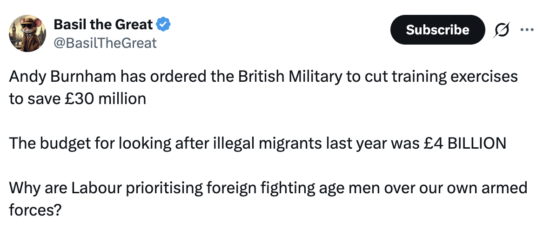
The immediate concern is the growing strain on the Armed Forces’ day-to-day finances. Britain is committed to increasing headline defence expenditure, but the military is simultaneously being forced to find operational savings, while the government faces a £4.7 billion shortfall in its Defence Investment Plan.
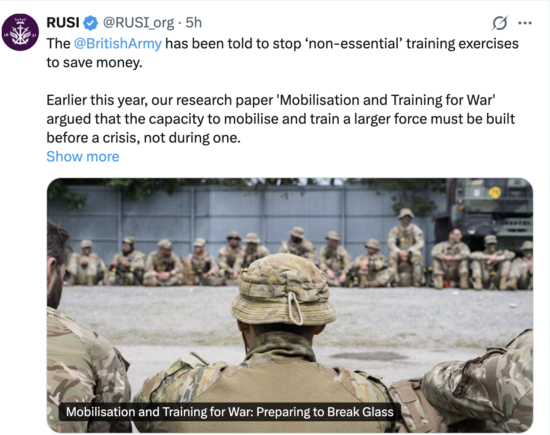
That contradiction has become more politically significant as Britain confronts a series of strategic disputes requiring it to demonstrate that its international commitments remain credible.
The latest came when Argentina’s President Javier Milei sharply intensified his country’s claim to the Falkland Islands, promising tougher sanctions against companies involved in oil exploration around the British-controlled archipelago.
Milei argued that changing global circumstances were increasingly favourable to Argentina’s sovereignty claim and announced plans to strengthen the legal and economic measures available against companies operating around the islands without Buenos Aires’ approval.
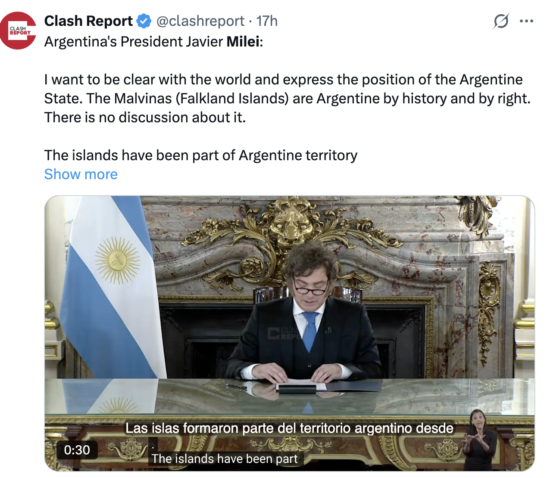
Britain responded unequivocally.
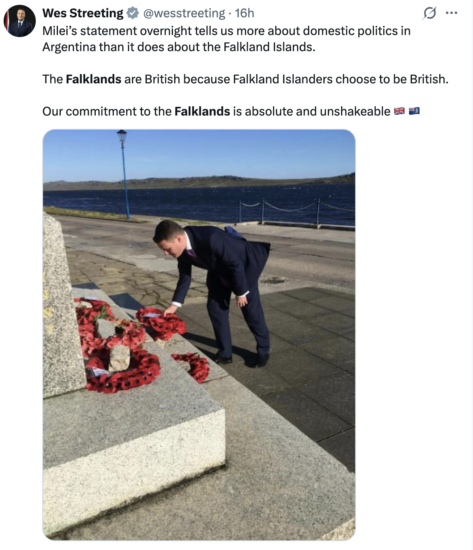
Defence Secretary Wes Streeting said the Falklands remained British because their inhabitants wished them to remain British and described the government’s commitment to the islands as unwavering. British officials also suggested that Milei’s rhetoric reflected Argentina’s domestic politics rather than any change in the islands’ constitutional position.
The exchange has nevertheless sharpened a wider question facing Burnham: whether Britain’s military resources are sufficient for the range of commitments the government continues to uphold.
The issue is not simply that Britain is cutting its defence budget.
On paper, defence expenditure is set to rise, and Burnham appointed Streeting to the defence brief while moving John Healey to the Treasury amid expectations that the new administration would make Britain more militarily prepared.
But higher headline expenditure does not eliminate the pressures inside individual defence programmes.
Burnham inherited a £4.7 billion funding gap in the Defence Investment Plan, while wider fiscal pressures are limiting the government’s room for manoeuvre. Healey is preparing his first Budget for 28 October amid high borrowing costs and speculation that further tax increases may be necessary to reconcile the government’s spending ambitions with its fiscal rules.
This creates a difficult distinction between what Britain intends to spend on future military capabilities and what the Armed Forces can afford to do today.
Large investment programmes in areas such as combat aircraft, drones, missile systems and the nuclear deterrent may strengthen Britain’s long-term position, but they do not automatically resolve shortages affecting personnel, training, maintenance and conventional readiness.
That matters particularly when the government continues to make security commitments stretching far beyond Europe.
The renewed dispute with Argentina provides a particularly striking example.
Milei has long maintained Argentina’s claim over the islands, known in Argentina as Las Malvinas, but his latest intervention represents a more assertive approach.
The Argentine president said he would pursue stronger sanctions against companies associated with the Sea Lion oil project north of the Falklands. The field is estimated to contain around 1.7 billion barrels of oil and is being developed by Navitas Petroleum and Rockhopper Exploration under licences issued by the Falkland Islands authorities.
Buenos Aires considers those licences illegal and regards exploitation of the resources as a violation of Argentine sovereignty.
London and the Falkland Islands Government reject that claim.
The dispute has acquired additional significance because US President Donald Trump said on 31 August that Washington was reviewing its position on the Falklands. The United States has traditionally remained formally neutral on the sovereignty dispute, despite supporting Britain during the 1982 war.
Milei interpreted Trump’s remarks as evidence that the international environment could be moving in Argentina’s favour.
No formal change in American policy has yet been announced, but even the possibility of a reassessment adds uncertainty to a question London has for decades regarded as settled by the wishes of the islanders.The Falklands therefore present Burnham with a classic test of deterrence: Britain may never need to fight another war over the islands, but its ability to prevent such a crisis partly depends on convincing other governments that it could defend them if necessary.
At the same time, Burnham’s government is dealing with another politically sensitive overseas territory.
Britain has been pursuing an agreement with Mauritius concerning sovereignty over the Chagos Archipelago while seeking to preserve the joint British-American military base on Diego Garcia.
The base is one of the most important Western military facilities in the Indian Ocean and provides a strategic platform for operations across the Middle East and Indo-Pacific.
Supporters of an agreement argue that resolving the sovereignty dispute with Mauritius would provide stronger legal foundations for the continued operation of Diego Garcia.
Critics argue that relinquishing sovereignty over strategically valuable territory is particularly questionable at a moment when Britain’s military resources are already stretched.
Taken together with the latest Falklands confrontation, the Chagos controversy illustrates the geographical scale of Britain’s defence obligations.
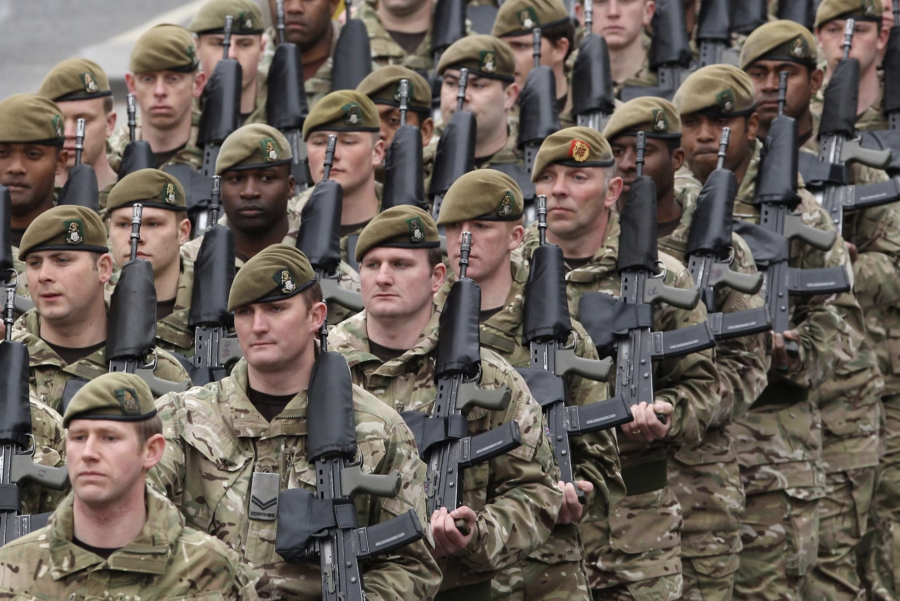
London is simultaneously expected to contribute substantially to NATO’s eastern flank, support Ukraine, maintain a nuclear deterrent, protect overseas territories, sustain bases abroad and participate in increasingly sophisticated military programmes with allies.
The Falklands dispute also comes during a more difficult period in relations between London and Washington.
Trump has recently launched unusually strong criticism of Burnham’s Britain, attacking its energy policies and immigration record and describing the country as being close to disaster.
His decision to review Washington’s Falklands position therefore carries significance beyond the islands themselves.
For decades, British defence planning has rested heavily on the assumption of an exceptionally close strategic relationship with the United States.
If American support becomes more conditional, Britain may have to devote greater resources to military capabilities it previously expected to exercise alongside Washington.
That would intensify the financial pressures already confronting the Burnham government.
None of this means Britain is abandoning defence.
The government continues to pursue new military technology and major international programmes. Canada’s recent decision to join the Global Combat Air Programme was an early success for Burnham and reinforced Britain’s ambition to remain at the forefront of advanced aerospace development.

The question is instead whether those ambitions can be reconciled with current fiscal constraints.
Britain is attempting to modernise its Armed Forces while also preserving commitments inherited from a period when the country possessed substantially greater relative military power.
The renewed Falklands dispute makes that tension harder to ignore.
Argentina has not threatened another invasion, and Britain’s sovereignty position remains unchanged. The islanders voted overwhelmingly in 2013 to remain a British Overseas Territory, and London continues to insist that their right to self-determination is decisive.
But effective deterrence depends not merely on declarations of commitment. It also depends on military capability.
That is why Milei’s latest challenge, the uncertainty surrounding Washington’s position and the continuing controversy over Chagos all feed into the same debate now confronting Burnham.
Britain can continue to maintain global strategic ambitions. But the more commitments it makes from Europe and the Indian Ocean to the South Atlantic, the harder it becomes to avoid the central question facing its defence policy: whether the resources available to the Armed Forces are sufficient to make those commitments credible.
Photo: X @Basil the Great
Tomasz Modrzejewski