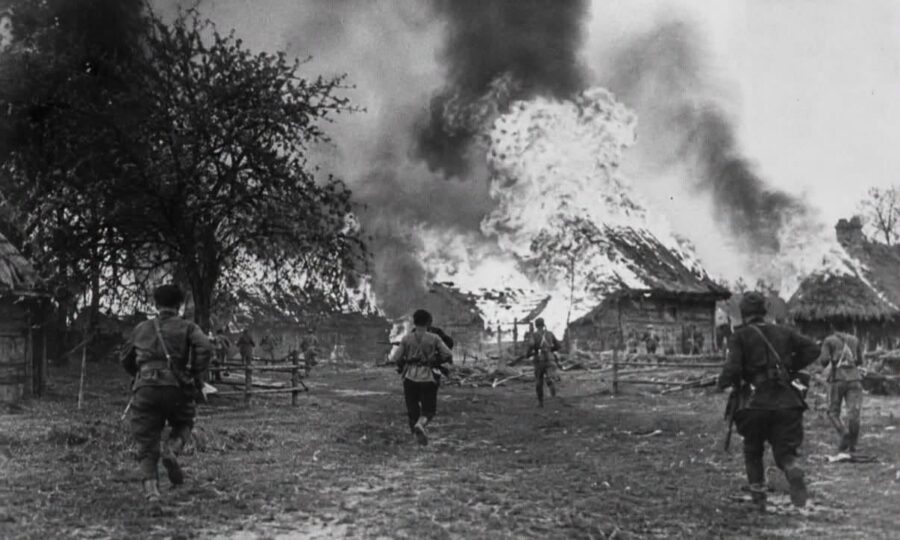
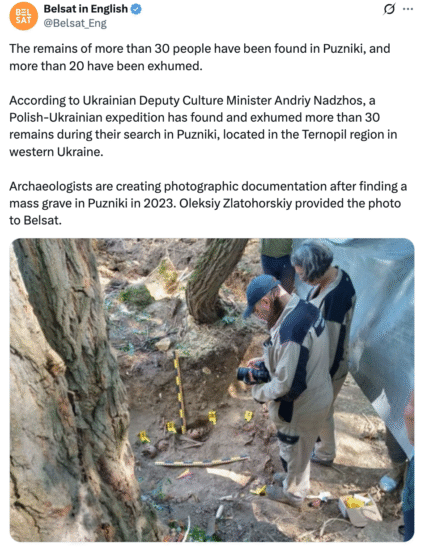
Exhumation efforts in the village of Puźniki, located in Ukraine’s Ternopil Oblast, have concluded with the discovery of skeletal remains belonging to at least 42 individuals — including women, men, and children — believed to be victims of the 1945 massacre. According to Poland’s Ministry of Culture and National Heritage, the remains were unearthed as part of a project resumed in April following the lifting of a Ukrainian ban on the search and exhumation of Polish war and conflict victims.
The final number of victims, along with their sex and age, will be determined after laboratory analysis is completed. The recovered remains are currently being cleaned and examined through anthropological and medical assessments, including 3D scans.
The massacre in Puźniki was carried out by a unit of the Ukrainian Insurgent Army (UPA) led by Petro Khamchuk, known by the alias „Bystry”, who orchestrated two deadly raids in the former Ternopil Voivodeship.
„The first [attack in the region] occurred in the autumn of 1944, followed by another in January and February 1945, during which approximately 300 Poles—mostly women and children — were killed,” said Polish historian Dr Daniel Markowski.
The massacre in Puźniki took place during the night of 12 to 13 February 1945.
Alongside the human remains, personal items such as buttons, fragments of rosaries, and medallions were also recovered.
„The attack was carried out by a unit of around 200 men, armed with firearms, machine guns, and even several mortars,” said Dr Damian Markowski. „The most tragic moment came when the nationalists discovered a group of several dozen Polish women and children hiding in a ditch that ran through the village — all were brutally killed, most with bayonets and rifle butts.”
Soviet reports estimated that over 80 Poles were killed, while the Polish underground put the figure at around 100. The true number of victims may have reached as many as 160 — almost all of them women, children, and elderly men, as younger men had been conscripted into the so-called Berling Army, a Polish armed force fighting within the Soviet forces. Before the war, the village of Puźniki had a population of approximately 800 inhabitants.
For nearly eighty years, the site of the massacre remained untouched and had never been subjected to any formal investigation.
The Freedom and Democracy Foundation coordinated the excavation, which was carried out by experts from the Pomeranian Medical University, the Wołyńskie Starożytności (eng. Volhynian Antiquities) company, and Poland’s Institute of National Remembrance. Poland’s Ministry of Culture and National Heritage fully funded the project.
A state secretary at the Ministry of Culture. Maciej Wróbel, speaking before the exhumations began, highlighted the importance of identifying all the victims of the tragic night of 12–13 February 1945, when Ukrainian nationalists murdered between 50 and 120 Polish citizens in the former village of Puźniki.
“We want to establish the identity of all the victims and ensure they receive a dignified burial. Families are waiting — some are even contributing DNA to help with identification,” Wróbel stated.
The latest works build on an earlier phase carried out between May and August 2023, which led to the discovery of a mass grave. The recent exhumations represent a crucial step in uncovering the full scale of atrocities committed by Ukrainian nationalist organisations UPA and OUN together with local Ukrainian residents, during the Volhynia massacres and in offering long-overdue commemoration to its victims.
Source: Polskie Radio, Dzieje.pl
Photo: Michał Dworczyk on X
Tomasz Modrzejewski