In the final, chaotic days of the Second World War, as the Third Reich collapsed under the pressure of advancing Allied forces, one of the most brutal atrocities of the conflict unfolded in a quiet corner of northern Germany. The massacre at Gardelegen, carried out on 13 April 1945, stands as a stark reminder that even in defeat, German Nazi violence did not abate but intensified.
By early April 1945, Allied troops had crossed the Rhine and were advancing rapidly into Germany. In response, SS authorities ordered the evacuation of prisoners from concentration camps such as Mittelbau-Dora and its subcamps. Thousands of exhausted inmates were forced onto trains or driven on foot deeper into the Reich in what became known as “death marches.”
One such transport, carrying several thousand prisoners, was halted near the town of Gardelegen after Allied bombing had destroyed the railway lines. Stranded and increasingly difficult to control, the prisoners became the responsibility not only of SS guards but also of hastily assembled local auxiliary members of the Volkssturm, Hitler Youth, Luftwaffe personnel, and even civilian firefighters.
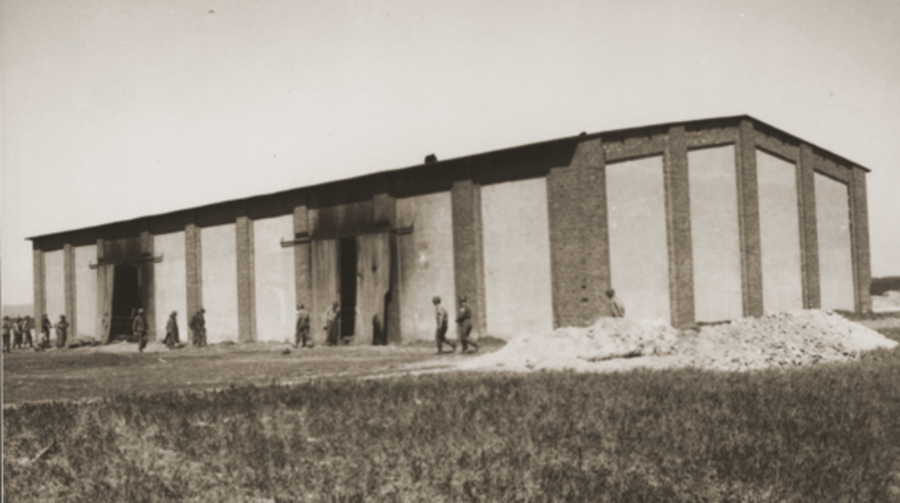
On 13 April, over a thousand prisoners, many too weak to continue marching, were marched to a large barn on the Isenschnibbe estate. What followed was a calculated act of mass murder.
The victims were forced inside the building, the doors barricaded, and straw soaked in petrol was set alight. As flames engulfed the building, those who tried to escape were shot, while grenades were thrown into the inferno.
In total, 1,016 prisoners were killed, burned alive or executed as they attempted to flee. The majority were foreign forced labourers and concentration camp inmates, with Poles forming the largest national group among the victims.
The following day, American troops of the 102nd Infantry Division entered Gardelegen. On 15 April, they uncovered the still-smouldering remains of the barn and the bodies within. Only eleven prisoners had survived the massacre.
The discovery shocked even battle-hardened soldiers. The scale and savagery of the crime provided undeniable evidence of German Nazi atrocities at a time when some still dismissed such reports as propaganda. The U.S. Army ordered local German civilians to exhume and bury the victims individually, forcing them to confront the consequences of the regime in whose name the crime had been committed.
Responsibility for the massacre extended beyond the SS. Local participants, teenagers from the Hitler Youth, elderly members of the Volkssturm, and ordinary townspeople took part in guarding, shooting, and ensuring the completion of the atrocity.
Yet, as in many cases of German Nazi crimes, justice proved incomplete. Some perpetrators were tried in the post-war years, but others evaded punishment entirely and lived out their lives in relative obscurity.
Today, Gardelegen is a memorial site, centred around the remains of the barn and a cemetery where the victims are buried. The site serves not only as a place of mourning but also as a warning, an enduring testament to the consequences of hatred, dehumanisation, and collective complicity.
In recent years, diplomatic representatives, including those of Poland, have continued to commemorate the victims, underscoring the international dimension of the tragedy and the importance of preserving historical memory. Acts of remembrance also respond to ongoing challenges, such as vandalism of graves, which highlight the continuing need to safeguard the dignity of the dead.
The massacre at Gardelegen was not an isolated incident but part of a broader pattern of violence that marked the final phase of the war. As the German regime disintegrated, its machinery of terror lashed out with renewed brutality.
What makes Gardelegen particularly chilling is not only the scale of the crime but the involvement of ordinary people who, even in the face of imminent defeat, chose participation over resistance.
In 2023, the graves of the victims of the Gardelegen massacre were vandalised.
Photo: X/@CptAllenHistory
Tomasz Modrzejewski