A torchlit procession organised by German nationalist student fraternities in the Polish city of Wrocław has sparked controversy over historical revisionism and the political activities of the Deutsche Burschenschaft. Among those attending was Alternative for Germany (AfD) politician Helmut Strauf, whose subsequent remarks about German identity in Silesia have raised fresh questions about the ideological ambitions of parts of Germany’s traditional fraternity movement.
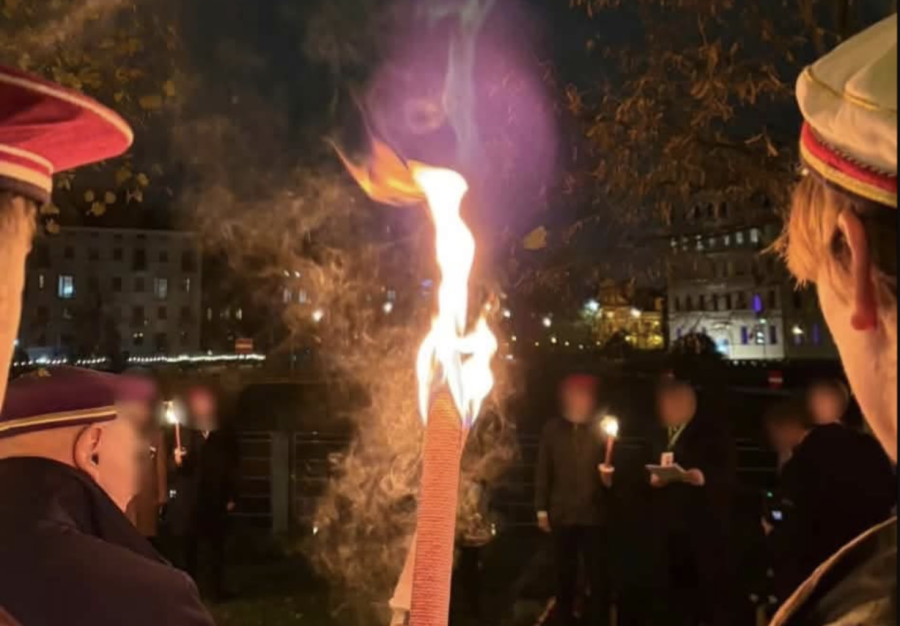
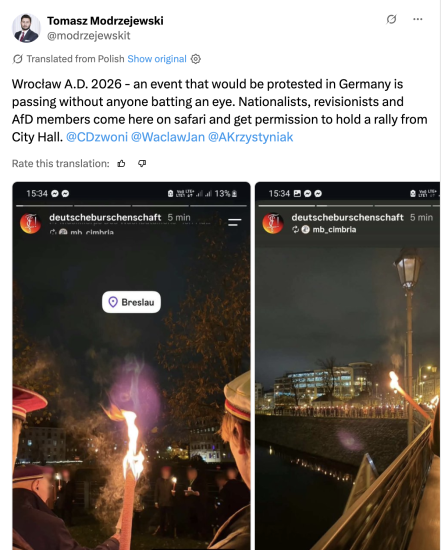
On Friday, 20 November 2026, a procession of German student fraternity members carrying flaming torches marched through the streets of Wrocław. The event formed part of a three-day gathering of the Deutsche Burschenschaft, an association of traditional German and Austrian student fraternities which has long attracted controversy over the nationalist character of some of its member organisations.
The gathering, held between 20 and 22 November, was hosted by the Alte Breslauer Burschenschaft der Raczeks zu Bonn, a fraternity originating in pre-war Wrocław which resumed its activities in Bonn, West Germany, following the Second World War.
The procession was organised under the banner *Totengedenken mit Fackelmarsch* — a commemoration of the dead accompanied by a torchlit march. Footage shared on social media shows participants wearing traditional fraternity colours and carrying burning torches through the city centre.
Although such ceremonies form part of the historical traditions of certain German student fraternities and the military, both the location of the event and the political affiliations of its participants make it not merely controversial, but unacceptable on the streets of a Polish city.
Wrocław, one of the cities in which Poland’s first king, Bolesław the Brave, established a bishopric, has a history marked by successive changes of sovereignty. Following the political upheavals of the feudal era, the city came under the Bohemian Crown, the Kingdom of Prussia — following Prussia’s wars of aggression against Silesia — and subsequently the German Empire. Poles remained present throughout the city’s history. Even in the eighteenth century, long after Wrocław had ceased to belong to the Polish Crown, newspapers and administrative publications continued to be issued in Polish on the orders of the Prussian king.
Following the Second World War, the city returned to Poland. Most of its German inhabitants left Wrocław, while Polish settlers arrived, including people displaced from the eastern territories of the Second Polish Republic annexed by the Soviet Union. This demographic transformation should not, however, obscure the fact that Poles had also lived in the city before 1945.
Wrocław occupies a special place in both Polish and German academic history, and its university traditions are considerably more complex than an exclusive emphasis on the city’s German past might suggest.
As early as 1695, Fryderyk Kazimierz Wolff, a Jesuit educated at the court of the Polish King John II Casimir, campaigned for the establishment of a university in the city. His efforts ultimately contributed to the founding of the Leopoldina Academy in 1702. Wrocław also became the birthplace of the Polish student fraternity movement. It was here, in 1816, that Polonia, regarded as the first Polish academic fraternity, was established — twelve years before the famous Konwent Polonia in Dorpat, now Tartu in Estonia. Over the following decades, Polish students formed their own organisations, preserving their language and national identity under Prussian rule.
Of particular importance was the Society of Upper Silesian Students (Towarzystwo Akademików Górnoślązaków), founded in 1892. Its members included Wojciech Korfanty, who would later become a leading figure in the Polish national movement in Upper Silesia and one of the founding fathers of the reborn Polish Republic.
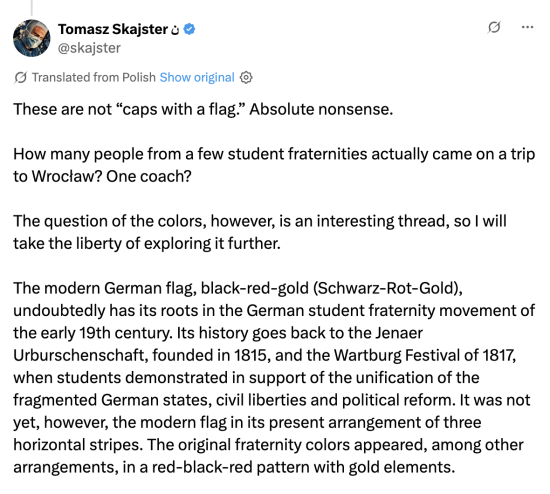
At the same time, Wrocław played an important role in the development of modern German national identity. In February 1813, the volunteer Lützow Free Corps (*Lützowsches Freikorps*), which fought against Napoleon, was organised in the city. Its black uniforms, red facings and gold buttons became one of the historical inspirations for the black, red and gold colours of the German national movement, later adopted by the Burschenschaft movement and eventually incorporated into the German flag.
Although the precise origins of this colour scheme remain a subject of historical debate, the role of Lützow’s Free Corps in popularising these colours is well documented. Wrocław’s history therefore demonstrates that the city holds considerable significance for the national traditions of both neighbouring countries.
It is also worth remembering that the origins of the German national movement, from which the Burschenschaften emerged, were rooted not only in aspirations for German unification but also in solidarity with other nations struggling for independence.
One particularly important example was the Hambach Festival (*Hambacher Fest*), held between 27 and 30 May 1832 at Hambach Castle in the Palatinate. The gathering, now regarded as one of the most significant events in the history of German democracy, attracted approximately 20,000–30,000 participants demanding civil liberties, national unity and an end to absolutist rule. Poles also played an important role, particularly political émigrés and veterans of the November Uprising, which had recently been suppressed by Russia. Their struggle for independence inspired enormous sympathy among German liberals, giving rise to a wave of enthusiasm for the Polish cause throughout the German states, known as Polenbegeisterung.
At the head of the procession towards Hambach Castle, the Polish white-and-red flag was carried alongside the German black-red-gold colours, which would only later become the official national colours of a united Germany. Both flags were subsequently displayed on the castle walls, symbolising a shared commitment to freedom. One of the principal organisers, Philipp Jakob Siebenpfeiffer, concluded his speech with the declaration: 'Long live the Poles, the allies of the Germans!’
Johann Georg August Wirth likewise linked the future of a free and democratic Germany to the liberation of Poland and other European nations. The legacy of Hambach thus recalls an important, though not always prominently acknowledged, tradition of German patriotism in which the pursuit of national unity went hand in hand with recognition of the Polish people’s right to independence. Contrasted with the revisionist rhetoric of certain contemporary Burschenschaften, the history of Hambach illustrates how radically different meanings can be attached to the same nineteenth-century nationalist traditions.
Deutsche Burschenschaft: from German unification to contemporary nationalism
The Deutsche Burschenschaft (DB), whose members were present on the streets of Wrocław on Friday, is an association of German and Austrian student fraternities originating in the Burschenschaft movement, whose beginnings date back to the early nineteenth century.
The first Burschenschaften emerged following the Napoleonic Wars, combining demands for constitutional reform and civil liberties with aspirations for the unification of the fragmented German states. In 1817, students organised the famous Wartburg Festival, which became one of the defining events of the German national movement.
Over time, however, some Burschenschaften began adopting an increasingly ethnic understanding of German national identity. During the twentieth century, certain sections of the movement moved closer to extreme nationalist ideologies.
Today, the Deutsche Burschenschaft remains a particularly controversial organisation. Disputes have centred on attitudes towards immigration, definitions of German identity and connections with the radical right. One of the most contentious issues has been whether German ethnic ancestry should be a prerequisite for membership of a fraternity.
These conflicts have led to divisions within the organisation and prompted several more moderate fraternities to leave the Deutsche Burschenschaft.
It should nevertheless be emphasised that the DB does not represent the German student fraternity movement as a whole. Germany and Austria have numerous academic associations with different traditions, membership requirements and attitudes towards politics.
Raczeks: a Wrocław fraternity at the centre of controversy
The Alte Breslauer Burschenschaft der Raczeks zu Bonn is one of the historic academic fraternities originating in Wrocław. Its history dates back to 1817, when the city belonged to the Kingdom of Prussia.
Following the Second World War, the fraternity continued its activities in Bonn, preserving its historical identity and maintaining links with the traditions of the former Breslau.
The Raczeks attracted nationwide attention in Germany in 2011 following a dispute over membership requirements within the Deutsche Burschenschaft.
Representatives of the fraternity challenged the eligibility of a student of Chinese ancestry to belong to a Burschenschaft. The controversy centred on whether someone without German ancestors could become a member of a German fraternity.
The incident sparked widespread debate in the German media and exposed deep ideological divisions within the Deutsche Burschenschaft. It also became emblematic of the ethnic nationalism present in sections of the movement.
On its Instagram profile, the fraternity publishes photographs and quotations glorifying German nationalists and figures implicated in historical atrocities, including Albert Leo Schlageter. Schlageter has been associated with crimes against civilians and Silesian insurgents, as well as the murder of the Polish Catholic priest Augustyn Strzybny, although his personal responsibility for the killing has not been conclusively established. The brutal activities of his unit are also depicted in Szczepan Twardoch’s latest novel, *Waldkauz*, in which one of the antagonists is Karl Guido Oskar Hauenstein, commander of a special unit of the German *Selbstschutz*.
The symbolic 'return’ of the Raczeks to Wrocław for fraternity ceremonies can therefore be viewed from two distinct perspectives. On the one hand, it represents an attempt to reconnect with the history of an organisation founded in the city. On the other, given the fraternity’s previous controversies and the involvement of individuals associated with the radical right, the event raises questions about its political and demonstrative character.
Helmut Strauf and revisionist rhetoric following his visit to Silesia
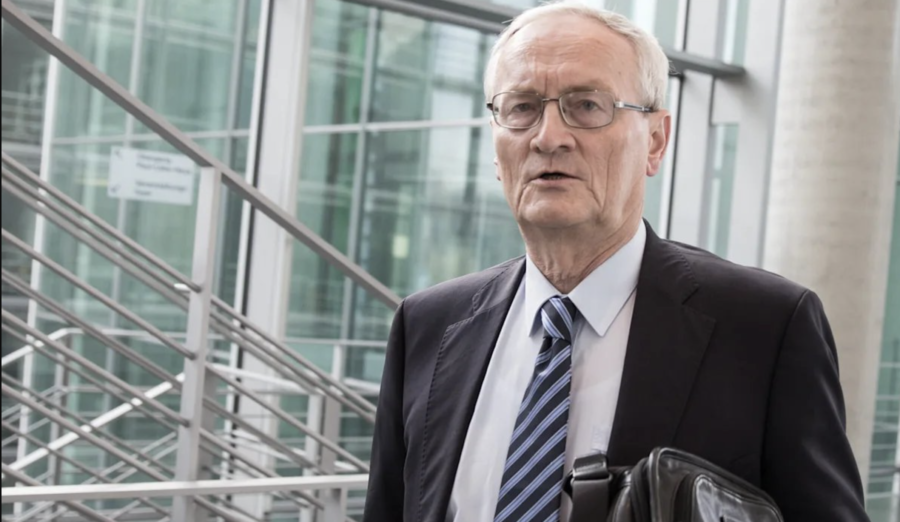
Among those who travelled to Wrocław was Helmut Strauf, an activist associated with Alternative for Germany (AfD) and the Munich-based Burschenschaft Cimbria.
This was not the first time Strauf had found himself at the centre of political controversy. In October 2026, he published a map on social media depicting an enlarged Germany encompassing territories that currently belong to neighbouring countries, including Poland.
The image, shared to mark German Unity Day, was interpreted as an expression of territorial revisionism and provoked criticism even within the AfD itself. Following the controversy, Strauf resigned on 10 October from his position in the federal leadership of the party’s youth organisation, Generation Deutschland.
After his November visit to Wrocław, the politician published photographs taken in the city, accompanied by the words: ’See you again, my Silesia!’
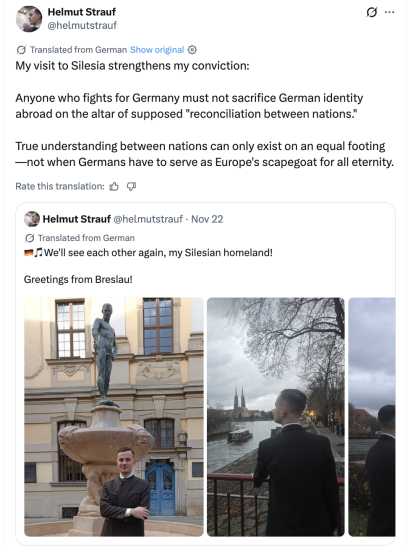
His subsequent post was considerably more revealing, addressing German national identity and international relations.
’My visit to Silesia reinforces my conviction: anyone fighting for Germany cannot sacrifice German identity beyond the country’s borders on the altar of supposed „international understanding”.’
He continued: ’Genuine understanding between nations can only exist on equal terms — not when Germans must forever play the role of Europe’s scapegoat.’
Although Strauf did not explicitly demand changes to Poland’s borders, his remarks are difficult to separate from his earlier publication of maps challenging the post-war territorial settlement.
By invoking the need to defend 'German identity abroad’, the politician presented Silesia’s German heritage not so much as part of the region’s shared history, but as the subject of a contemporary political struggle.
Particularly revealing is his juxtaposition of the defence of German identity against the concept of international understanding. Such rhetoric reflects a way of thinking characteristic of revisionist circles that regard the post-war European settlement as a source of historical injustice towards Germany.
Burschenschaft Cimbria: fraternity traditions and connections with the radical right
The Munich-based Burschenschaft Cimbria, to which Strauf belongs, is another fraternity operating within the Deutsche Burschenschaft.
Like other traditional German student fraternities, it preserves academic customs dating back to the nineteenth century. These include wearing fraternity colours, organising ceremonial gatherings and maintaining lifelong bonds between members.
Cimbria nevertheless belongs to that section of the German fraternity movement which maintains connections with national-conservative and radical right-wing circles.
Strauf’s membership demonstrates that certain Burschenschaften are more than associations dedicated to preserving student traditions. They may also serve as networks bringing together individuals who share similar political convictions.
This does not, of course, mean that every member of Cimbria shares Strauf’s revisionist views. His political activities and presence at Deutsche Burschenschaft events nevertheless warrant closer scrutiny of the ideological character of this section of the German fraternity movement.
German student fraternities are not just Burschenschaften: the Corps tradition
The events in Wrocław should not lead to the entire German student fraternity movement being equated with nationalism or revisionism.
German academic fraternities constitute an exceptionally diverse community, encompassing organisations with different traditions, principles and worldviews.
The Corps occupy a particularly important place within this tradition. These longstanding academic fraternities base their identity primarily on the principles of honour, friendship, tolerance and political non-partisanship within fraternity life.
Unlike the nationalist-oriented sections of the Burschenschaft movement, the Corps generally do not make membership conditional upon a particular ethnic origin or nationality.
Within this tradition, personal qualities, individual conduct and adherence to the fraternity’s principles are considered more important than national background.
Many German Corps belong to the Kösener Senioren-Convents-Verband (KSCV), founded in 1848, or the Weinheimer Senioren-Convent (WSC).
The Corps also have a complex history, and their members may hold a wide range of political views. Nevertheless, ideological and political tolerance remains one of the fundamental principles distinguishing their tradition.
Particularly importantly from a Polish perspective, German Corps maintain friendly relations with Polish academic fraternities, demonstrating that an attachment to one’s own national traditions need not entail hostility towards other nations.
Polish fraternities and German Corps: relationships across borders
A compelling example of a different side of the European fraternity movement can be found in the relationships between German Corps and Polish academic fraternities.
The Polish fraternity movement, which developed during the nineteenth century, possesses its own history and traditions, rooted in the ideals of friendship, honour, patriotism and service to society.
One of Poland’s oldest fraternities is the Korporacja Akademicka Sarmatia, founded in St Petersburg in 1908 and subsequently established in Warsaw.
Sarmatia is among those organisations which preserve traditional fraternity customs while maintaining contacts with academic associations abroad, including German Corps.
One example of Polish-German fraternity cooperation is Sarmatia’s participation in certain gatherings in Bad Kösen, a small town in Saxony-Anhalt which is among the most important historical centres of the German Corps movement.
Since the nineteenth century, Bad Kösen has hosted gatherings of the Kösener Senioren-Convents-Verband, bringing together representatives of academic fraternities from various German cities.
This example demonstrates that patriotism and respect for one’s own history can go hand in hand with openness towards other nations, particularly neighbouring peoples.
Polish fraternity members do not have to abandon their identity to participate in the ceremonies of German Corps. Equally, German students and alumni can preserve their traditions without questioning Poland’s sovereignty or its borders.
This provides a particularly important contrast to the nationalist rhetoric surrounding the Deutsche Burschenschaft gathering in Wrocław in November.
Breslau’s German history does not undermine Wrocław’s Polish identity
There can be no doubt that the German past constitutes an important part of Wrocław’s heritage. For centuries, the city was a significant centre of German culture, scholarship and academic life.
Modern Wrocław does not seek to erase this history. On the contrary, its German, Czech, Austrian, Jewish and Polish heritage is increasingly recognised as an integral part of the city’s multicultural identity.
There is therefore nothing inherently objectionable about historic Wrocław fraternities visiting the city in which they were founded, commemorating their predecessors or exploring places associated with their past.
What matters, however, is how such commemorations are conducted and the political message that accompanies them.
Preserving the memory of the German inhabitants of the former Breslau is one thing; exploiting that memory to advance nationalist political demands is quite another.
The presence at the Wrocław gathering of an AfD politician who had previously published maps depicting German territorial claims over neighbouring countries gives the event a particularly troubling context.
His subsequent statements, which place the defence of German identity in opposition to international understanding, only reinforce these concerns.
More than eighty years after the end of the Second World War, Wrocław’s status as part of Poland and the course of the Republic’s western border are not matters for political negotiation. They form part of the internationally recognised European order and are fundamental to contemporary Polish-German relations.
It is therefore all the more important to remember that another side of the German fraternity tradition exists, represented by Corps which successfully combine an attachment to history with respect for other nations.
While the nationalist rhetoric of certain sections of the Deutsche Burschenschaft risks reviving old antagonisms, the friendly relationships between Polish academic fraternities and German Corps demonstrate that shared traditions can serve not confrontation, but genuine reconciliation, forging lasting bonds of personal friendship between Germans and Poles.
Photo: Instagram Deutscheburschenschaft
Tomasz Modrzejewski