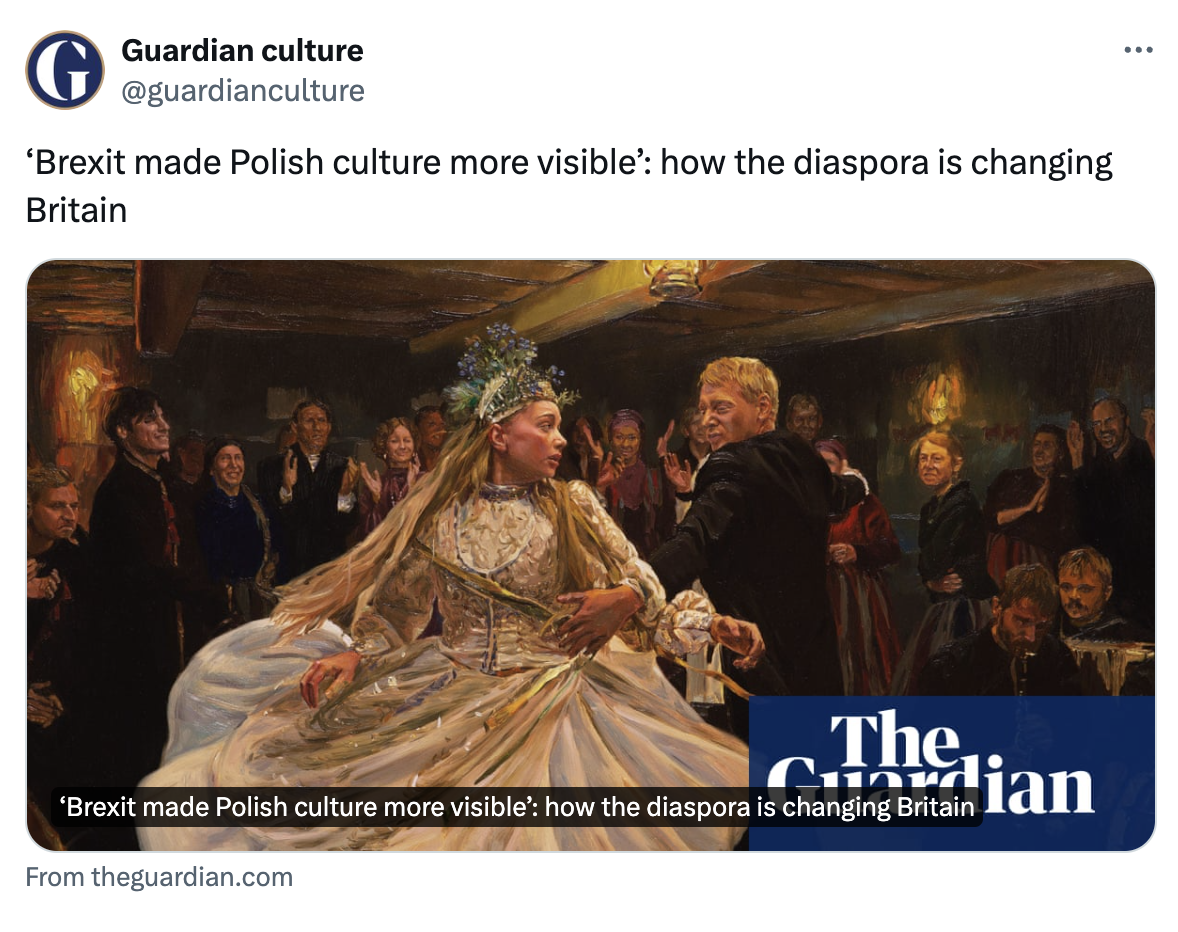
The British newspaper says that despite low TV coverage the culture of Polish 700,00 strong diaspora in the UK is marking its visible place in film, books and music like never before.
One of the examples of such phenomena is Polish-born rapper “Pat”, or Patryk Wójcik. A young Pole emigrated from Silesia in 2007 together with his parents and learned English while listening to songs of popular British rapers like Jme and Devlin. His lyrics reflect a close attachment to his fatherland.
The Polish 700,000 diaspora in the United Kingdom constitutes one of the country’s largest minorities, and its history stretches back from the times of the 2WW to the communist era and the membership of Poland in the European Union. Yet it is noticed that the cultural flavour of that part of the British culture and arts, “is effectively absent,” says Juliette Bretan, a PhD candidate studying representations of Poland at Cambridge.
Juliette Bretan believes that the reason behind such a situation is the division within the Polish diaspora based on class, religion and history, represented by three waves of Polish emigration into the UK: military officers, politicians and aristocracy during 2 World War, middle-class and dissidents in the 1970s and 1980s and working-class Poles but also students and experts that left the country for pursuit of a better future after the fall of communism.
She also points out the unique complexness of the idea of “Polishness” a phenomena encompassing Catholics, Jews and even Muslim Tatars, and many other ethnic groups coming from the present territories of Ukraine, Belarus and Lithuania.
The other reason for the lack of visibility is the Polish high ability to assimilate into British society.
“The pressure to not be Polish was a weird one,” Piotr Wójcik known as rapper “Pat” tells “Guardian”. “As soon as I started learning the language, I tried to be as English as I possibly could.”
The researcher also says that while the Brexit campaign highlighted the question of the Polish diaspora it paradoxically moved something with its ranks at the same time. There are more and more people who want to get in contact with their ancestry than ever before which can be seen in the rising popularity of Polish festivals and culture centres across the country.
The Guardian also mentions Gabriel Krazue, a popularity-gaining Polish writer who described his life in London in a debut book called “Who They Was,” longlisted for the 2020 Booker Prize.
“The output of eastern European cinema that has a certain darkness to it, and a romanticism of despair inspires me, especially with Poland being invaded so many times,” the writer recalls, remembering his experience with the Polish film school movies of Kieślowski, Żuławski and Wajda and their impact on his artistic nature.
Photo: jwvein/Pixabay
Tomasz Modrzejewski