The historical novels of Henryk Sienkiewicz not only granted him the Nobel prize for literary craftsmanship but were able to re-create a way of thinning for the Poles who won the most important battle for Polish independence in 1918.
Surely Henryk Sienkiewicz’s works are among the greatest pieces of Polish literature. One can find a deep understanding of Polish and Ukrainian history as well as great depictions of people living in the times of the golden age when Poland was a regional power and fought for its position with Musovy, the Crimean Tartars and the Ottoman Empire.
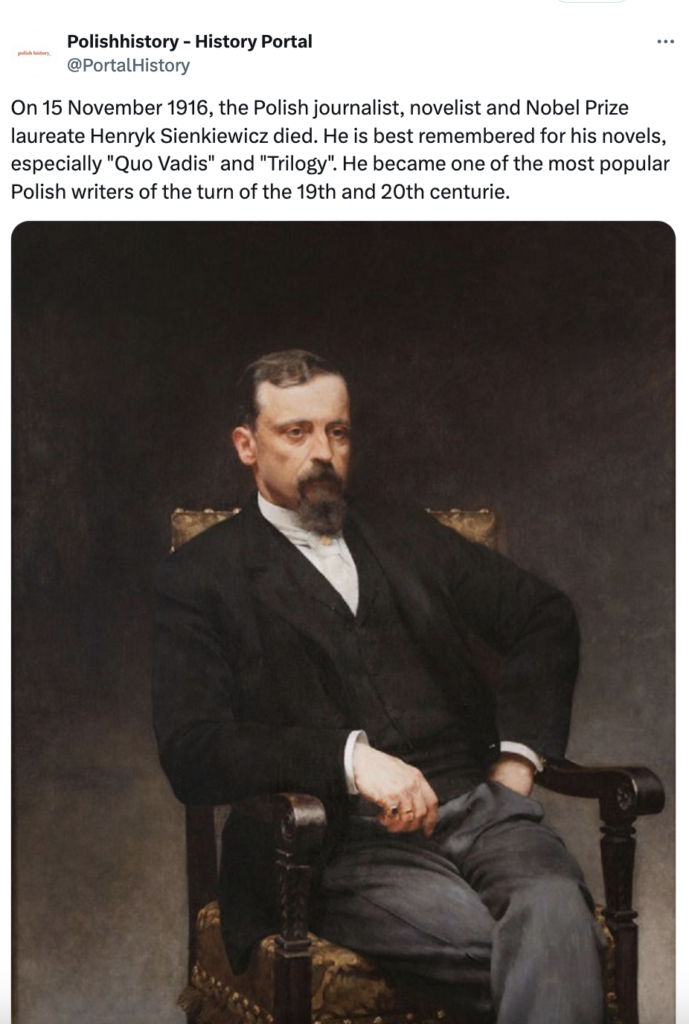
He came from an impoverished landed gentry family of the Oszyk coat of arms, descended by the sword from Tartars settled in Lithuania.
During the time of his studies, he was passionate about literature and history. He was under the great influence of the Scottish writer Walter Scott, as well as Polish classics: Adam Mickiewicz and Juliusz Słowacki.
He was studying to become a doctor, then changed it to law studies to finally focus only on history and literature.
After the Russian authorities closed the Polish-language Szkoła Główna in Warsaw, he continued his studies in the Russian language at the University of Warsaw, which he left in 1870 without taking the final exams.
During the time of his studies, Sienkiewicz became a member of various groups that concentrated on the ideas of positivism. He began to publish in various newspapers and was known for his theatrical and literary critique.
He was also a friend of many great artists of his time including Helena Modrzejewska and Stanisław Witkiewicz.
Between 1876 and 1878, Sienkiewicz served as a correspondent of the ‘Gazeta Polska’ in the USA. Together with Helena Modrzejewska and her friends, he tried to settle in a farming commune in California.
Sienkiewicz will spend one-third of his life on his trips outside Poland.
The most important work of his life was surely the famous Trilogy. The three historical novels „With Fire and Sword”, „Deluge” and „Pan Michael”, were published in parts in a newspaper “Słowo”.
Fire and Sword or ‘Ogniem i Mieczem’ was surely the most important novel set during the Cossack wars in the mid-seventeenth century. It was loved by the readers but widely criticised by critics and historians.
On the other hand, The Deluge set in the time of Polish-Swedish war in 1655 was praised by those unhappy with his previous novel because of Sienkiewicz’s strong criticism of the Polish magnates and the anarchy that deepened the crisis of the Polish-Lithuanian Commonwealth at that time.

The last book of the Trilogy “Pan Michal” was mostly focused on the Polish-Ottoman rivalry and romantic heroes who fought under Hetman and later the great Polish King Jan Sobieski.
Today Sienkiewicz’s books are ever more actual because of their great depiction of complicated cultural and geopolitical themes of the Polish-Lithuanian statehood that reached Ukraine and Belarus and which always had to face the dangers from the Muscovy.
Interestingly most foreign readers know Sienkiewicz for his excellent book “Quo Vadis” which tells the story of the persecution of Christians in Rome during the reign of Emperor Nero. A great story of the love of a Roman soldier and aristocrat Marcus and Ligia, a daughter of the barbarian king and a hostage in Nero’s court bring the reader into a great spectacle of the end of the classic world and the moral decline of Rome and rise of Christianity.
Henryk Sienkiewicz died on 15 November 1916, during the Great War which in the end helped Poland regain its independence after 123 years of partitions. Although he was unable to see the resurrection of his beloved homeland, today we can say he paved the mental way to Polish victory by waking the battle spirit of an enslaved nation.
Source: Culture.pl
Photo: Portrait of Henryk Sienkiewicz by Kazimierz Pochwalski, 1915
Tomasz Modrzejewski