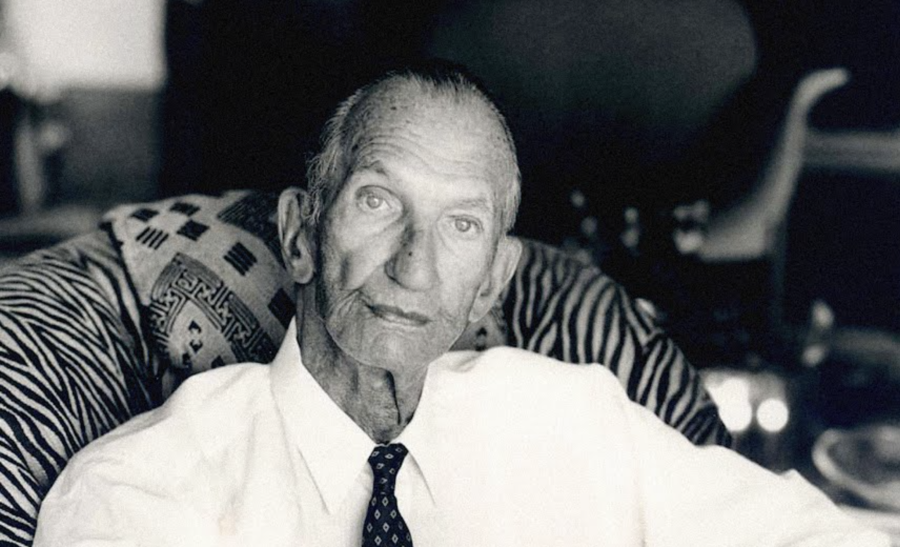
Jan Kozielewski (codename Jan Karski) was born on 24 June 1914 in Łódź, a multicultural city with a large Jewish community. He grew up in a Catholic family as the youngest of eight siblings. He graduated in law and diplomacy from Lwów University and the Volhynia School of Reserve Cadets. Shortly before the start of the Second World War, he began his career at the Ministry of Foreign Affairs.
After the Russians invaded eastern Poland in September 1939, Karski, along with thousands of Polish officers, found himself in Soviet captivity.
By a fortunate twist of fate, he made it to the German occupation zone and escaped from the transport, while most of his comrades-in-arms were murdered in Katyn in 1940.
After reaching Warsaw, Karski became involved in the resistance movement and became a courier for the Polish Underground State.
Thanks to his perfect memory and ability to speak several foreign languages, he went on several occasions on missions to the Polish government-in-exile in France and the United Kingdom, carrying secret instructions and orders. He contributed to building the structures of the Polish Underground State.
During one of his missions, he was arrested and tortured by the Gestapo. After being recaptured by Home Army soldiers, he continued his underground activities.
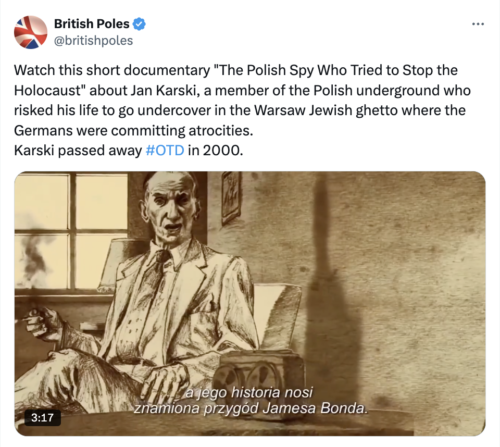
Karski also entered the Warsaw Ghetto twice to witness with his own eyes the tragic situation of the Jews.
Dressed as a Ukrainian soldier, he also spent several hours in the transit camp in Izbica, from which Jews were transported to the death camps at Sobibor and Majdanek. There he again saw German atrocities.
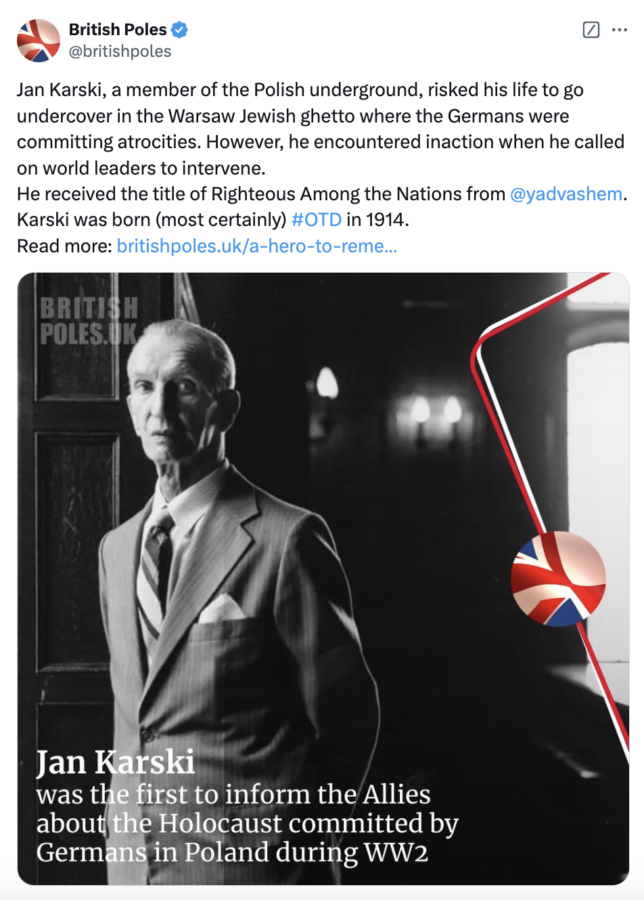
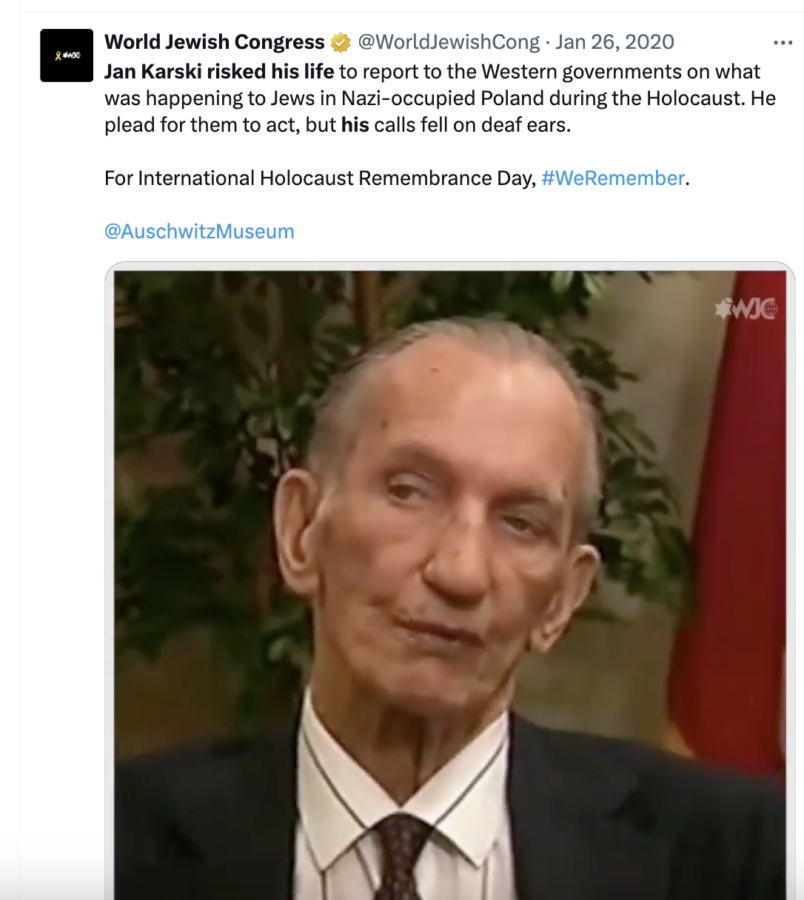
In 1942, Karski passed information about the extermination of the Jews to the Western Allies. He provided detailed reports and, as an eyewitness, appealed to British Foreign Secretary Anthony Eden, and representatives of the British media and political establishment to take action to stop the Holocaust.

In July 1943, two months after the annihilation of the Warsaw ghetto, Karski met at the White House with the President of the United States, Franklin D. Roosevelt. Karski’s talks were unsuccessful and Allied intervention never came.
After the war, Jan Karski remained in the US, unable to return to communist Poland. After graduating and receiving his PhD from Georgetown University in Washington, D.C., he lectured in international relations and the theory of communism for forty years at the School of Foreign Service there, considered the most important and prestigious school for American diplomats.
On 2 June 1982, Yad Vashem recognised Jan Karski as Righteous Among the Nations. Poles constitute the largest national group within the Righteous Among the Nations recognised by Yad Vashem. 27.712 people have been recognised so far. More than 25% of them were Polish. More can be read at the official Yad Vashem website.

We need to remember that throughout the German occupation of Poland, many Poles risked their own lives – and the lives of their families – to rescue Jews from the Germans.
To date, 7,112 Christian Poles have been awarded the title of Righteous Among the Nations by the State of Israel, more than those of any other nation (compared to Germany – just 638).
Considering the harsh punishment that threatened rescuers, this is a most impressive number. Polish citizens were hampered by the most extreme conditions in all of German-occupied Europe.
Occupied Poland was the only territory where the Germans decreed that any kind of help for Jews was punishable by death for the helper and their entire family.
At least 50.000 Poles were executed by the Germans solely as repression for saving Jews.
Jan Karski received the Order of the White Eagle (the highest Polish civil decoration) and the Order Virtuti Militari (the highest military decoration awarded for bravery in combat).
He died on 13th July 2000.
Source: jankarski.net
Photo: X @WBH_2016
Tomasz Modrzejewski