Katowice’s historic Rialto Cinema Theatre became a temple of chess for one evening as Poland’s Jan-Krzysztof Duda produced a commanding 5–1 blitz victory over reigning world champion Gukesh Dommaraju. The 18-year-old Indian prodigy, already a history-maker in his sport, faced the home favourite in a contest that was as entertaining for the crowd as it was demanding for the players.
But the chessboard battle was only part of the attraction. The evening opened with on-stage conversations with both grandmasters, giving the audience a rare insight into their careers, philosophies, and personal rituals. Fans were invited to pose questions, collect autographs, and capture the moment in photographs.
First to speak was Gukesh, who charted his journey to the top: the guiding hand of his family, the emotional strain of elite competition, and the quiet discipline of yoga and meditation. He also revealed how artificial intelligence has become an essential tool in his training.
The teenager, already the face of India’s chess renaissance, reflected on the mental qualities modern chess demands:
“You must learn to accept mistakes, deal with defeat, and keep ambition in balance with humility. Chess has taught me never to rely solely on plans – you have to adapt to what’s in front of you. Every opponent forces you to grow, and the learning never stops.”
Gukesh also credited India’s chess surge to improved access to online coaching, strong educational foundations, and an enthusiastic network of public and private support.
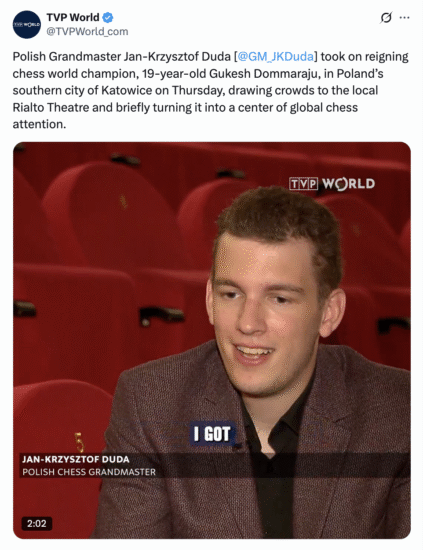
When Duda took the stage, he recalled discovering chess at the age of five, encouraged by his mother’s unwavering support. The 2021 FIDE World Cup winner spoke of responsibility, discipline, and mental toughness – and why excuses have no place in his sport.
“Chess holds you accountable for your decisions. It’s hard to blame anything else when you lose. I joke about it sometimes, but the truth is I try to cut out negative emotions and focus on what can be improved. Every move is your choice, and the consequences are instant. That teaches self-discipline, which carries over into life.”
For Duda, success is as testing as failure:
“After winning, you need to stay sharp – it’s easy to rest on your laurels. Every tournament demands mental readiness for tough moments and rapid decisions. Too much planning can backfire, because the opponent can seize the initiative. Chess is a constant test of concentration under pressure.”
Between the interviews and the blitz showdown came a panel discussion featuring Katowice’s mayor, Marcin Krupa, deputy mayor Maciej Stachura, FIDE secretary general Łukasz Turlej, Silesian Chess Association president Andrzej Matusiak, Superbet Foundation’s Katarzyna Gawlik, and Duda’s manager Adam Dzwonkowski.
The panellists agreed: chess is far more than a sport. It fosters analytical thinking, stress resilience, time management, and teamwork. It strengthens social bonds, enriches education, and even shapes corporate and civic identity. Its role in CSR strategies and both formal and informal learning is, they argued, on the rise.
When the pieces were finally set, the pace was truly amazing. While the scoreline suggested a comfortable victory for Duda, every game was a whirl of tactical twists and sudden momentum shifts.
“I’m happy with my play,” Duda said afterwards. “The games were exciting – for us as players and for the audience too.”
For Gukesh, the match served a different purpose:
“This was valuable training for me. Playing one of the best players in the world is an experience I’ll take into future tournaments.”
For the young masters, Katowice encounter was a preparation for the upcoming Grand Chess Tour event in the United States, starting on 11 August.
Source: Nasze Miasto
Photo: X/@FIDE_chess
Tomasz Modrzejewski