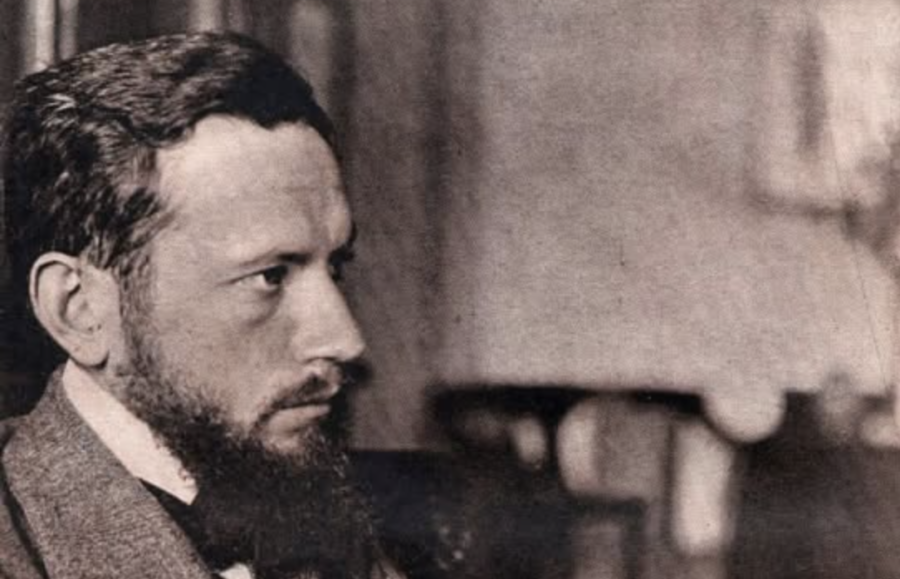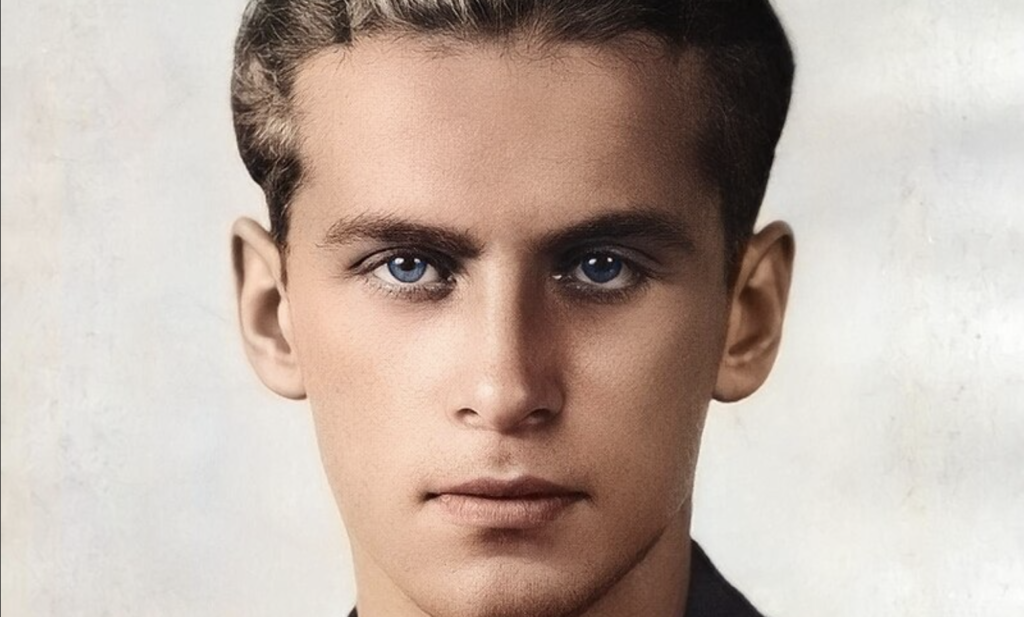
Although Krzysztof Kamil Baczyński was the author of only five volumes of poetry, he is considered the most outstanding poet of the so-called Columbuses generation – meaning the Poles born soon after 1918 when Poland regained its independence, and whose youth or adultery was marked by World War II and the tragedy of genocidal German occupation. Baczyński died 80 years ago at Teatralny Square in Warsaw, on the fourth day of the Warsaw Uprising.
Baczyński’s parents were Stefania Zieleńczyk, a teacher, translator and author of children’s books, and Stanisław Baczyński, a writer, independence activist, member of the Polish Military Organisation and a Polish intelligence officer, involved in the Third Silesian Uprising. Kamil’s childhood was strongly shaped by his mother, as the father left the family for another woman. He later rejoined his son and wife shortly before he died in 1939.
He attended the famous Stefan Batory gymnasium and secondary school in Warsaw, and studied in the same group with the future soldiers of the Grey Ranks Assault Group: Tadeusz Zawadzki „Zośka”, Janek Bytnar „Rudy”, and Aleksy Dawidowski „Alek” (all heroes of the famous Polish war-time novel called “Stones for the Rampart”).
All of them were also members of the 23rd Warsaw Scout Group, which operated at their school. However, soon Baczyński’s political decisions took him outside of the group, in high school he experienced a fascination with the socialist movement and joined the Union of Independent Socialist Youth „Spartakus”, a semi-legal youth branch of the PPS.
At that time Baczyński wrote many poems exploring the socialist symbolics and reflecting his personal views. After the Moscow trials of the members of the Communist Party of Poland, the Soviet attack on Poland in 1939 and the news about the Katyn Massacre he dropped his fascination with leftist political ideas.
Since the autumn of 1942, he studied Polish philology at the underground University of Warsaw. In 1940, he published his first volume of poetry – „Zamknięty echem„. Two years later he published his 'Selected Poems’, which included 20 works and came out in one hundred copies.
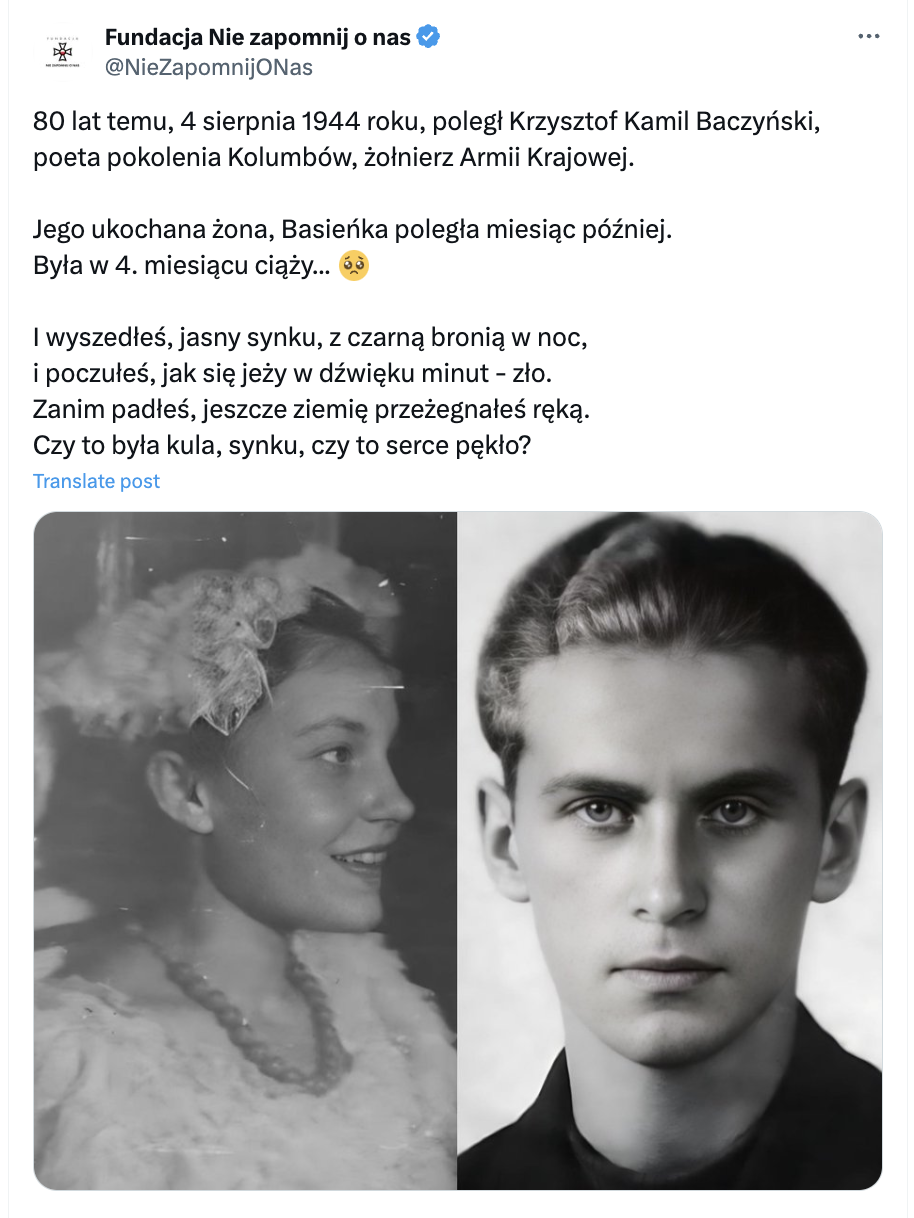
In July 1943, Baczyński joined the Home Army. He belonged to the 2nd platoon „Alek” of the 2nd company „Rudy” of the „Zośka” battalion with the rank of senior rifleman under the pseudonym „Krzysztof Zieliński”. By an order of the commander of the 2nd Company of the „Zośka” Battalion, Lieutenant-Colonel Andrzej Romocki, dated 1 July 1944, Baczyński was relieved of his duties „due to his low usefulness in field conditions”, with a request to take up the unofficial post of the company’s press division chief. Baczyński then decided to transfer to a different unit, the Scout Battalion „Parasol” as deputy commander of the 3rd Platoon of the 3rd Company.
On 1 August 1944, at the outbreak of the Warsaw Uprising near Teatralny Square, Baczyński was supposed to pick up shoes for his unit. He was cut off from his colleagues and joined another unit. On 4 August, while on guard duty, he was shot in the head.
Paramedic Krystyna Sypniewska, PS. „Stella”, described that moment:
„Under constant German fire from various directions, we crawled to the wounded man. The bullets that were flying through the windows were bouncing off the wall. They made it impossible to move freely. With the greatest care, I crawled to the wounded insurgent. He had a wound on the left side of his head the size of a five-penny, slightly elongated, in which the brain shone through. The wound was not bleeding, his face was deathly pale. The wounded man was a petite blond man whom we struggled to put on a stretcher […]. There was also another man who helped us carry the injured over the wall to the sanitary post in the City Hall. I later found out that the wounded man was a young poet of the occupation years, Krzysztof Kamil Baczyński„.
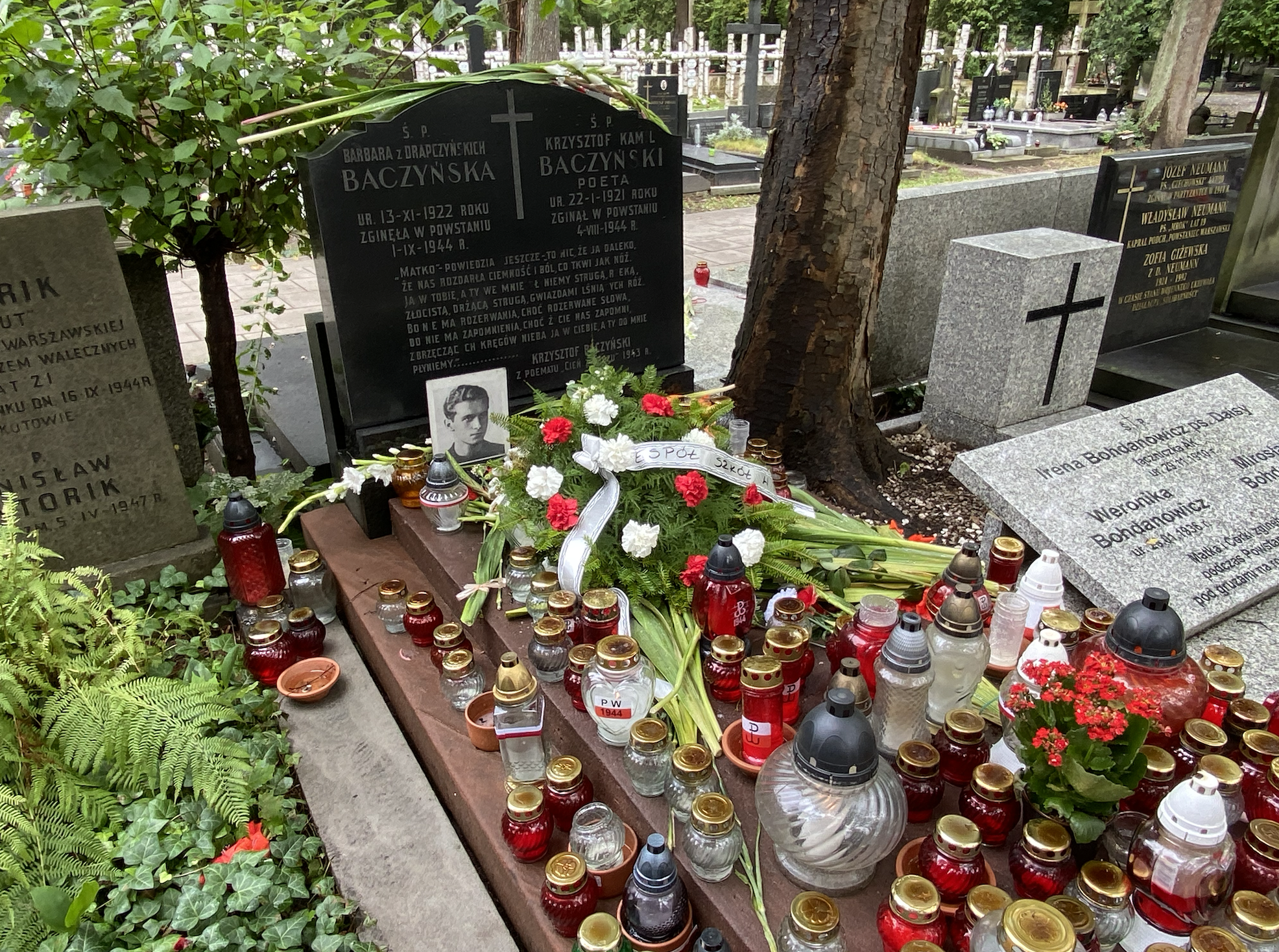
Krzysztof Kamil Baczyński died the same day.
Despite surviving only 4 of the 63 days of the Uprising Baczyński remains a symbol of the fighting Warsaw and the underground occupation culture. Among his most important poems from that era one remains particularly important for the Uprising memory:
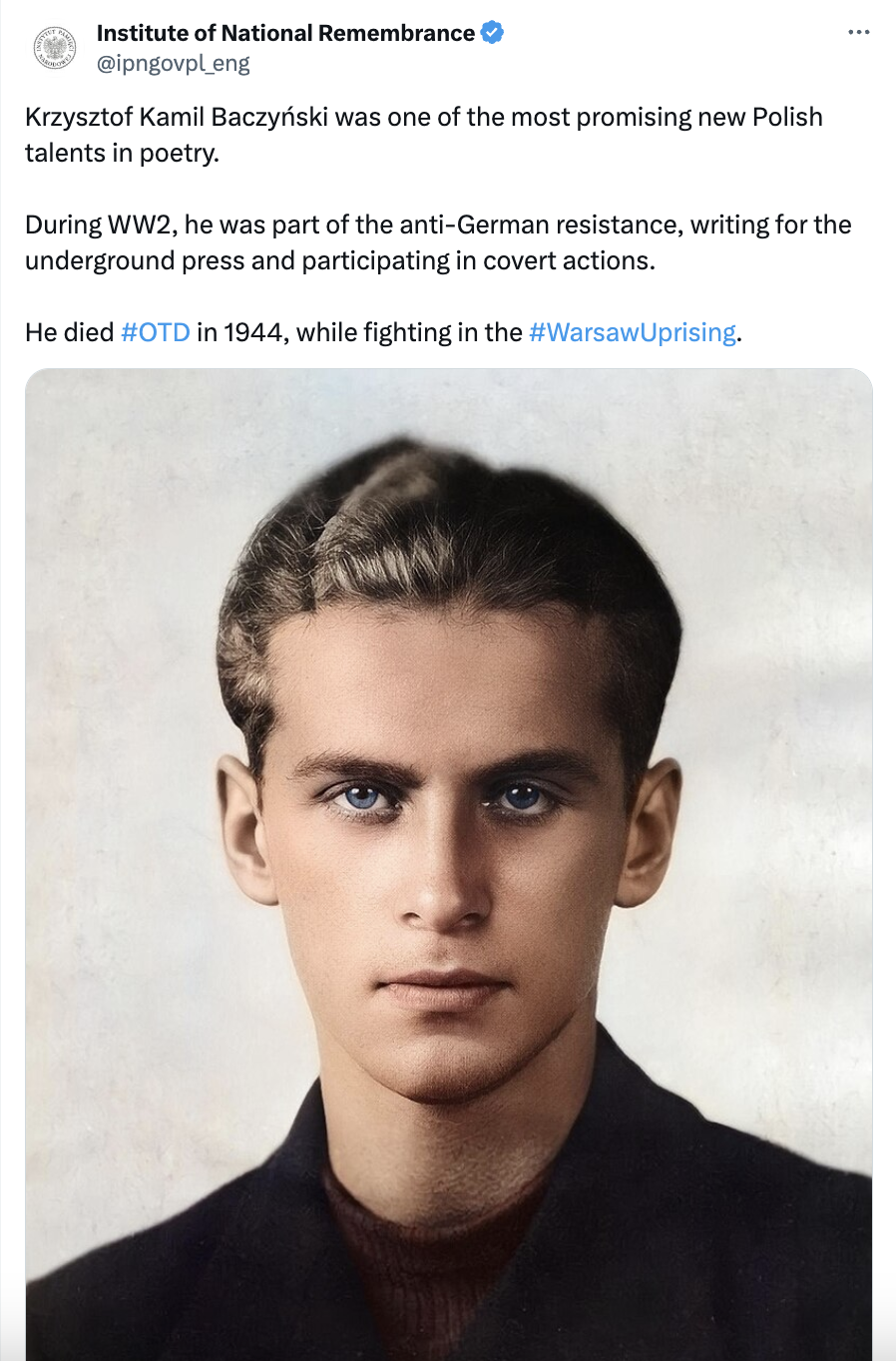
Elegy of a Polish boy (Elegia o chłopcu polskim )
They have separated you, my little son, from the dreams, which are trembling like butterflies
They were weaving you, my little son, your sad eyes with red blood
They painted you landscapes with yellow stitches of fires
They were weaving with hanging men sea flowing with trees
They taught you, my little son, your land to remember
when you have cut her tracks with steel tears
They raised you in darkness, they fed you with bread of fear
you have crossed groping your way through the most shameful of men’s ways
and you left, my little light son, with a dark gun into the night
and you felt how the evil is bristling in the sounds of minutes
before you fell, you crossed the land with your hand
was it a bullet, my little son, or it was your heart which broke?
Source: PAP, war-poetry.livejournal.com
Tomasz Modrzejewski