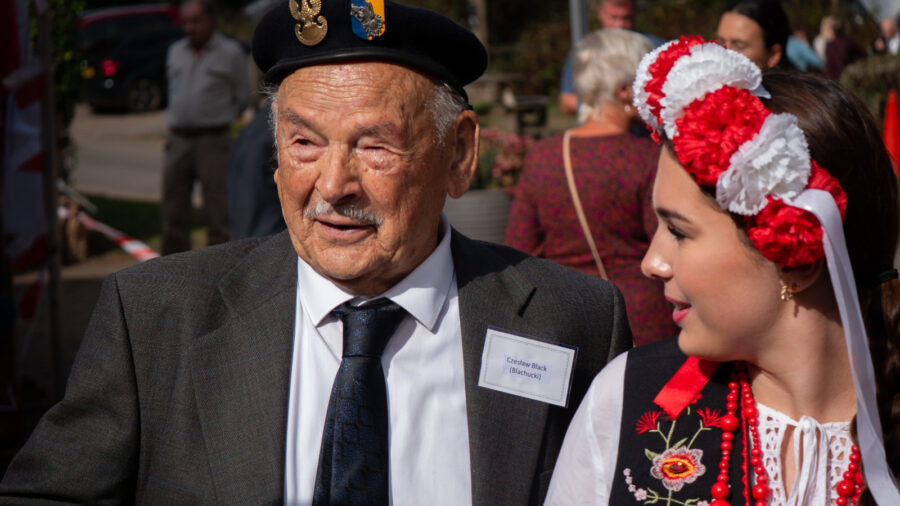
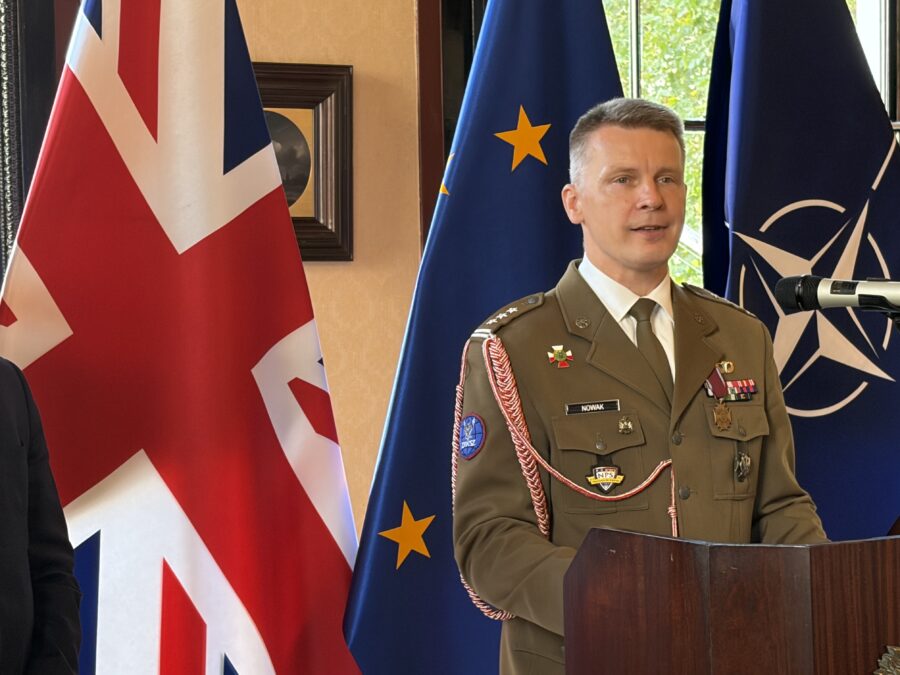
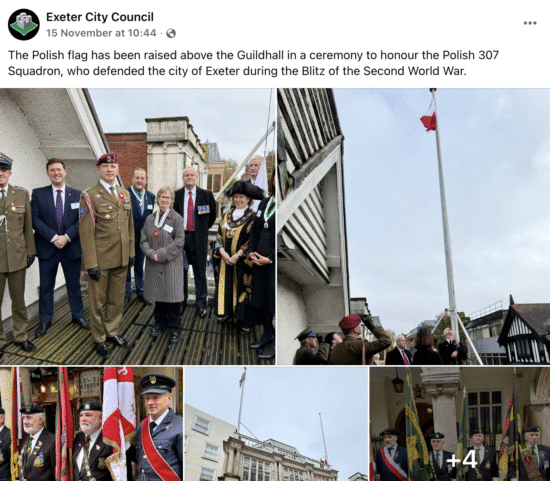
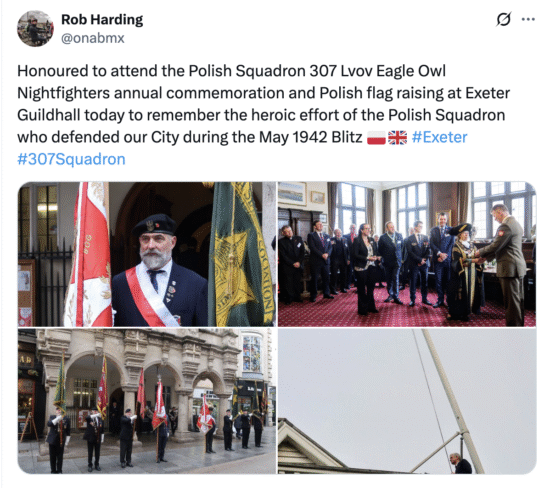
On 15 November, Exeter once again paid homage to the Polish airmen of No. 307 Squadron during the annual remembrance ceremony at the historic Guildhall. The event, now an integral part of the city’s calendar, symbolises both gratitude and friendship between Exeter and Poland.
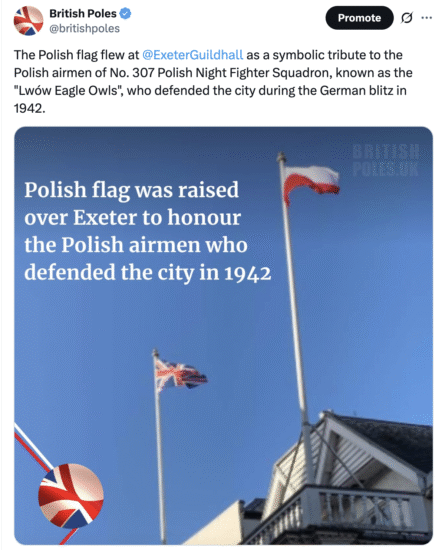
The centrepiece of the ceremony remains the raising of the Polish flag above the Guildhall, which is an echo of the moment in 1942 when the wartime mayor, Rowland Glave-Saunders, first lifted the banner in recognition of the squadron’s defence of the city. His words, spoken amid the turmoil of war, still resonate today: “These pilots have been our guardian angels… we shall hang this flag proudly to remind future generations what Poland did for us in our darkest hours.”
Formed in Blackpool in August 1940, No. 307 (Polish) Night Fighter Squadron became the RAF’s first non-British radar-equipped night-fighter unit. Marked by the emblem of a green-eyed eagle owl, the squadron played a key role in Britain’s night-time defence.
In April 1941, the squadron moved to RAF Exeter (today’s Exeter Airport), where it served for two years. Its defining moment came during the Baedeker Raids of May 1942. As the Luftwaffe sent dozens of bombers to level the “defenceless” city, the Polish crews rose to meet them. Through the night of 3–4 May, 307 Squadron intercepted the attack and shot down four German aircraft, preventing devastation that would have changed Exeter forever.
The first Polish flag gifted to Exeter by Squadron Leader Jan Michałowski on 15 November 1942 was kept in the Guildhall for decades before eventually disappearing. In 2012, inspired by local historians and supported by the emerging 307 Squadron Project, the City Hall revived the tradition by commissioning a new Polish flag. Since then, the 15th of November has officially been celebrated as 307 Squadron Day.
Across the squadron’s wartime service, more than 1,400 personnel passed through its ranks. They flew 3,879 operational sorties, often in the most challenging night-flying conditions. Their dedication came at a heavy cost: 28 pilots and 26 air gunners, and navigators were killed on duty.
For many Polish servicemen, Britain was not simply an ally but the last refuge of a nation overrun by invasion. They continued to fight with unwavering commitment, frequently demonstrating exceptional skill and discipline alongside their RAF counterparts. Their efforts contributed meaningfully to the Allied air defence and, ultimately, to victory against Germany in Europe.
Today, 31 members of No. 307 Squadron rest at Exeter’s Higher Cemetery. Each flag-raising ceremony honours not only their heroism but also the broader story of Polish resistance, loyalty, and sacrifice.
More than eight decades after the squadron’s wartime vigilance, Exeter continues to watch its skies through a lens of gratitude. The Polish flag flying above the Guildhall each November is more than a symbol; it is a promise to remember.
As the crowd gathered at this year’s ceremony, it was clear that the bond forged in 1942 between a threatened British city and its Polish protectors endures, carried forward by new generations who recognise the extraordinary service of the “Guardian Angels of Exeter.”
Source: British Poles, Exeter City Council
Photo: Exeter City Council/Facebook
Tomasz Modrzejewski