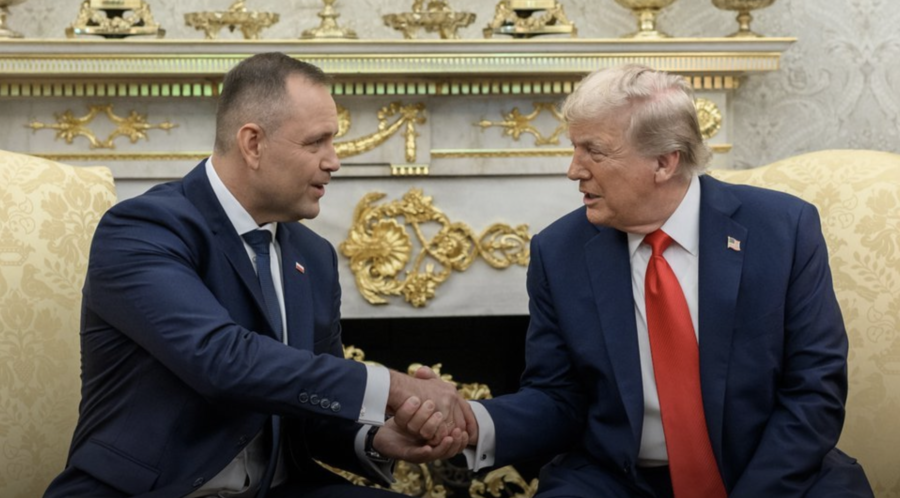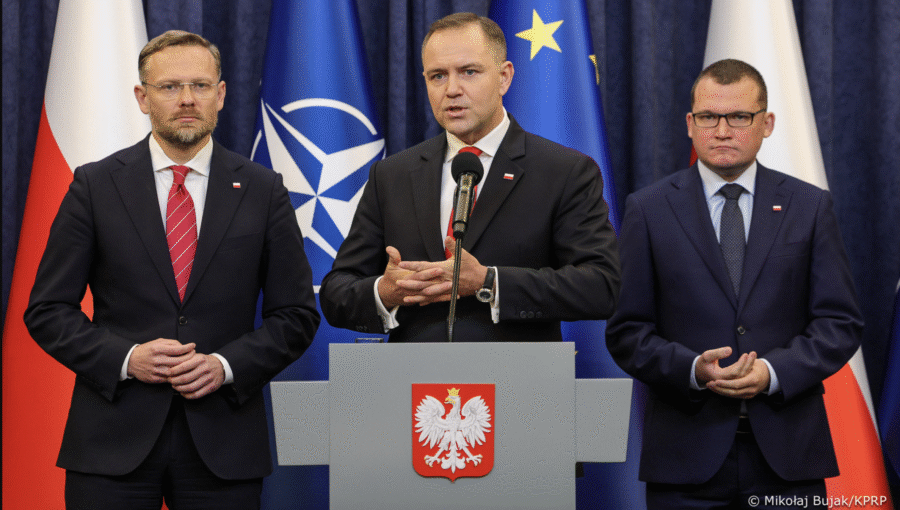
President Karol Nawrocki announced that he had declined to sign the amendment to the law on assistance for Ukrainian nationals. He justified his decision by arguing that the “800 plus” child benefit should only be available to Ukrainians who are employed in Poland.
“This law does not address the correction which has been at the heart of public debate. My position remains unchanged: the 800-plus benefit should be reserved for Ukrainians who undertake work in Poland,” the president said at a briefing.
During the legislative process, members of the opposition Law and Justice party (PiS) had sought to make the benefit conditional on employment or running a business in Poland, and also pushed for stricter rules on obtaining Polish citizenship. Their proposals were rejected in the parliament.
Explaining his decision, Nawrocki recalled that Russia’s invasion of Ukraine three and a half years ago had shaken the global security order. At that time, Poles demonstrated remarkable solidarity and generosity, he said, but the measures adopted then were intended to be temporary.
“Today, after three and a half years, both the state of Poland’s public finances and the political and social climate are very different. A law designed for that earlier moment now requires adjustment – but this has not been done,” he argued.
The president also raised concerns over access to healthcare, noting that Ukrainians are entitled to medical services regardless of whether they work or pay health insurance contributions.
“This leaves Polish citizens worse off than our guests from Ukraine. I cannot accept such a situation,” he emphasised.
Nawrocki announced that he will submit his own draft legislation. His proposal is expected to extend the naturalisation process from three to ten years, increase the maximum penalty for illegal border crossing to five years’ imprisonment, and introduce new provisions relating to symbols that praise Ukrainian nationalist formations such as OUN-UPA, responsible for the WW2 genocide on Poles.
He declared that the law should explicitly state “stop Banderaism”, equating the use of Banderist symbols with those of Nazi Germany and Soviet communism, and that the Act on the Institute of National Remembrance should be amended to include crimes committed by the OUN-UPA. Such steps, he insisted, were essential both to safeguard Polish national interests and to build relations with Ukraine based on justice, truth, and resistance to Russian propaganda.
Minister Paweł Szefernaker, head of the president’s office, later stressed that the current legislation on support for Ukrainians remains in force only until the end of September.
He appealed to MPs to adopt a new law before that deadline: “If parliament passes the bill in the form we have prepared, the president will sign it immediately. We want cooperation and dialogue across party lines to ensure the law reaches the president’s desk by September,” he said.
The amendment Nawrocki refused to sign had been designed to implement an EU Council decision of 25 June 2024, extending temporary protection for Ukrainians fleeing the war until 4 March 2026.
It also sought to clarify entitlement to the 800-plus benefit, so that it covered children over school-leaving age but still in full-time education or vocational training, give regional governors longer deadlines to process applications for temporary and permanent residence, as well as EU long-term resident status, tighten eligibility rules to prevent abuse of the system, particularly by short-term border crossers using local border traffic permits, repeal provisions allowing revenue from alcohol licence fees to be allocated to Ukrainian aid, require documentary proof of family ties for third-country nationals claiming rights through Ukrainian relatives, continue financial support for local authorities tasked with educating and caring for Ukrainian children, and restrict simplified procedures allowing Ukrainian doctors, dentists, nurses, and midwives as well as other professionals trained outside the EU to practise in Poland.
Source: PAP
Photo: Mikołaj Bujak KPRP
Tomasz Modrzejewski