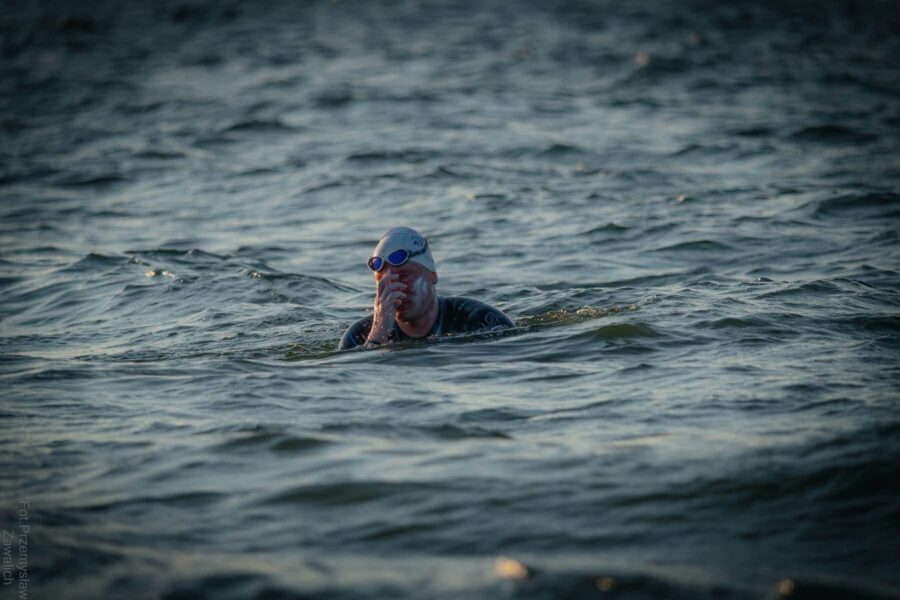
Polish long-distance swimmer Bartłomiej Kubkowski has successfully swum across the Baltic Sea, completing a gruelling journey of more than 160 kilometres in around 55 hours.
Kubkowski reached the beach at Dziwnów in north-western Poland on Sunday evening, bringing to an end his fifth attempt to cross the Baltic from Sweden and the first to finish successfully.
Crowds of supporters gathered on the beach to welcome the exhausted swimmer as he emerged from the water at around 8pm. Asked moments later how it felt to have finally crossed the Baltic, Kubkowski admitted that he was simply too tired to comprehend what he had achieved.
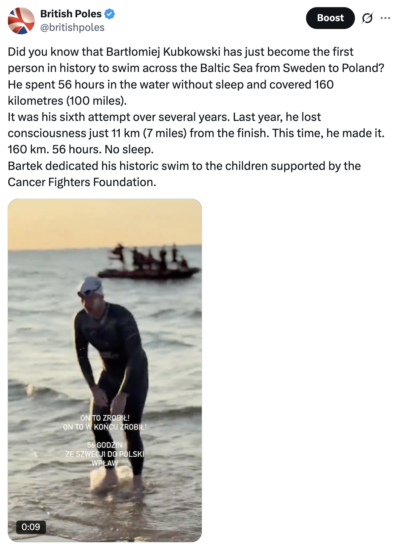
Under the rules of the challenge, he was required to reach the shore and leave the water unaided. He managed to do so after swimming continuously for approximately 55 hours.
During the crossing, Kubkowski did not touch the support boat, sleep or take any conventional rest breaks. His team accompanied him throughout the attempt, providing navigation, food and safety support while ensuring that the swim remained uninterrupted.
Marcin Cieślak of Purely Athletic said the athlete had continued “stroke after stroke” throughout the entire crossing without once relying on the accompanying vessel for physical support.
One of the greatest difficulties was severe sleep deprivation. According to Cieślak, such extreme endurance events inevitably produce periods of crisis, particularly during the second night without sleep, when exhaustion can lead to hallucinations and temporary loss of awareness.
Kubkowski had experienced similar problems during previous attempts, but his team sought to minimise the risks through carefully planned nutrition, extensive preparation and specialised training.
The successful crossing came after four unsuccessful efforts dating back to 2022. During his first attempt, Kubkowski covered around 115 kilometres in 32 hours before abandoning the challenge.
He returned to the Baltic every year, gradually getting closer to his objective. In 2025, he came within just 11 kilometres of the Polish coast after swimming 159 kilometres over 53 uninterrupted hours. That attempt had to be stopped when he lost consciousness.
His support team said the experience gained during those previous crossings proved decisive this time.
Cieślak described Kubkowski as noticeably calmer and more focused before the latest attempt, saying that years of failures and preparation had given him greater confidence and a better understanding of the demands of the crossing.
The swimmer decided early in 2026 that he would make another attempt and subsequently embarked on an exceptionally demanding training programme. Some sessions reportedly lasted as long as a day and a half and included overnight swimming, pool sessions covering dozens of kilometres, strength work on land and mental preparation.
Kubkowski dedicated the achievement to children supported by the Cancer Fighters Foundation. The Baltic crossing was also used to raise money for the organisation and its beneficiaries.
The athlete is a prominent figure in Polish ultra-distance swimming and the founder of the Ultra Baltic Swim project. He holds a world record in 24-hour swimming and has won multiple medals at Polish and international championships.
His successful August 2026 crossing marks the culmination of several years of attempts to complete one of the most demanding open-water challenges in the region.
Another Polish swimmer, Karolina Szczepaniak, also tried a Baltic crossing from Sweden but unfortunately failed after a 58-hour swim, just 40 kilometres before reaching her goal.
Szczepaniak, who competed at the Beijing and London Olympic Games and holds both Guinness and world records in ultra-distance swimming, is making her second attempt to cross the sea. She plans to reach Pobierowo on Poland’s Baltic coast.
Her swim has a charitable purpose as well. Szczepaniak is raising funds to support the treatment and rehabilitation of 14-year-old Piotr Małolepszy.
Photo: X/m_turski
Tomasz Modrzejewski