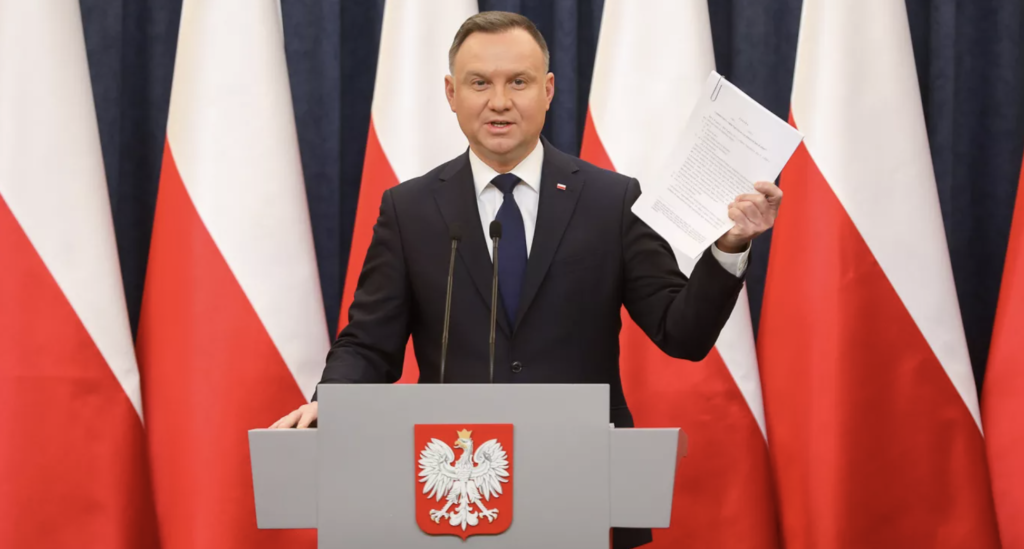
President Andrzej Duda vetoed an act of law approved by the Polish Parliament to recognise the Silesian language as one of Poland’s regional languages. The President explained the reason for the decision was the opinion of linguistic experts as well as fear of hybrid warfare dangers that may result from creating divisions within Polish society. The British Poles asked members of the Silesian community about their opinion on the subject.
The question of Silesian regional laws sparked fiery debate as many indicate the province was not a part of Poland for some 400 years, becoming a part of the Czech Kingdom in the XIV century, and then being conquered by Prussia in the XVIII century. During that time the Polish language of the inhabitants used in the XIV century evolved within the Czech and German states bringing many new words, especially those connected to the industrial development of the XVIII and XIX centuries. Interestingly Silesian migrant communities living in the US (f.e. Panna Maria in Texas) do not use German-originated words as their contact with the German-speaking communities left much less influence.
The period of the Industrial Revolution and the formation of national movements met Silesia proper as part of the German II Reich. For some, that means there are always circles both in Germany and Silesia that want to bring the region back as part of Germany. Others claim that all the Silesians want is more regional recognition for their culture and history within the Polish state.
The President’s office issued a statement explaining the decision to freeze the attempts to recognise the language: “In the President’s opinion, whether the statutory criteria [to sign the law] are met should be the subject of an objective assessment. The mere belief of the social group concerned that it differs significantly from other citizens in terms of language, culture or tradition is insufficient here”.
The statement also referred to the need for equal treatment of other ethnic groups and geopolitical circumstances:
“The President, sharing concerns that recognising the Silesian ethnolect as a regional language, and thus providing it with the protection resulting from this title, may result in similar expectations among representatives of other regional groups who want to cultivate their local languages… […]. Hybrid activities that cannot be ruled out, which may be taken against the Republic of Poland, related to the war being waged on the eastern border, require special care to preserve national identity. In particular, cultivating the native language and preserving the national identity.”
The explanations given by the President’s office suggested that foreign actors could use tensions among ethnic minorities in Poland to create unrest in a broader, hybrid warfare action.
We asked several members of the Silesian community and opinion-forming NGOs for comments about the vetoed law.
We reached out to Grzegorz Franki, the Head of the Upper Silesian Union, the largest regional organisation of Silesians about his comment on the president’s decision:
‘The President’s veto was predictable, although I had a secret hope that he would stand out for self-independence in this matter and make a good gesture towards half a million citizens of the Republic of Poland. As we well know, this did not happen. He sided with his political circle, unfortunately also ridiculing himself. In justification of his decision, the president linked the issue of the Silesian language with current international politics by talking about hybrid warfare. It’s funny on the one hand, but terrible and very sad on the other.’
We asked Mr Franki for the next steps for the legislation supporters:
‘As for the Silesian language users themselves, we all did a great job. Not everyone is the same, but many circles brought our language to public life and the high culture in Poland. The Silesian language is present in film, music, business and also in schools. Already several years ago, the Silesian syllabus was created, a handbook with the alphabet for students. However, funds are still needed for language research and teacher support and training. I believe that such an act will be signed by the next Polish president in the future.’
While asked about fears of those opposing the law, that such an act might be used in hybrid warfare against Poland, Mr Franki said:
‘This case is like the so-called Silesian ‘bebok’ (monsters). They used to scare little children with them. ‘Bebok’ is a nice creature. There are over 50 sculptures of them in Katowice today. Language is a matter of our identity and culture. It has little to do with current politics. It distinguishes us just like other nations and ethnic groups. There is nothing dangerous about it. For Silesia, even the famous autonomy statute was not a symbol of separation but of unity with Poland, because it was granted to us by the Polish Sejm in 1920, 2 years before Silesia was brought back to Poland. It was a symbol of common trust. Nobody is talking about separating Silesia from Poland today. We are loyal citizens of the Republic of Poland and we will remain the same way. I also want to use that opportunity to invite all your readers to visit Upper Silesia.’
The latest national census in Poland shows that some 460,000 citizens use Silesian as their home language. The number of those using Silesian is much higher than 87,600 Kashubian speakers, which is a regional language of the citizens of Poland residing in the northern provinces of the country surrounding the Baltic Sea coast.
Such official recognition allows a language to be taught in schools and used in local administration in municipalities where at least 20 percent of the population declares the use of such language.
The President’s decision was met with strong criticism from both Prime Minister Donald Tusk and Speaker of the Polish Parliament Szymon Hołownia.
Interestingly an expert in linguistics who shared rather favourable opinions about the processed law in the past, Prof. Jerzy Bralczyk said in a comment: ‘I rarely agree with the president, but this time I can’t judge him badly’.
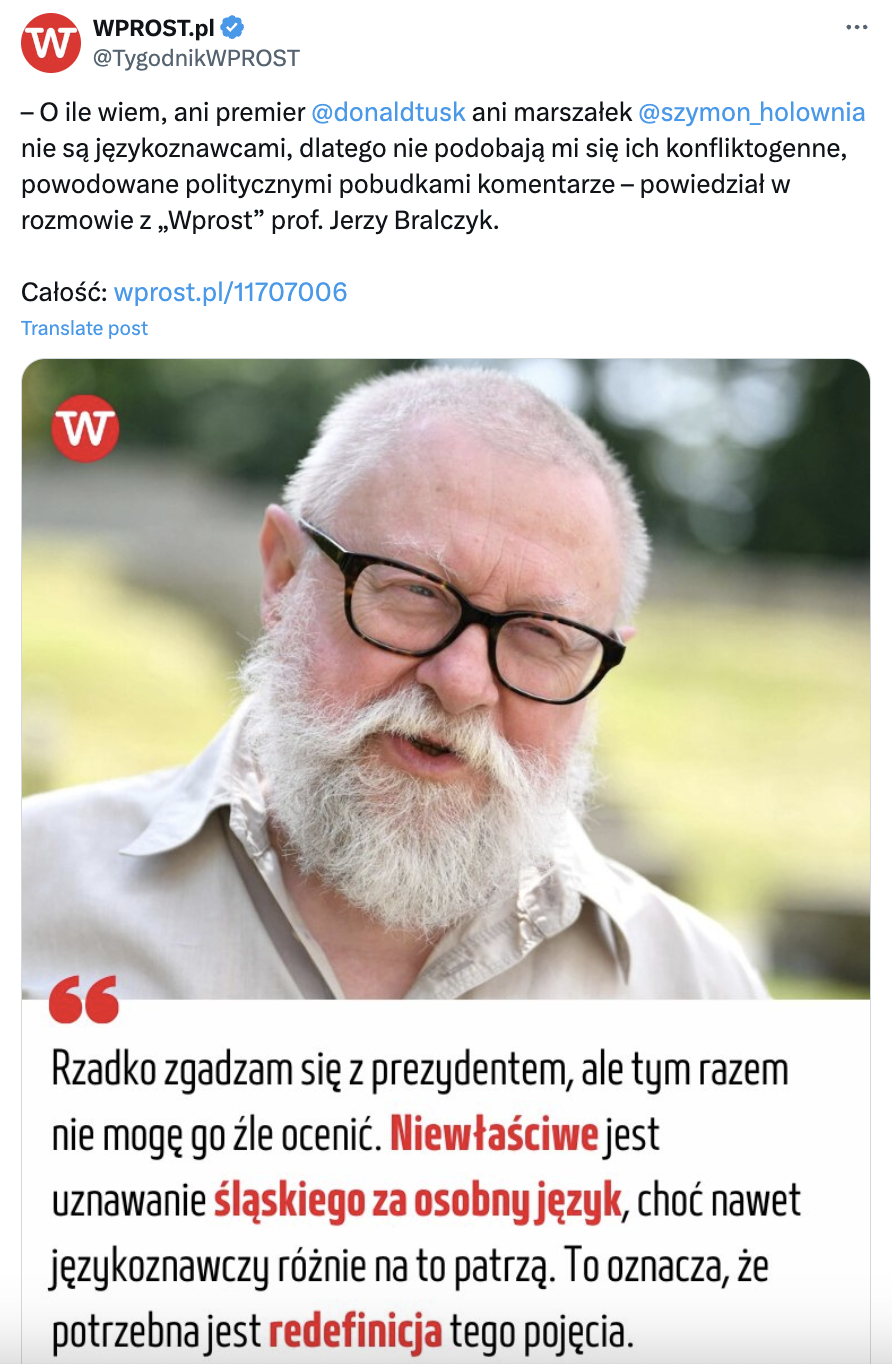
‘As far as I know, neither Prime Minister Tusk nor Chairman Hołownia are linguists, which is why I don’t like their conflict-generating, politically motivated comments,’ Prof. Bralczyk added.
‘There are several understatements and half-truths in recognising the Silesian language as a regional language. First of all, identity issues became the banner for progressive circles, for which the identity topics are not that easy to handle as Silesians are rather more conservative than Polish society overall,’ Michał Muszalik, a member of the Jagiellonian Club (a centre-right think tank), lawyer and poet living in Silesia told British Poles.
‘However, we are aware that this law will be implemented anyway when the next president comes to office,’ Mr Muszalik said.
‘In my opinion, the threat of Silesian separatism does not exist now, because such demands are only made by individuals who encounter a lot of criticism even within the Silesian circles,’ concludes Muszalik.
The idea to grant more recognition for Silesia remains lively amongst the Polish political class but it seems that a successful legislation process will need either a new political form or a major change in parliamentary and presidential cast. Nevertheless, the question of Polish national unity will remain an important factor in explaining the problem to the rest of the country.
Tomasz Modrzejewski
Zdjęcie X @KPRP Przemysław Keler