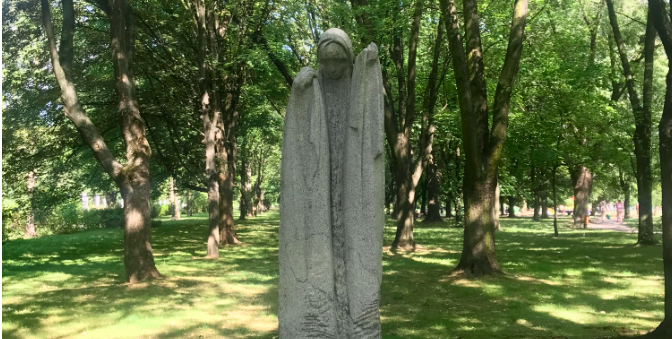
British Poles: The Warsaw Rising Museum has just published a video where you talk about the Monument to a Mother, your sculpture known as ‘the Empty Pieta’ dedicated to mothers who lost their children in Warsaw Rising and during WWII. The monument emanates with meaning as it stands in Warsaw, a city razed by the fury of the war. Can it be understood by people abroad? In the UK or in the States?
Łukasz Krupski: I inscribed intentionally the word ‘Mother’ on the postument in four languages of the four nations that were at war between 1939-1945. ‘Mother’ in Polish, German, Russian and Hebrew. The message of fraternity is salient as we should always remember that any war is fratricide when a son of a mother kills a son of someone else.
Whenever we focus on a mother and her loss, on a mother-child relationship so close to any of us, we become aware of the most painful aspect of any war and its universal character. In this way, the Monument belongs to any place in the world razed by the flames of war.
London was also affected by the bombing and the British sacrificed their lives in the Allied war effort. Here in Warsaw, there was almost no building left standing with 84% of the city‘s architectural substance torn down to foundations. That is where the Monument to a Mother found its place. It is very powerful as could we imagine London affected to such an extent?
Still, a general human dimension is no less important. Thus, the questions about the condition of a man and suffering. These are the most important questions asked by ‘the Empty Pieta’- Mary carrying the empty shroud… When I was sculpting I was immersed in the trauma of my Father’s death who lost his life in a plane crash.
British Poles: Is suffering a vital theme in your creative work?
Łukasz Krupski: Yes. However, a man is the key one. Being conscious of suffering is an important element of a human condition but a man is a multi-dimensional phenomenon. Apart from being aware of evanescence, we are fully immersed in life. It is up to us which path we chose and if we have to face traumatic experiences we cannot escape from suffering.
At the same time, I believe in free will. Isn’t it a wonderful phenomenon to undertake in a work of art? It continuously stimulates the vision of my sculptures. It is present in ‘the Empty Pieta’ as anyone can see in the empty shroud whatever one believes in. For some, this will be death, for others – resurrection, for someone else – a curtain of unsolved mystery. Art should be a mirror we reflect on ourselves in.
British Poles: If a work of art has to be like a mirror, what is the reflection we get of ‘the Monument to a Mother’ so many years after WWII?
Łukasz Krupski: I see in it mothers who take their kids for a walk to a park where the Monument is situated. To the Park that is the Cemetery of Warsaw Insurgents in the Wola District of Warsaw. They walk over mass graves. The very place responds with the message of life as the very city of Warsaw that was sentenced to death in WWII is now a vibrant metropolis. This is the reflection of a human will to live.
‘Historia magistra vitae est’ but the present and the future are more important and I am deeply convinced that if we create a sign of the past it should concentrate on what is to come.
The Monument to a Mother I created was my attempt to face the challenge as to what would be a golden mean between our remembrance of unthinkable atrocities we had endured in WWII towards forgiveness and reconciliation.
The artist was interviewed by Aleksandra Duda.
Picture: British Poles
Łukasz Krupski website is available here