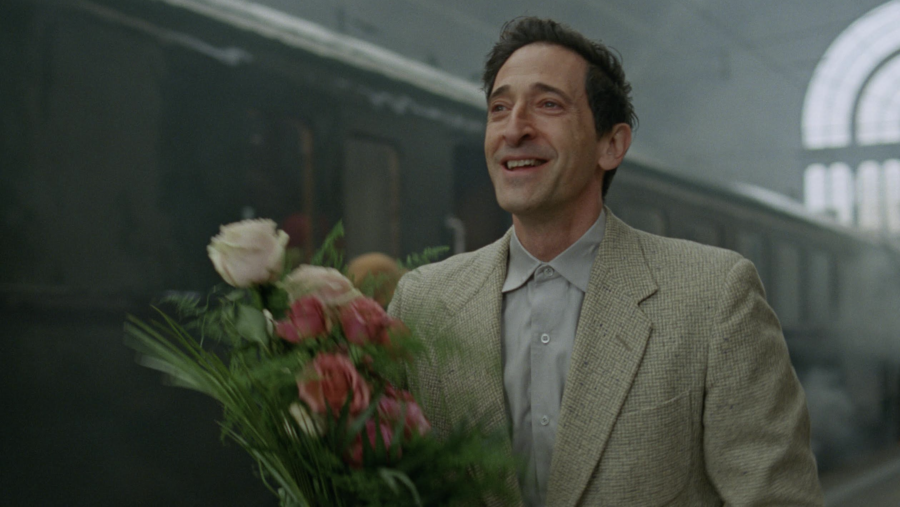
In Brady Corbet’s instant classic (a winner of three Academy awards), Adrien Brody plays a Hungarian émigré architect, László Tóth, who tries to find a sense of life in a new country. He will soon learn that being a self-made American is a lie. In the post-war US, you’re either American or no one.
The Brutalist commences with a portent: when Brody’s Hungarian arrives in the United States, the first thing he spots is the Statue of Liberty. However, the camera’s angle is reversed. It looks like its torch is touching the floor. Now, it’s more like a hanging man than the actual symbol of freedom. We have a feeling that Tóth’s gonna regret coming here.
After trying to find a job in the land of liberty, Brody’s architect soon meets a wealthy businessman, Harrison Lee Van Buren (the fantastic Guy Pearce), who hires him to construct a project in tribute to his late mother. This commission would soon become Toth’s opus magnum; a building, which will be a final test for him. It would prove (mostly to others) if he really deserves to be “American” just like the rest of them, this upper class of ignorants and illiterates.
While watching The Brutalist, we think all sorts of things. It’s an epic film, deeply rooted in its vast storytelling, wide shots, a few plot twists and archetypical motives (rise and fall, the end of romance, class frictions). Thus, comparing it to all those riveting masterpieces from the 1950s and 1960s feels almost inescapable. It’s like a modern East of Eden, only about immigrant experiences, identity and social differences. Even the characters and nihilistic tropes probably (deliberately) refer to Steinbeck’s and Faulkner’s literature. Maybe this is why Corbet’s film, embedded in all these themes from a previous century, seems slightly old-fashioned for most modern viewers.
One cannot forget about an excellent Brody, who is sort of re-interpreting his performance from Roman Polański’s The Pianist (2002). Brody’s acting relies on the same tropes, as he quickly switches between opposite emotions. In one second, he is an ambitious architect believing he found a gold mine; in the other, Tóth is a heroin addict, cruel, weak and destroyed by the system and its human cogs.
The Brutalist has a 15-minute intermission (just how an epic film should be screened!), so people consider it a half-masterpiece, and there is something in it. Corbet’s drama becomes chaotic in its second part, but it’s still something, worthy of experiencing in the best cinema and in your favourite seat.
Photo: Universal Pictures
4/5 stars
Author: Jan Tracz