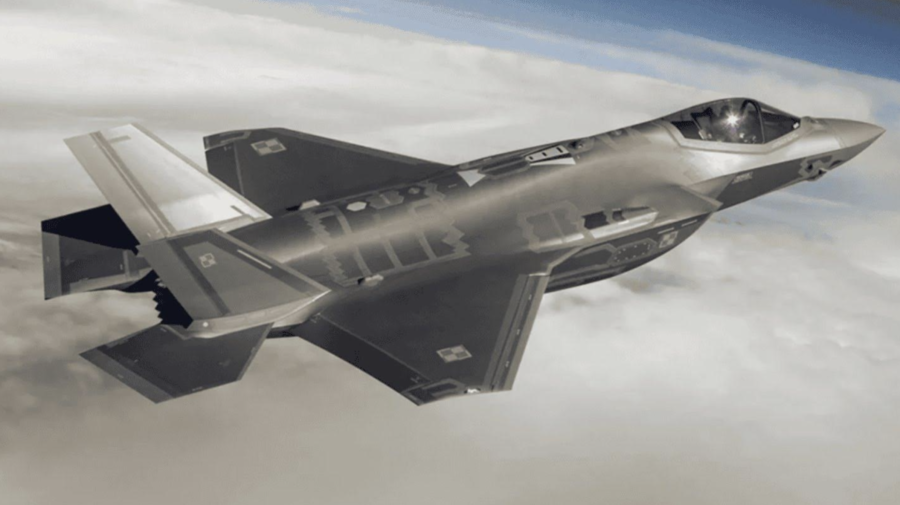
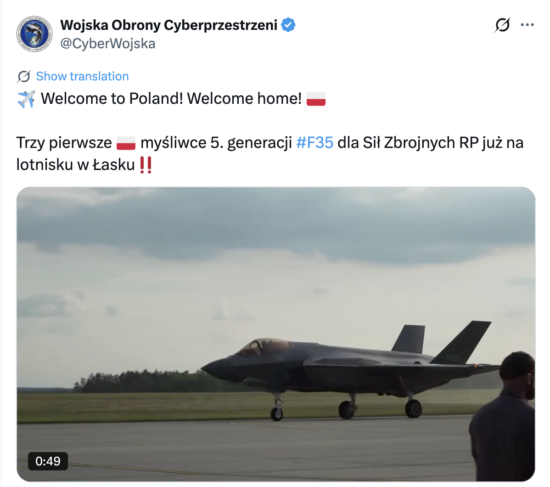
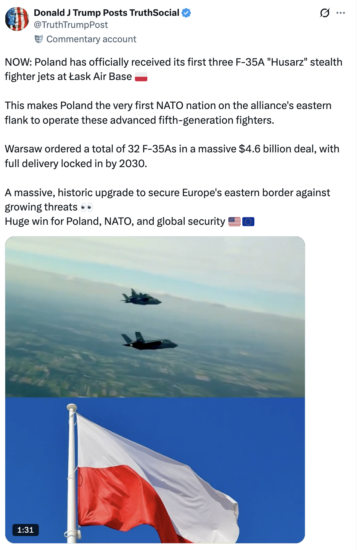
The arrival of Poland’s first F-35 fighter aircraft marks a defining moment in the evolution of the country’s armed forces and signals a profound transformation in the security architecture of NATO’s eastern flank. As the first three fifth-generation fighters touched down at the 32nd Tactical Air Base in Łask, Poland formally entered a new era of air power, characterised by strategic and technological reinvention.
For years, the acquisition of the F-35 had existed largely as a political commitment and a long-term defence ambition. Today, it has become a tangible reality. The aircraft, produced by Lockheed Martin, are among the most sophisticated combat platforms ever developed, combining stealth capabilities, advanced sensor integration, electronic warfare systems, and network-centric operational design. Their arrival fundamentally alters the character of the Polish Air Force and significantly enhances the country’s capacity to operate alongside its NATO allies in high-intensity conflict environments.
Poland’s decision to purchase 32 F-35 Lightning II aircraft under a contract signed in 2020 represented one of the largest defence procurements in the nation’s modern history. The programme, valued at approximately 4.6 billion US dollars, was conceived not simply as a replacement for ageing Soviet-era aircraft, but as a strategic leap into the future of warfare.
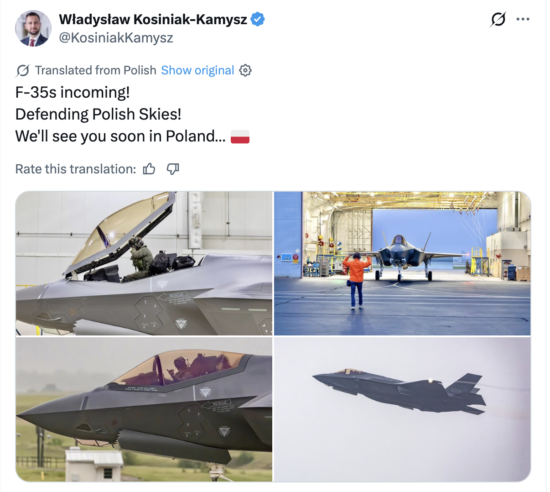
The significance of the programme extends far beyond aviation. Deputy Prime Minister and Minister of National Defence Władysław Kosiniak-Kamysz described the arrival of the aircraft as a moment that transforms the operational capabilities of the entire Polish military establishment. He also characterised the F-35 programme as a powerful symbol of transatlantic partnership, underlining Poland’s increasingly prominent role within the NATO alliance and its deepening strategic relationship with the United States.
The aircraft has been given the name “Husarz”, invoking the memory of the famed Polish winged hussars whose battlefield prowess became an enduring symbol of military excellence and national resilience. The choice is emblematic. Much like their historical namesakes, the new fighters are intended to provide Poland with speed, flexibility, deterrence, and a decisive operational edge in an increasingly uncertain security environment.
The F-35’s greatest strength lies not solely in its stealth profile but in its extraordinary ability to gather, process, and distribute information across the battlespace. Its sensor suite allows pilots to detect and track hostile systems at vast distances while simultaneously sharing critical intelligence with allied forces operating on land, at sea, and in the air. In practical terms, the aircraft functions as both a combat platform and an airborne command-and-control node, capable of integrating diverse military assets into a single operational network.
Its combat capabilities are equally formidable. The aircraft can carry advanced air-to-air missiles such as the AIM-120 AMRAAM and AIM-9X Sidewinder, alongside precision-guided munitions and long-range AGM-158 JASSM cruise missiles capable of striking targets hundreds of kilometres away. Combined with its reduced radar signature, these systems provide the Polish Air Force with capabilities previously unavailable in the region.
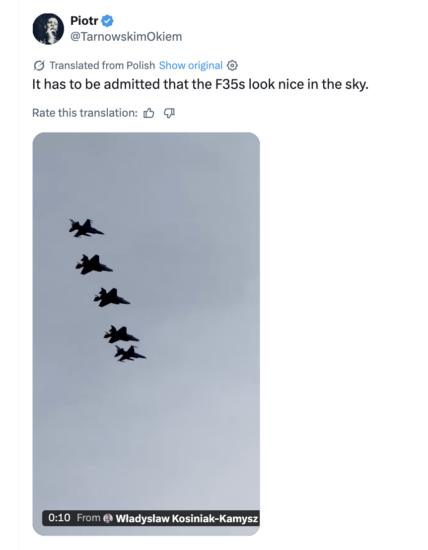
The geopolitical implications are considerable. Poland becomes the first state on NATO’s eastern flank to operate fifth-generation fighters on this scale, strengthening the alliance’s deterrence posture at a time of heightened regional instability. Russia’s invasion of Ukraine has fundamentally reshaped European security thinking, prompting many states to accelerate defence spending and military modernisation. Within this context, the arrival of the F-35 is not merely symbolic; it is a direct response to the evolving realities of contemporary warfare.
Yet the programme is not confined to the aircraft themselves. Considerable investment has also been directed towards pilot training, technical infrastructure, maintenance capabilities, and operational integration with other advanced systems such as Patriot air defence batteries and Abrams tanks. Polish personnel have spent years training in the United States, and the country now possesses its own cadre of qualified instructors capable of preparing future generations of pilots for fifth-generation operations.
The arrival of the first F-35s in Łask therefore represents far more than the delivery of military hardware. It is the visible culmination of a broader strategic transformation — one that reflects Poland’s ambition to become one of Europe’s foremost military powers and one of NATO’s principal pillars of deterrence in the East.
For Poland, the age of the F-35 has just begun.
Photo: X/@Rybitzky
Tomasz Modrzejewski