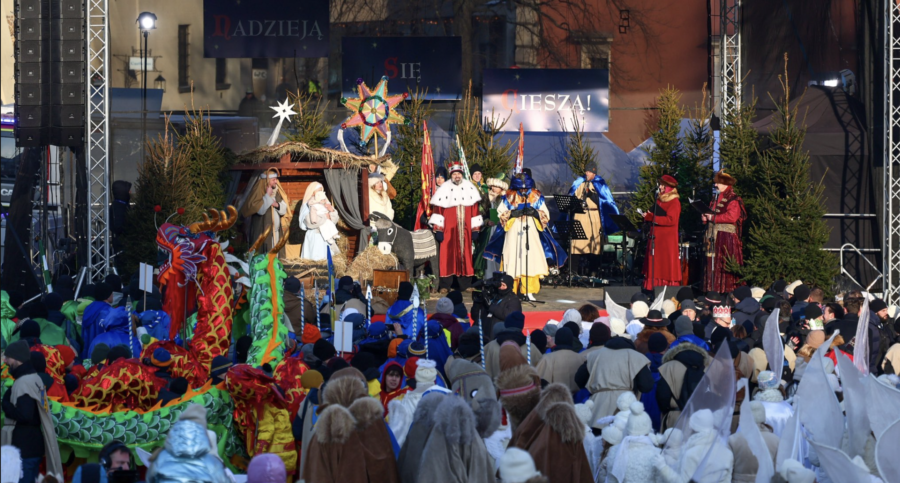
Thousands of people gathered in the heart of Warsaw as the Three Kings’ Procession once again filled the Royal Route with colour, music and prayer. Among the participants were the President of the Republic of Poland, Karol Nawrocki, and his wife, who joined the procession near the Presidential Palace.

This year’s march unfolded under the theme “They rejoice in hope!”, a line drawn from a centuries-old Polish Christmas carol, underscoring the event’s strong connection to both faith and national tradition. The procession began with the Angelus prayer at the Nicolaus Copernicus Monument, where Archbishop Adrian Galbas offered his blessing to the assembled crowd.

Leading the parade was a star-bearer carrying the symbol of Bethlehem, followed by carol singers, folkloric figures, children dressed as shepherds and angels, and finally the Three Kings themselves, travelling with their retinues on decorated vehicles. Each group represented a different continent, accompanied by distinct messages centred on hope, perseverance and following Christ.

Speaking to reporters, President Nawrocki described the procession as a powerful expression of Poland’s enduring Christian identity. He stressed that initiatives such as this one grew from grassroots engagement rather than political decree, reflecting values deeply rooted in society. According to the President, ideals such as love, mercy and respect for others continue to shape the nation, regardless of shifting political landscapes.
“We will walk while saying out loud that Poland is deeply attached to Catholic and Christian traditions, to the revelation of Jesus,” the President told journalists.
He emphasised that events such as the Three Kings’ Procession had from the outset been grassroots initiatives inspired by the public.

“Alongside the beauty of the Polish language and our culture, Christian values, which have accompanied us for over a thousand years, are what constitute our national community, even when those in power do not necessarily cultivate them,” Nawrocki said.

The symbolic culmination of the event took place in Castle Square, where the Kings paid homage at the Nativity scene, offering gold, frankincense and myrrh, traditional gifts representing kingship, prayer and sacrifice. Archbishop Galbas used the moment to reflect on humility and peace, suggesting that a world capable of kneeling before the newborn Christ would be a world marked by greater calm and hope.
In his closing address, the Archbishop encouraged participants to carry their faith beyond the procession and into everyday life. Public witness, he said, should not be limited to festive occasions but expressed consistently through authentic Christian living.
Archbishop Adrian Galbas noted that what an individual can do is bow their head before Christ, recognising in Him Emmanuel, the God who is with us.
“Thanks to this, even though I walk through the darkest valley, I will fear no evil, for I am not alone, for He is with us. From this flows hope. (…) We are free from despair and hopelessness because God is with us, with His love and blessing,” the hierarch said.
He also called for courageous witness to faith in everyday life.
“Just as today we are not ashamed of our faith and go out to show it publicly, so may it be on all the days of this coming year and throughout our lives. (…) Let us go not dressed up as Christians, but as true Christians,” Archbishop Galbas urged.
A message was also delivered from the Secretariat of State of the Holy See, emphasising the theme of hope in connection with the recently concluded Jubilee Year. Special attention was given to families, young people and those who suffer, as well as to missionaries working far from home.
The procession concluded with a traditional polonaise danced to the melody of “God Is Born”, followed by an evening of communal carol singing featuring renowned folk musicians and choirs. As Warsaw marked the Solemnity of the Epiphany, a feast among the oldest in Christian tradition, the event once again demonstrated how faith, culture and public life continue to intersect in contemporary Poland.
The procession took place in hundreds of Polish cities.
Photo: X @warszawa
Tomasz Modrzejewski