In a landmark decision announced today, the UK Supreme Court ruled that the legal definition of a woman refers to biological sex. The judgment marks a decisive intervention in a long-running dispute between Scottish gender-critical campaigners and the Scottish Government, which had sought to include transgender women with gender recognition certificates in its legislative definition of „woman”.
Outside the court building in London, a large crowd gathered in anticipation of the ruling. Many activists held placards bearing slogans such as “Women are adult human females” and “A man cannot be a lesbian.”
A group of women also congregated near the statue of suffragist Millicent Fawcett – a pioneering physician and the first woman to serve as a mayor in England – underscoring the historical significance of the moment.
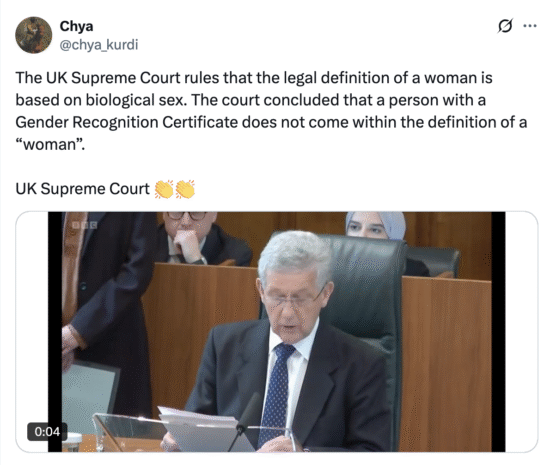
Delivering the judgment, Supreme Court Justice Patrick Hodge stated that the definition of „woman” as outlined in the Equality Act 2010 – which applies across the United Kingdom – is grounded in biological sex.
The judge also stressed that the ruling should not be interpreted as a victory for one side over another. Importantly, he reiterated that transgender individuals continue to be protected under anti-discrimination laws.
A five-judge panel, comprising three men and two women, delivered the unanimous verdict.
There were jubilant scenes inside the courtroom as campaigners from For Women Scotland responded enthusiastically to the Supreme Court’s ruling. The group’s director, Trina Budge, hailed the decision in an interview with The Daily Telegraph, calling it “an absolute victory for women’s rights”.
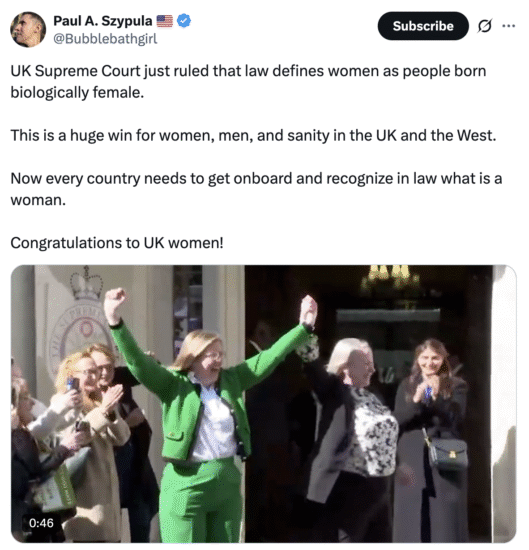
„Today, the judges have said what we always believed to be the case, that women are protected by their biological sex. Sex is real and women can now feel safe that services and spaces designated for women are for women, and we are enormously grateful to the Supreme Court for this ruling,” added Women For Scotland co-founder Susan Smith.
The legal battle began after the Scottish Government passed legislation in 2018 aimed at improving gender balance on public sector boards. Activists from For Women Scotland took issue with a clause in the law that included transgender individuals with gender recognition certificates within the category of “women”.
Importantly, the case did not concern individuals who self-identify their gender without legal documentation, but rather those who hold formal gender recognition certificates. According to Sex Matters, around 8,000 people in the UK fall into this latter category. Under the Equality Act, individuals who identify as a gender different from their biological sex, including non-binary people, are still legally recognised by their biological sex.
Source: BBC, PAP
Photo: @visegrad24
Tomasz Modrzejewski