On 18 November, the Ukrainian government appointed its former ambassador to Berlin, Andrij Melnyk (47), as Deputy Minister for Foreign Affairs. The decision is widely commented in the media. Kyiv’s decision is described as unfortunate at best to scandalous.
Why such a negative reaction? Well, Mr Melnyk recently made the headlines for having openly expressed his admiration for the Ukrainian war criminal and Nazi collaborator Stepan Bandera during an interview with German journalist Tilo Jung, while serving as ambassador in Berlin.
https://twitter.com/dw_politics/status/1594697514137096193?s=20&t=SnI2LMsMz4yhAU8hxmeq3g
The Ukrainian politician defended Bandera’s antisemitic and anti-Polish stances and denied the slaughter of Polish civilians in Volhynia by questioning the historical sources.
In a show of ignorance or ill will, he argued that Bandera “Bandera was not a mass murderer of Jews and Poles” as “there is no evidence for that.” It’s worth reminding that Bandera coordinated atrocious massacres of thousands of Poles and Jews in Volhynia and eastern Lesser Poland during WWII.
Melnyk even stated that Poland was “a similar enemy of Ukraine” in the 1940s, as were Nazi Germany and the Soviet Union. In an interview with RMF FM, the head of the Polish presidential Office for Foreign Affairs, Jakub Kumoch referred to this statement as “absolutely scandalous”.
The outrage was preceded by surprise, given the fact that Melnyk was recalled from his post as ambassador shortly after his controversial comments back in July.
https://twitter.com/MelnykAndrij/status/1593912275135614980?s=20&t=QEB1rJId21BdOY6H_dEQrQ
Melnyk’s appointment shocked the entire Polish political scene, from left to right. Deputy Speaker of Parliament Piotr Zgorzelski (PSL), referred to the recent nomination as “a stab in the heart of the families of the victims of Volhynia.”
Poles were not the only ones to react negatively after learning the news. The Israeli Embassy in Germany had already accused the Ukrainian Ambassador of minimising the Holocaust following his controversial remarks.
„The statements of the Ukrainian ambassador are a distortion of historical facts, a trivialisation of the Holocaust and an insult to those who were murdered by Bandera and his people,” the Israeli embassy in Berlin wrote on Twitter.
Kyiv’s decision to nominate such a controversial figure to a diplomatic position raises many questions, especially given the timing of such a nomination. Indeed, the decision was made just days after the tragic Przewodów tragedy on 15 November, which killed two Poles.
Other examples of questionable decisions include the recent removal of the Turul statue of the Munkács Castle, a historic monument celebrating 1,000 years of Hungarian presence in the Carpathian Basin, today on Ukrainian soil.
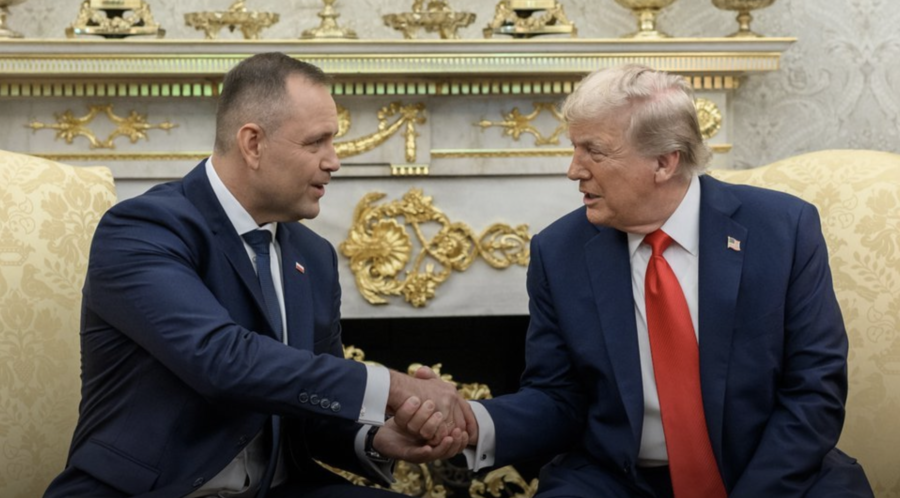
Image: Twitter (MelnykAndrij)
Author: Sébastien Meuwissen