Renowned composer and pianist Władysław Szpilman survived the Warsaw Ghetto, the Warsaw Uprising, and the harrowing post-uprising period, during which he spent several months hiding among the ruins of the city. His story under German occupation became the basis for the Oscar-winning film The Pianist, directed by Roman Polański.
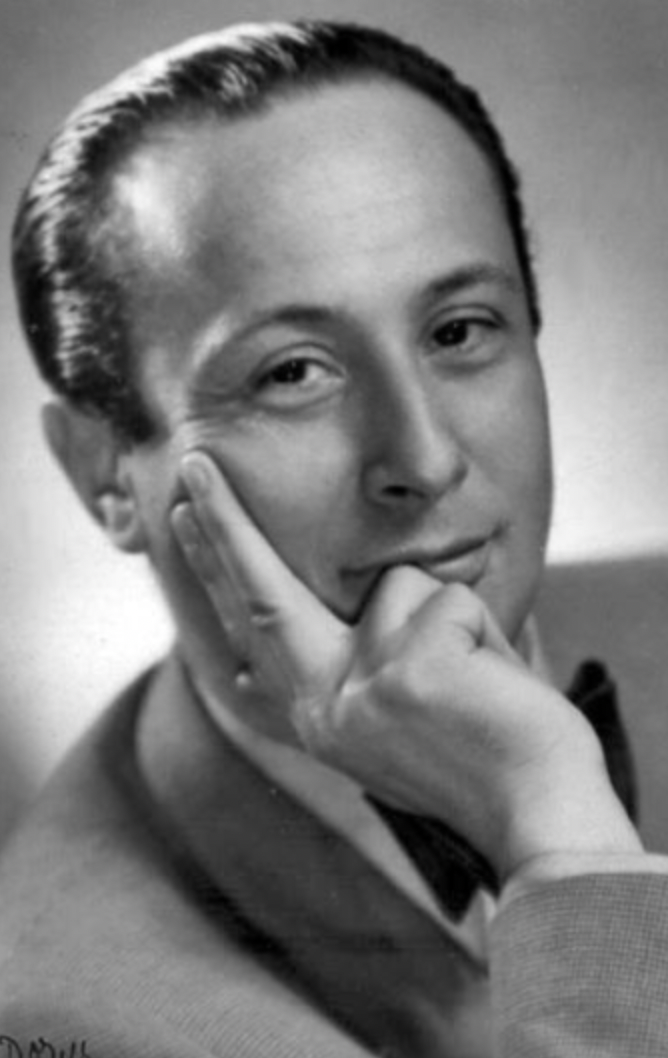
Szpilman was born on 5 December 1911. From an early age, he studied at music schools, strongly encouraged by his parents—his father was a violinist, and his mother a pianist. Before the war broke out, he performed in concerts and composed popular, film, and radio music, as well as scores for musical comedies.
On 23 September 1939, during the siege of Warsaw, Szpilman gave a live recital of Chopin’s music on Polish Radio. The broadcast was cut short due to a power outage caused by German bombs hitting the Powiśle power station.
In 1940, Szpilman and his entire family were forced to move into the Warsaw Ghetto. He played piano in cafés to support them. Tragically, in August 1942, his parents, brother, and two sisters were deported to the Treblinka extermination camp. Szpilman survived after being pulled from the Umschlagplatz by a Jewish policeman who recognised him as a musician. After 1942, he worked as a construction labourer. Just before the outbreak of the Warsaw Uprising, with the help of friends, he escaped to the so-called Aryan side of the city, where he remained in hiding. Among those who sheltered him was composer Witold Lutosławski.
After the uprising fell, Szpilman became one of the so-called „Robinson Crusoes of Warsaw”—hiding in the deserted, systematically looted and burned city, west of the Vistula River. In the ruins of a burnt-out building, he was discovered by Wehrmacht officer Wilhelm Hosenfeld, who began helping him by providing food, clothing, and newspapers. Szpilman survived in hiding until the arrival of the Red Army in Warsaw. After the war, Hosenfeld was taken prisoner by the Soviets. Despite Szpilman’s efforts to secure his release, Hosenfeld died in a camp near Stalingrad in 1952.
Szpilman wrote about his wartime experiences in Death of a City (1946), which later formed the basis for Roman Polański’s critically acclaimed film The Pianist (2002). When his son Andrzej once asked him, “What kept you alive in the rubble of Warsaw?”, Szpilman replied, “Music. Only music.”
After the war, Szpilman married Halina Grzecznarowska, with whom he had two sons, Andrzej and Krzysztof. He resumed his career as a performer and composer, playing solo and with chamber orchestras in Poland and around the world. He also worked for Polish Radio, and was the founder, co-organiser, and director of the orchestra of the Sopot International Song Festival. He composed music for radio dramas, children’s songs, recitals, and theatre productions. He wrote over 500 songs, more than 150 of which became hits performed by the most popular artists of the time.
During the political thaw of October 1956, Szpilman spearheaded the reactivation of the Association of Authors and Composers (ZAiK, dissolved in 1948), under the new name the Polish Association of Authors and Composers (ZAKR), serving as its president until 1961. He was awarded the Gold Cross of Merit, the Knight’s Cross, and the Commander’s Cross with Star of the Order of Polonia Restituta.
From 1967 onwards, the Security Service (SB) monitored Szpilman, suspecting him of anti-state activity and sympathies with Zionist circles. His comments on Israel were meticulously recorded by the secret police.
Władysław Szpilman died on 6 July 2000. He is buried at the Powązki Military Cemetery in Warsaw.
Source: Institute of National Remembrance (IPN)