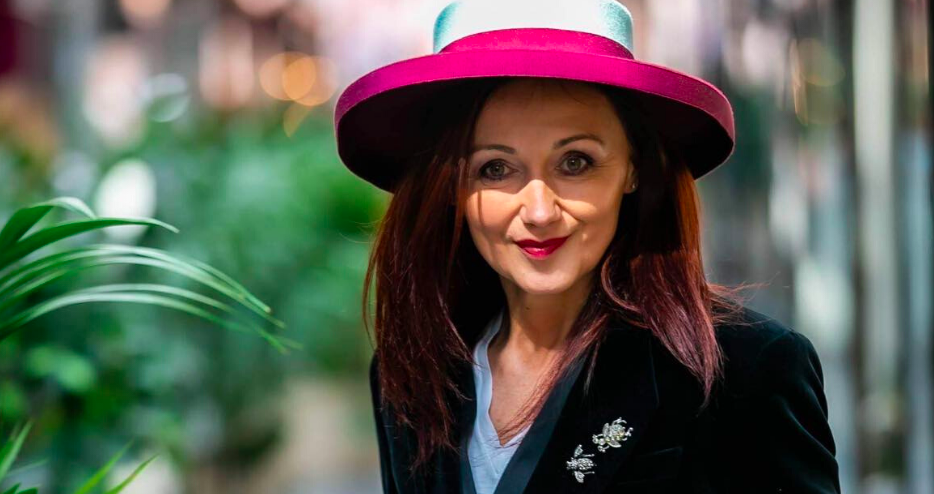
Monika Ciesiełkiewicz is a Polish milliner who worked for several years for the most renown hat designer in the world: Philip Treacy. She creates hats for royal families and stars such as Lady Gaga, Kate Moss or Tina Turner.
British Poles contacted her to offer its readers an exclusive interview with this leading figure of the Polish fashion world.
British Poles: Where does your passion for fashion and hats, in particular, come from?
Monika Ciesiełkiewicz: It started very early for me. I always liked doing artistic stuff, already right after elementary school. At that time I was looking for an art school. It has always been important for me to see the result of my work immediately. I was wondering what was the point for me to go to high school and then study for many more years. And I was thinking: when will I see the effect of this work? Back then already, I hated waiting.
One day, my mother took me to an old fashion studio with hats. Once I saw this whole universe, with all these flowers, hats, and all that stuff, I already knew that I wanted to stay there and that I would be doing it for a living. Then I went to a vocational school. It was there that I had an apprenticeship in such a fashion studio.
I know today that going to a vocational school was the best I could do when it comes to this profession. I can’t imagine learning this job in any other way. The only way to do so is through practice from the very beginning. Now, after many years, I know for sure that neither any course nor any YouTube video can replace those many hours of practice. It is necessary to do it yourself, to repeat the same actions again and again, and to learn from one’s mistakes, … Besides, I had the opportunity to work with a woman who, unfortunately, no longer lives, who used to work with traditional family methods passed down from generation to generation. In Polish, the profession I do is called a “modystka”, while in English it is a milliner.
BP: That sounds almost like a “millionaire”.
MC: I have indeed had several funny situations in relation to this (laughs). It happened more than once that someone asked me about my occupation, to which I replied that I am a milliner. It happened for example during my first weeks in London when I did not speak English at all. I remember a strange look some lady once gave me in an employment office. After some time, I wanted to check what was written in the documents and saw that she wrote that my occupation is to be a millionaire! So it was fun. And as I said, it happened many times. Of course, I am not surprised because it is not a very popular profession.
BP: How did your professional career start?
MC: It all started in Kalisz, the oldest Polish city. After some time, I moved to Krakow where I worked for two years and started my fashion studio. Then I met a man who lived in London and that is why I moved here. Unfortunately, only London remained from this relationship (laughs). However, it all turned out great. I was a bit afraid of it, despite the fact that I had a place to live. I didn’t know the language at all. In fact, it was the first time I was in this city and I didn’t know anyone there. But the big plus was that I knew London was a hat paradise. There is no better place in this regard, so I thought it was worth a try.
Here in London is the studio of Philip Treacy, who is a true guru in this field. There is no one above him when it comes to hats. If à classification of the world’s best hat designers was to be made, he would probably be on top. He even made hats a return to favour to some extent. However, he was beyond my dreams. I was thinking about some ways to get in touch with him anyway. I was wondering whether I should go clean at his place or whatever. Just to be able to touch it, to see what it really looks like in his studio (laughs).
During the first three months, I worked in various places. After a while, I decided that I had to try. So I sent some e-mails to fashion studios, including Pillip [Treacy]’s too. A few days later, I received a reply from Phillip’s studio. They told me that they were delighted with the photos of my work and asked me to send them my CV. It was a challenge for me. At the age of 40, I had never written a CV in my entire life! Eventually, with the help of some friends, I managed to create a very basic CV, and it turned out to be sufficient.
BP: Just a few weeks before, you would not have imagined such a scenario, right?
MC: Of course not! In this regard, I would like to share the fact that many people write to me that I am a sort of inspiration for them. Indeed, despite my age, my ill knowledge of the language, and the fact that I had no particular diploma whatsoever, I found myself in such an unbelievable situation. Yet I didn’t have any financial background or any strange connections. It is a good message, especially for young people, showing that it is always possible. It is not worth explaining that you do not have any studies or that you are shy or not. You can always achieve what you dream about.
BP: How did your first encounter with this legend of hat designing look like?
MC: I was invited for an interview, which was a terrifying step for me. On the one hand, I was afraid of it, on the other hand, not so much. I knew that I would go there and take with me some of my works, about which I would anyway not be able to say much about due to my poor English. I also knew that a few days would not be enough to catch with my huge arrears in this regard. Besides, it was some kind of cosmos for me. The very fact of meeting Philip Treacy was an amazing achievement in itself. In a way, it took a lot of the pressure off my shoulders because it was already such a great success to get to know him and possibly see his studio. What more could you want? I thought to myself that once I meet him, I don’t even have to work in his studio.
So I went there and found it very nice. First, I spoke to his production manager. Later he came. He turned out to be a really lovely man. This is a man who works with numerous international stars as well as royal families, and yet I had the impression that he was trying very hard to facilitate this encounter for me. He asked simple questions and spoke clear English. It was a pleasant surprise for me because I thought that I should be the one trying hard here, not him. At the end of the interview, I was informed that I would be accepted for a three-month trial period and that we would see what to do next. It was a complete shock. I got out of there and didn’t believe it was actually happening.
BP: How did this new job look like?
MC: Everything turned out great. We were a group of just a few people working directly with him. I noticed right away that the atmosphere in this world-class studio reminded me of the little studio in which I used to practice. It was a family atmosphere where the boss worked with us, sat among us, sewed, etc. It wasn’t like he was showing us a project, and we were doing it. No. He was with us all the time. His dogs were running around under our feet all around, we often ate together, talking about everything. Of course, there were also difficult moments. Sometimes tears were shedding too, but that’s just like in any family. After three months, they told me that they were very satisfied and that they would be happy to hire me.
Another thing that surprised me was that I was asked to make hats for the royal family to make after just à few weeks. The first hat I made was for Camila Parker-Bowles, the wife of our future English king. I slowly became the person in charge of her hats. At first, my hands were shaking a bit, but with time I got used to it, and it turned out quite well.
BP: Did you have the opportunity to meet some of the stars you were creating hats for?
MC: Yes, that was something I loved from the beginning. Philip often invited these VIPs to his studio so that they could see how we work, what it all looks like. It should be noted here that the creation of these hats is based solely on manual work from start to finish. It is a long process. In fact, the work of a milliner today is similar to what it was a hundred years ago, especially in these exclusive studios. So it is a long and time-consuming process, but it really gives a great effect.
BP: You made hats, among others for Kate Moss, Lady Gaga, Naomi Campbell, Tina Turner, … Which of them did you meet, and which made the best impression on you?
MC: Kate Bush made a great impression on me. She was actually not our client, but I remember her visiting our studio. She radiated such warmth. Not only that, but she approached everyone and talked to them. I’ve always admired her. I felt really honoured to be able to talk to such an artist in private. Another star that impressed me was Tina Turner. When I met her, she looked so beautiful that I found it hard to believe that she was the age of a grandmother.
In addition, we also had the opportunity to meet the Swedish Queen, who was also in the studio personally. There were also Naomi Campbell, Demi Moore and Lady Gaga, whom I had the opportunity to get to know better after one of her concerts, where I went with Philip. I was even invited to her wardrobe, where we drank a glass of champagne together, etc. It was even more fun because I always saw Lady Gaga as someone completely disconnected from the real world. The possibility, give her a hug! Oh, my! It was awesome. It also made a huge impression on me.
BP: What do you do now?
MC: I am currently working on my brand, which will be called Maria Monika. I made this decision because my surname is not particularly commercial and difficult to pronounce. Likewise, I always hoped it would be under my name, but “Ciesiełkiewicz” is both hard to pronounce and to remember. Hence, the name Maria Monika, which refers to my name: in fact, I am Monika Maria.
BP: Thank you for your time
MC: Thank you.
Interviewer: Sébastien Meuwissen
Cover photo: private archives of Monika Ciesiełkiewicz