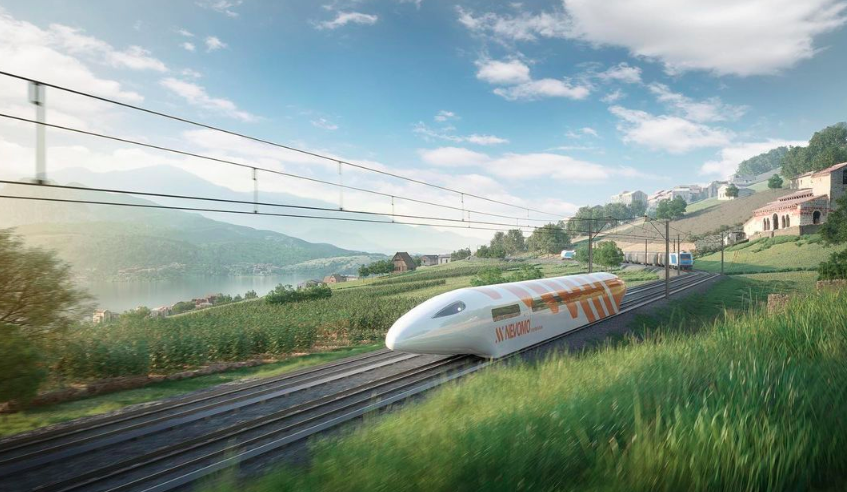
A groundbreaking success in trials for an ultra-high-speed levitating train on a test track in Nowa Sarzyna. Nevomo’s MagRail technology holds the promise of connecting traditional rail systems with the futuristic hyperloop.
Conducted on a test track located in Nowa Sarzyna, a Polish deep tech company has achieved groundbreaking trials for an ultra-high-speed train that utilises levitation technology above the current railway infrastructure. During a press conference held in Brussels, Nevomo revealed the successful results, indicating that their innovative MagRail technology could potentially transform transportation by serving as a connection between conventional rail systems and the futuristic hyperloop solutions often touted as the future of travel.

Throughout tests conducted on a specially constructed track, MagRail vehicles reached speeds of over 135 kilometres per hour across a 720-metre track segment. These vehicles, weighing two tons and measuring six meters in length, began levitating once they hit 70 kilometres per hour and accelerated to 100 kilometres per hour in just eleven seconds.
In the end, MagRail passenger trains are anticipated to attain speeds of 550 kilometers per hour, resulting in a substantial reduction in travel durations.
https://x.com/NEVOMO_tech/status/1701193855117263116?s=20
Przemek Pączek, who serves as the CEO and co-founder of Nevomo, emphasised the significance of these findings by stating – “Today marks a landmark moment in Nevomo’s development. (…) For the first time in railway history, a rail vehicle moved not on the existing tracks, but over them, without friction.”
Expanding on his point, he further stated – “This shows that our MagRail technology is not just a vision for the future, it is a tangible solution for today. A solution for a greener, more connected Europe. (…) By leveraging existing infrastructure, we offer a cost-effective and environmentally friendly approach to modernising rail transport, in line with the European Green Deal’s objectives.”
Sebastian Kaluza, the Director of Product Development at Nevomo, remarked – “The successful tests are the result of the knowledge and hard work of dozens of our engineers and experts. And this is just the beginning. (…) We already collaborate with industry giants, including Rete Ferroviaria Italiana, SNCF, Duisport, and GATX to define various applications for MagRail, and these successful tests are paving the way for pre-commercial operational pilots.”
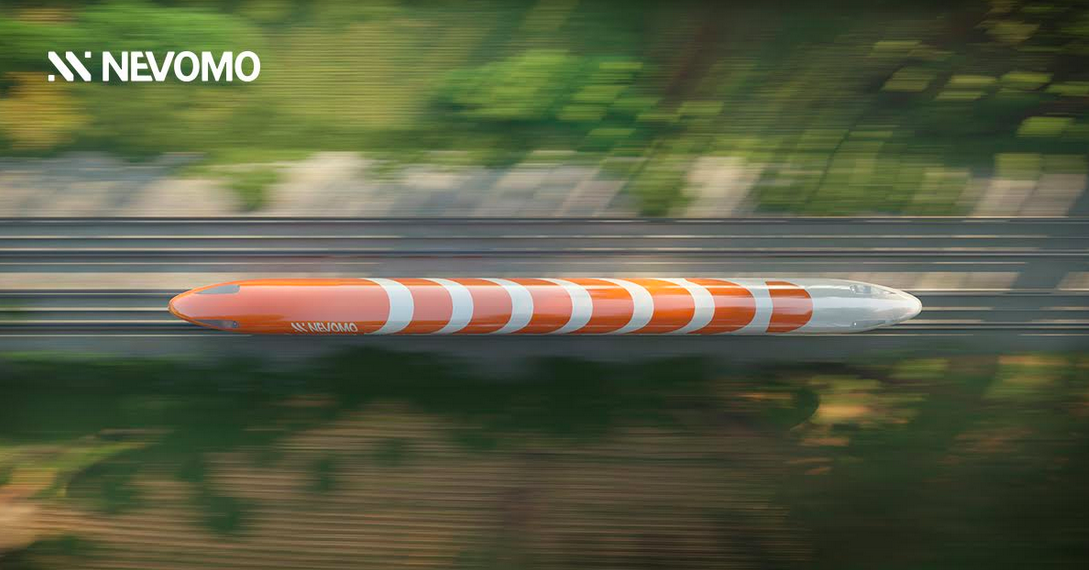
After an extensive three-and-a-half-year research effort, Nevomo’s concept aimed to demonstrate the feasibility of enhancing existing rail infrastructure with linear motor and magnetic levitation components, effectively merging the dependability of conventional rail systems with the possibilities offered by innovative technologies such as Maglev and hyperloop.
This technology offers the potential to revolutionise the rail experience. Instead of adhering to fixed schedules, MagRail trains will function with flexibility, adjusting to demand much like contemporary metro systems do.
Nevomo’s pioneering research suggests that waggons could autonomously adjust the number of carriages per train as required.
According to Nevomo’s engineers, achieving this would entail upgrades to selected sections or entire railway lines, eliminating the necessity to construct entirely new transportation infrastructure.
Nevomo has announced its intention to continue testing various applications before moving forward with the commercialisation of the initial versions of MagRail for freight transport in 2024.
Author: Patrycja Bodzek-Kurzyńska
Photo: Nevomo