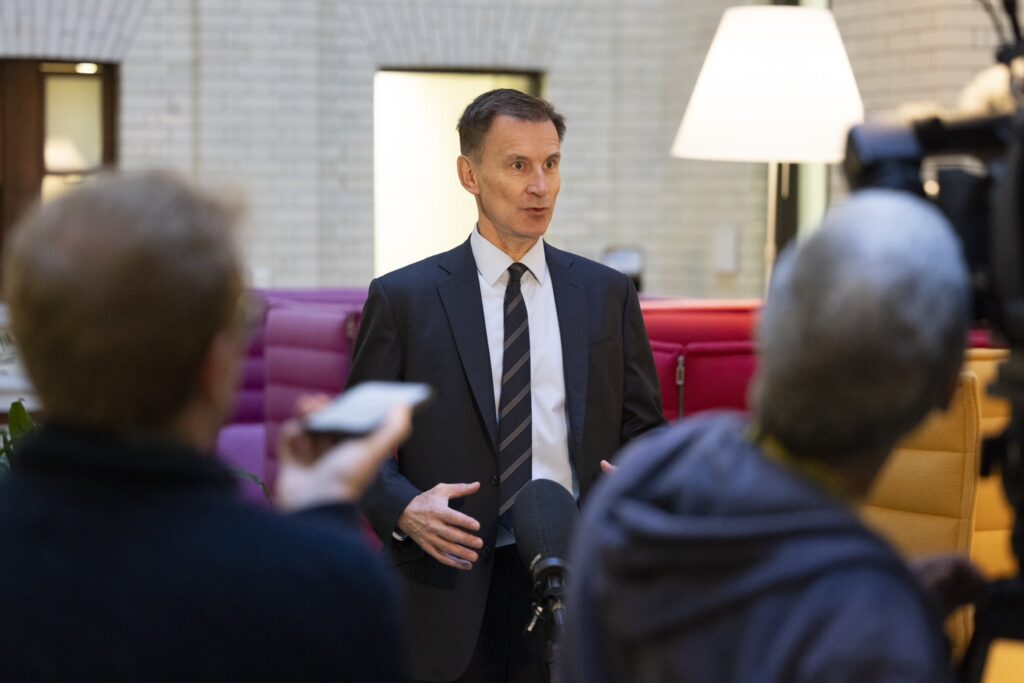
Jeremy Hunt, the UK Chancellor, assured on Sunday that he would demonstrate Britain’s progress toward a „path to a lower tax economy” during the upcoming Autumn Statement.
Hunt expressed confidence in the country’s substantial progress in curbing inflation. He outlined the focal point of his statement, scheduled for Wednesday, as centred on promoting growth, emphasising that lower taxes play a crucial role in establishing conditions for a more robust economy. However, he cautioned against announcing tax cuts that might complicate the Bank of England’s objective of lowering inflation to 2%, down from the October rate of 4.6%.
Jeremy Hunt has downplayed the likelihood of immediate income tax cuts, committing not to take any actions in this week’s autumn statement that could contribute to inflation. Despite this, the contentious idea of announcing an inheritance tax cut on Wednesday, which has the potential to incite a rebellion among Tory backbenchers representing marginal seats in less affluent areas, remains under consideration.
„I won’t implement any form of tax cut that contributes to inflation”.
Hunt declined to comment on what kind of tax cuts there might be in the Autumn Statement.
Shadow Chancellor Rachel Reeves expressed to the BBC that reducing inheritance tax amid a significant cost of living crisis and strained public services is not the appropriate focus. She acknowledged the desire for individuals to pass on their hard-earned assets to their children but emphasised that it is not the right course of action in the current circumstances, and the Labour Party would not endorse such a move.
Labour has provided data, asserting that a cut to inheritance tax would primarily benefit a select few rather than the broader population.
Cutting income tax or national insurance would have a broader positive impact on a larger segment of the population than a reduction in inheritance tax, although the latter is more likely to contribute to inflationary pressures.
During discussions with broadcasters on Saturday, Hunt underscored – „One thing I want to be very clear about: there’s no easy way to reduce the tax burden. What we need to do is take difficult decisions to reform the welfare state and to make public services more productive and more efficient.”
Hunt elaborated on a caution issued last week, stating that individuals receiving welfare who decline to participate with their job centre or reject offered employment may face a reduction or loss of benefits.
„We think it’s fair to say that if you are not engaging with this process at all, if you don’t engage for six months, we are going to close your case and stop your benefits. I think taxpayers would expect nothing less.(…) Anyone choosing to coast on the hard work of taxpayers will lose their benefits.” – Hunt said last week.
Nonetheless, the upcoming official forecasts on Wednesday are anticipated to indicate that Hunt has greater flexibility for providing concessions before encountering challenges with fiscal regulations compared to his annual budget released in March.
„If we’re going to be a dynamic, thriving, energetic, fizzing economy, we need to have a lower tax burden.” – said Hunt adding that the only way to bring personal taxes down was to spend public money more efficiently.
„We want to show people there is a path to lower taxes, but we also want to be honest with people. This is not going to happen overnight.”
Author: Patrycja Bodzek-Kurzyńska
Photo: Twitter/@Jeremy_Hunt