The history of the Silesian industry is commonly associated with overwhelming Prussian influence; however, it appears that among the most prominent builders of its economic prosperity were many aristocrats and investors of non-German origin. One of these figures is John Baildon, who played a key role in creating Silesia’s iron and steel industry.
Silesia was always a bordering region between the conquering powers of Central Europe. Located between Polish, German, Austrian and Czech influence the province slipped from hand to hand in the years preceding the industrial revolution that reshaped its meaning for Europe and the entire world.
When after the so-called Silesian Wars of the 1700s the region became a province of rising Prussia, ruled by the famed Frederick II the Great, it started to turn into an urbanised industry base for the rest of the continent. After 1763 the Prussians wanted to develop the region, reaching Britain in Scotland to find the best industrial technologies of the time.
Before the Prussian era in Silesia, the ironworkers were owned by the magnates, mostly of aristocratic roots who were not particularly interested in developing this industry – as they had various other sources of income. Furthermore, there was a widespread belief that good iron could only come from England or Sweden and that locals were unable to produce high-quality steel. Between 1786 and 1806, the number of coal mines increased from 48 to 112 throughout Silesia.
At that time Prussia was still a rather poor country, with most of its European potential located in an excellent army. It was soon to be changed by its economic development, and that especially concerned the mining and steel industry of Silesia.
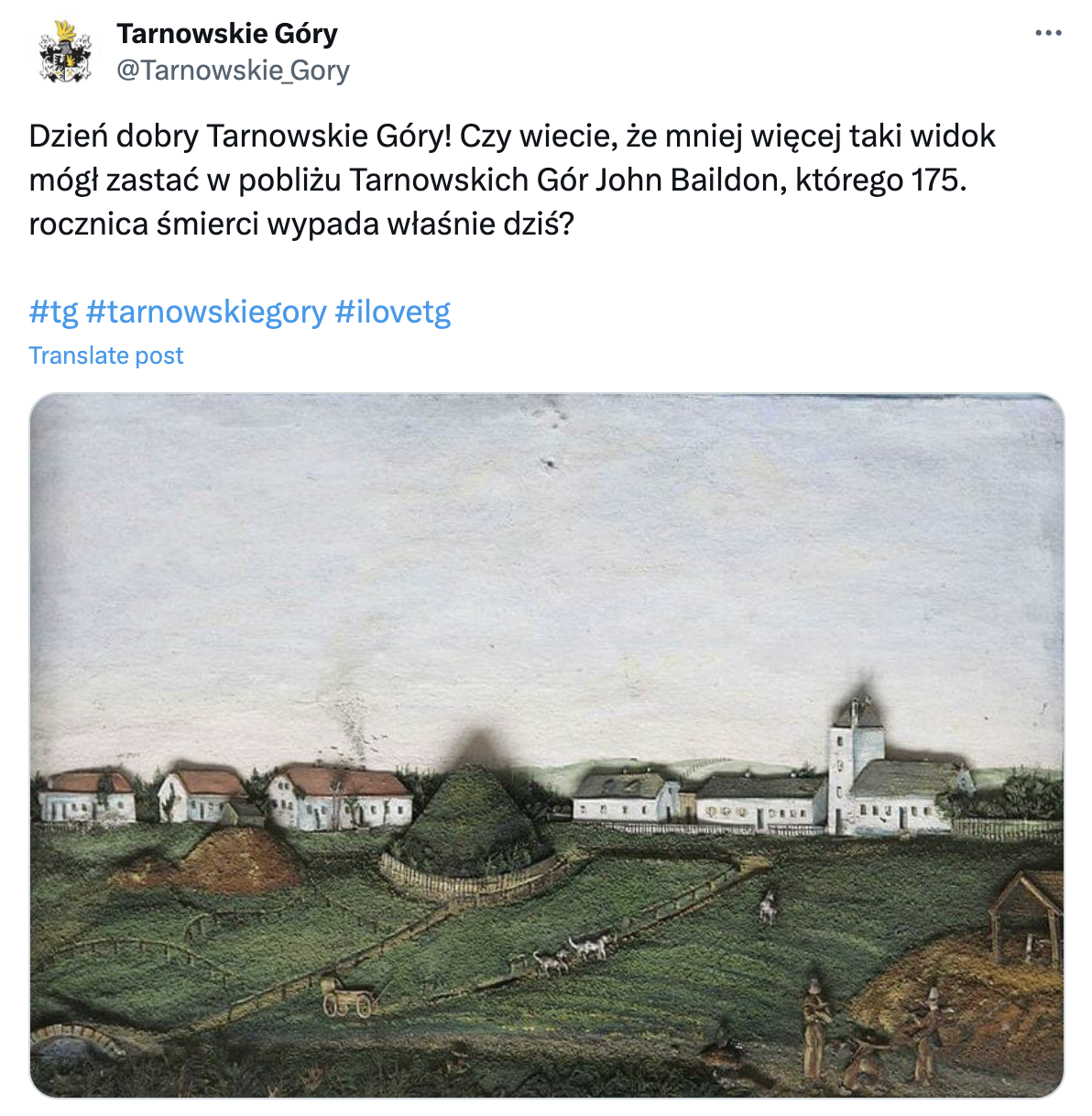
John Baildon was born in Larbert, in Falkirk, Scotland in 1772. His family is deeply connected to the steel and iron industry. John’s father, William Baildon (1736-1820), came from an old Baildon family that had lived in the village of Baildon in Yorkshire, near Bradford, since the 12th century. It is not exactly clear when the family moved to Scotland.
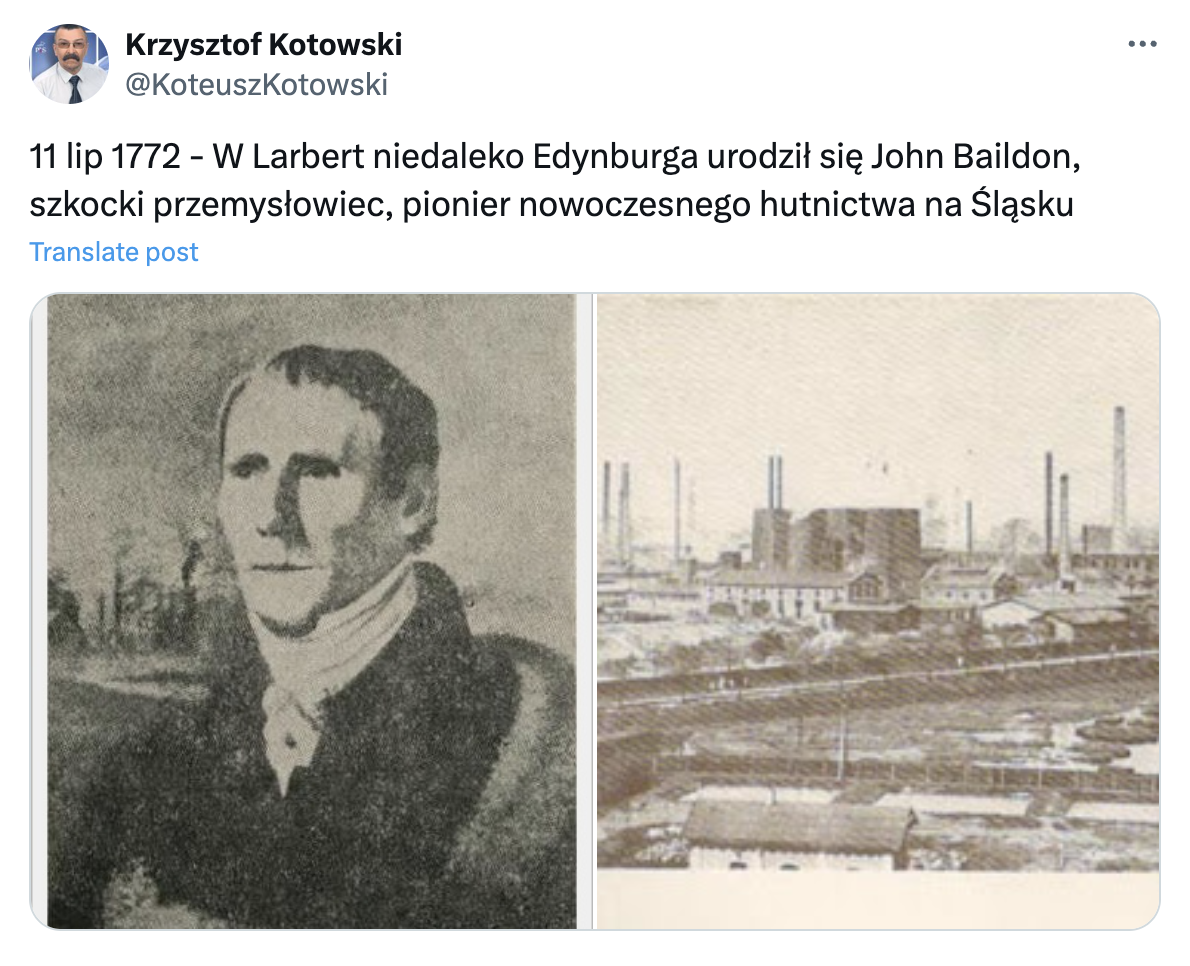
John spent his youth studying mechanics, hydraulics and technical drawing and thanks to his family experience, started to sink in the iron processing and foundry technology.
At that time he made possibly the most important acquaintance of his life. At the age of 17, he met Friedrich von Reden, a mining industry official in today’s Wrocław, who was soon to become the economy minister for Upper Silesia.
In 1793, at the invitation of Von Reden, he came to Silesia to work as a technical assistant during the construction of King’s Ironworks in Gliwice. Beldon was well regarded as an engineer thanks to his famous science mentor, John Smeaton. Baildon’s main task was to design and supervise the construction of a coke-fired blast furnace. Built by Baildon, according to a project by Ephraim Ludwig Abts, the blast furnace was the first of its kind on the European continent.
He was later engaged in many other infrastructural projects, but the most important was still to come.
In 1799, based on von Reden’s idea, Baildon and Wedding drew up technical designs and cost estimates for a new steelworks on the site of present-day Chorzów, which was renamed the Königshütte. Commissioned in 1802, it was the most modern steelworks in Europe at the time.
In 1823, he established a joint stock company with exclusively non-aristocratic capital, which built the Baildon Steelworks on the border of today’s Katowice. The constructed industry site was the 2nd of this type in the entire European continent.
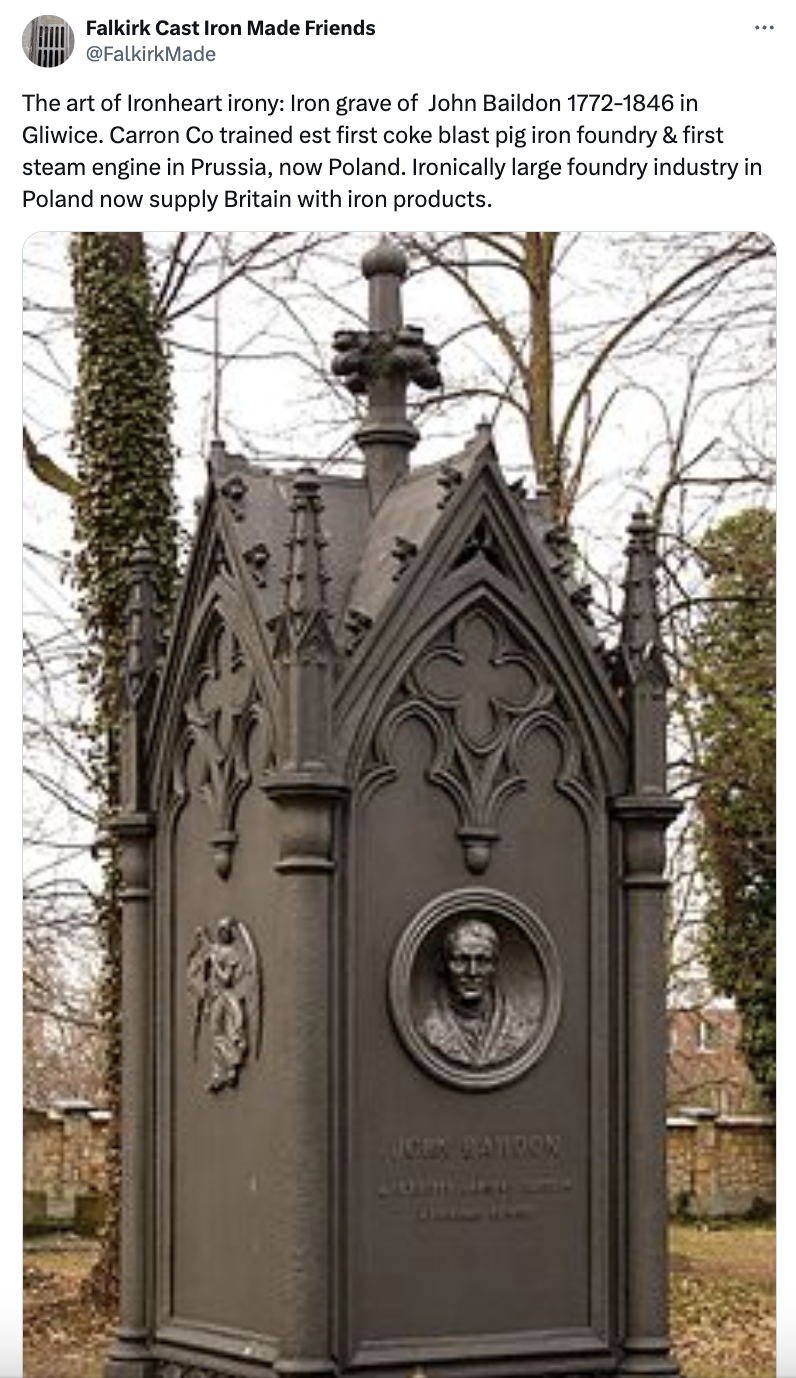
John Baildon died at the age of 74 in 1846 in Gliwice. He was buried in the Metallurgical Cemetery in Gliwice. His impact on the local industry and his key role in spreading the iron industry technology is still remembered in Silesia and remains important for the region’s history.
It is also important to understand that John Baildon personally made maps of the mining facilities and industrial designs. No other investor in Silesia, apart from Karol Godula (the Silesian self-made industrial magnate), was able to do this work by himself.
Source: PTTK Baildon Katowice
Photo: @Grubiusz
Tomasz Modrzejewski