80 years ago the Soviet soldiers of the 1st Ukrainian Front liberated the Auschwitz-Birkenau camp. About 7,000 prisoners, including 500 children survived and saw their liberation. To add to the tragedy, freedom from certain death was brought to them by another, Stalinist-communist, totalitarianism that occupied Poland and Central Europe for another 40 years.
Before World War 2 the German concentration camps, like Dachau, were a tool for isolating and exterminating the German anti-Nazi opposition and other social groups.
During the war, they turned into an instrument of terror, exploitation of the workforce and the implementation of the genocide programme of Jews and the conquered nations of Europe, and a place of criminal medical experiments.
Auschwitz-Birkenau was the largest Nazi German concentration and death camp. During its existence, the Germans exterminated at least 1,1 million people in the camp, including some 960,000 Jews, more than 70,000 Poles, some 21,000 Roma and Sinti, 15,000 Soviet prisoners of war and more than 10,000 prisoners of other nationalities.
The Germans established the camp in the spring of 1940 in the areas that were incorporated into the Third Reich after the September aggression against Poland. The camp complex consisted of: Auschwitz I, Auschwitz II-Birkenau and Auschwitz III-Monowitz and more than 40 sub-camps.
Originally, the camp was intended to be the extermination site for Polish intelligentsia and political prisoners. Its first chief was Rudolf Höss. The last commander of the genocidal site was Richard Baer, who was the only person to escape responsibility for his crimes (he died in custody in 1963).
To commemorate the Jews murdered by the Germans during World War II, on 1 November 2005, The UN General Assembly adopted a resolution establishing 27 January as the annual International Holocaust Remembrance Day.
The King reminded his support for the creation of the Jewish centre 17 years ago and his pride in being its supporter and watching its development.
During the commemoration trip to Poland, King Charles III visited the Jewish Community Centre in Krakow’s Kazimierz district, where he met with Holocaust survivors and Ukrainian refugees.
Marian Turski, an Auschwitz survivor and member of the International Auschwitz Council, welcomed those gathered. He said that there are only a handful of people like him left alive.
“By keeping alive the memory of the horrors of the past, we shape our future,” said the British monarch.
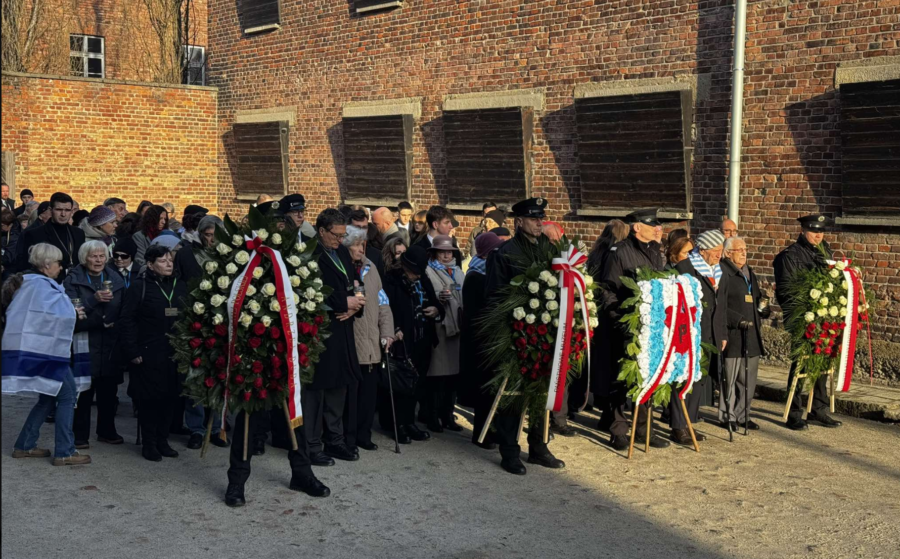
The main ceremony for the 80th anniversary of the liberation took place in the afternoon in a tent set up in front of the historic main gate of the Auschwitz II-Birkenau camp. It was attended by some 3,000 participants
“We Poles, on whose land – occupied by the Nazis – the Germans built this extermination camp, are today the guardians of memory. We continue this mission, which Rotmistrz Pilecki took upon himself voluntarily during the Second World War, who gave himself up here to bear witness, to create a resistance movement, to escape as living proof of what was happening here, to bring this testimony to the Western Allies, to testify to what Nazi Germany was doing to the conquered peoples in the lands it occupied” said President Andrzej Duda at the commemoration at the Auschwitz Camp.
Source: PAP
Photo: @AuschwitzMuseum
Tomasz Modrzejewski