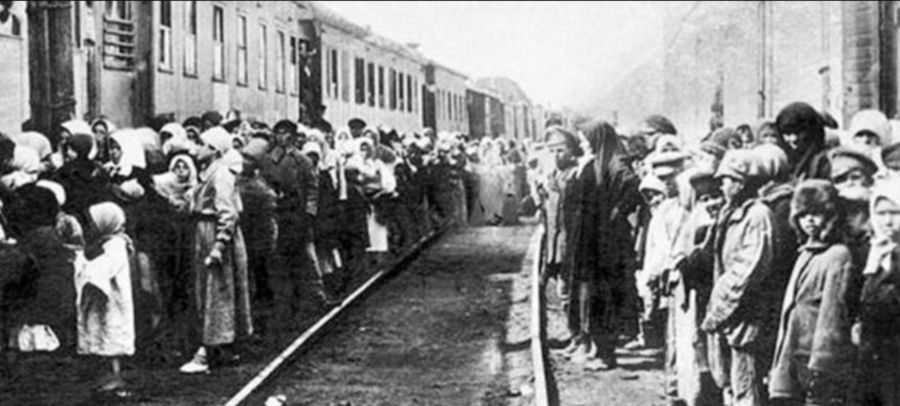
On 10 February 1940, the NKVD and Soviet repression apparatus began the first mass deportation of Poles to Siberia. Around 140,000 Polish nationals were deported deep into the inhumane lands of the Soviet Union. Many of them died already on the way, thousands never returned home. Among the deported were mainly families of military officers, civil servants, forestry and railway workers from the eastern borderlands of pre-war Poland.
As a result of the Soviet aggression against Poland on 17 September 1939, the lands of the 2nd Polish Republic were illegally occupied and annexed into the Soviet Union (the so-called Western Ukraine and Western Belarus).
It was the result of the Stalin-Hitler Pact of August 1939, commonly known as the Ribbentropp-Molotov Pact which created new zones of influence in Central Europe and effectively led to the 4th partition of Poland.
For the Poles, it meant an occupation that was used by all means to sovietise the Polish citizens. For this, the Soviets used education, forcing atheism, and imposing Soviet citizenship.
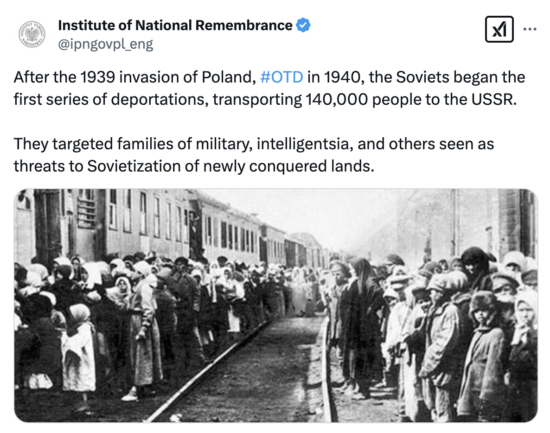
The four deportation waves of 1940-1941 were aimed at the destruction of Polish culture or statehood in the occupied territories (mostly Eastern Borderlands) and their annexation and unification into the Soviet Union. The deportations primarily targeted the Polish elite, which could potentially hamper that process.
The extermination or deportation of the intellectual and cultural elite was therefore an essential condition for the successful Sovietisation and full annexation of the Borderlands.
The first victims of the mass deportations were civilian and military settlers, as well as forest protection workers and their families, around 140,000 people in total. They were deployed in 115 settlements in 21 republics, countries and oblasts around the Soviet Union.
The second deportation, which began on 13 April 1940, involved government officials, policemen, teachers, political activists and landowners. It is estimated that some 61,000 people were deported at that time.
The third deportation action, on 29 June 1940, involved mainly so-called ‘bieżeńcy’, i.e. refugees from the German occupation, two-thirds of whom were Jews. Many members of the intelligentsia, including doctors and scientists. The number of deportees reached around 80,000. They were sent to Siberia, mostly to the Arkhangelsk, Sverdlovsk and Novosibirsk regions, and to the Komi, Mariya, Yakutsk and Altai republics.
The final, fourth deportation began on 20 June 1941 – on the eve of the outbreak of the German-Soviet war. The action targeted families and individuals associated with previously deported population groups. The deportation also included the Baltic republics and Moldova. A total of 90,000 people were deported, including more than 22,000 from so-called Western Belarus which was the name given to the occupied Polish territory.
Source: IPN
Photo: @ipngovpl_eng
Tomasz Modrzejewski