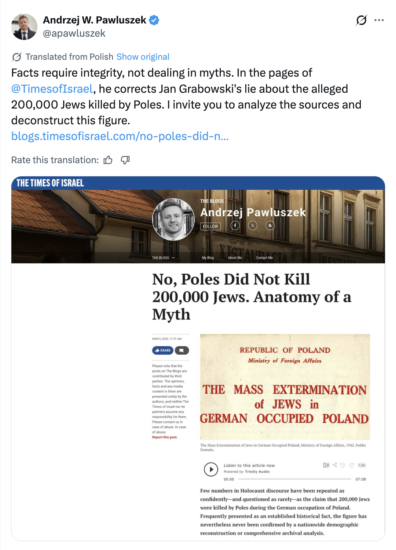
A recent commentary published on The Times of Israel Blogs titled “No, Poles Did Not Kill 200,000 Jews. Anatomy of a Myth” examines one of the most controversial numerical claims in discussions about the Holocaust in German-occupied Poland. The article argues that the frequently repeated figure of 200,000 Jews allegedly killed by Poles lacks a solid empirical foundation and illustrates how historical claims can gain authority through repetition rather than comprehensive research.
According to the article, the figure originates in the work of Polish-Jewish historian Szymon Datner. In 1970, Datner estimated that roughly 200,000–250,000 Jews escaped from ghettos during the German occupation of Poland. Of these, he suggested that around half might have died due to a range of causes such as starvation, disease, German manhunts, or violence. Crucially, Datner did not attribute these deaths to Polish perpetrators.
Over time, however, Datner’s demographic observation was allegedly reinterpreted. What began as an estimate of the fate of Jews who had fled ghettos gradually evolved in some public discussions into the claim that Poles themselves killed 200,000 Jews. The author of the blog post argues that this transformation occurred through repeated citation and simplification, eventually giving the figure the appearance of an established historical fact.
The commentary stresses the broader context of German Nazi rule in Poland during the Second World War. Poland was not governed by a collaborationist state but was directly occupied by Germany and subjected to severe terror. Helping Jews was punishable by death, often for entire families, and German authorities controlled the ghettos, deportations and extermination camps that led to the murder of around three million Polish Jews.
This environment, the article argues, complicates attempts to quantify responsibility for individual acts of violence committed by civilians. It also highlights the difficulty of reconstructing the fate of Jews who attempted to survive outside ghettos, often in hiding or while moving through the countryside.
The blog also refers to more recent historical research that examines specific regions rather than the whole country. One example cited is the collective study Night Without End: The Fate of Jews in Selected Counties of Occupied Poland. In nine counties examined by the researchers, 2,574 Jewish victims were documented as having been betrayed or killed by Poles. The author notes that these findings are morally significant but argues that extrapolating them to national-level figures remains methodologically problematic.
The issue forms part of a broader scholarly debate about the behaviour of non-Jewish populations during the Holocaust in Eastern Europe. Historians have documented a wide spectrum of responses among Poles from rescue and solidarity to indifference, hostility, or participation in violence. Many Poles lived under severe German repression, yet instances of denunciation, blackmail, and killings have also been recorded in the historical literature.
Public debate intensified in the early 2000s following works such as Jan T. Gross’s Neighbours, which examined the 1941 massacre of Jews in Jedwabne by local inhabitants and sparked a nationwide discussion about Polish-Jewish relations during the war.
The article’s broader argument is not merely about correcting a number but about how historical narratives are formed. According to the author, the case illustrates how statistics can become widely accepted through repetition and moral resonance even when the empirical basis remains uncertain.
For contemporary discussions about Holocaust memory, Polish-Jewish relations, and historical responsibility, the debate underscores the importance of careful methodological work and transparent use of sources. Numerical claims about wartime violence carry considerable moral and political weight, making rigorous historical analysis essential to avoid oversimplification or distortion of the past.
In this sense, the article contributes to an ongoing international conversation about how the complex realities of the Holocaust, especially in regions under brutal Nazi German occupation, should be studied, interpreted, and remembered.
Source: Times of Israel Blog
Photo: X/@apawluszek
Tomasz Modrzejewski