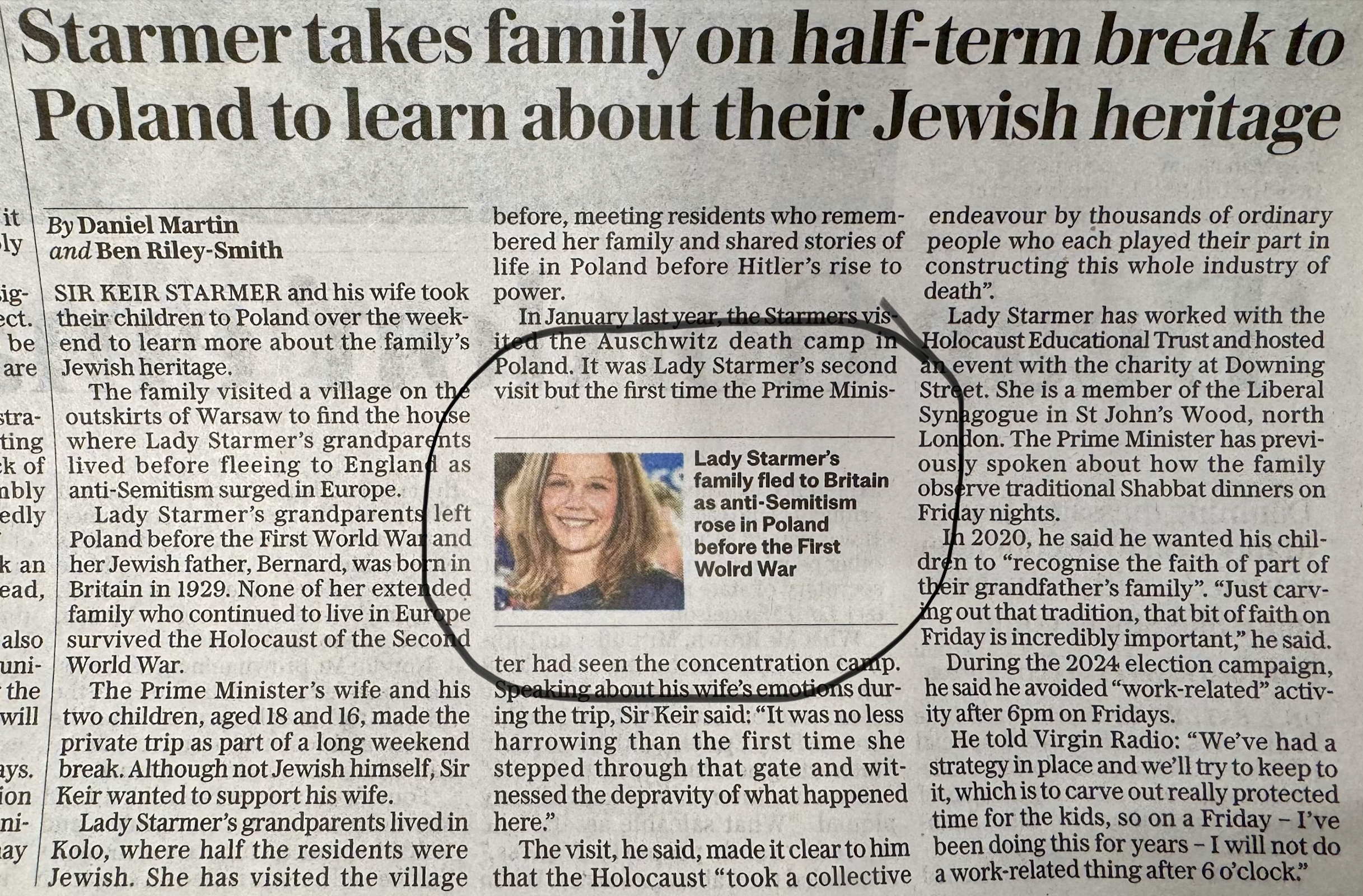
A recent article in the Telegraph informed the British public that the Jewish family of Lady Victoria Starmer left Poland amid growing antisemitism before the First World War. It is important to explain that at the time, Poland was under brutal occupation of the Russian Empire, which prohibited all political and social freedoms to Poles and Polish Jews alike. It seems that what the British and other foreign press sometimes describes as Polish antisemitism is really actions and legislation imposed on Poland by various organs of the Russian Empire that occupied Polish lands until 1918.
From the late Middle Ages onward, the lands of the Polish Crown and later the Polish–Lithuanian Commonwealth constituted one of the most important centres of Jewish life in Europe.
In 1264, Bolesław V the Chaste issued the Statute of Kalisz, granting Jews personal protection, freedom of trade, and legal autonomy. This charter was reaffirmed and expanded by Casimir III the Great in the 14th century and subsequently confirmed by later monarchs.
By the 16th–17th centuries, the Polish–Lithuanian Commonwealth was home to the largest Jewish population in the world. Jewish communities (kehilla) enjoyed far-reaching self-governance, including their own courts and communal institutions. Compared to expulsions in Western Europe (England 1290, France 14th century, Spain 1492), Poland-Lithuania became a safe haven for Jewish refugees.
This historical legacy is crucial when assessing developments after the partitions of Poland (1772, 1793, 1795), when much of Polish territory fell under Russian rule.
After the partitions, millions of Jews became subjects of the Russian Empire, a polity that developed a highly restrictive and discriminatory legal framework toward both Poles and Jews.
Established in 1791 and formalised over subsequent decades, the Pale of Settlement confined most Jews to specific western provinces of the empire, including large parts of former Polish lands. Jews were generally prohibited from residing freely in central Russia, including Moscow and St. Petersburg (with limited exceptions).
The Kingdom of Poland (Congress Poland), created in 1815 and formally linked to the Russian crown, was gradually integrated into this restrictive framework, especially after the failed uprisings of 1830–31 and 1863–64.
Following the assassination of Tsar Alexander II in 1881 (for which Jews were falsely and collectively blamed in public discourse), anti-Jewish violence erupted across the empire. In 1882, under Tsar Alexander III, the government enacted the so-called “Temporary Regulations,” commonly known as the May Laws.
These measures prohibited Jews from settling outside towns and townlets (shtetls), restricted property ownership, and limited commercial activity in rural areas.
Although framed as temporary, these restrictions remained in force for decades and deepened the economic marginalisation of Jewish communities.
The Russian Empire imposed quotas (numerus clausus) on Jewish students in secondary schools and universities, particularly in the 1880s and 1890s. In many regions, Jews were limited to 3–10% of admitted students. Similar informal and formal restrictions affected access to certain professions and public offices.
The imperial secret police, known as the Okhrana, played a significant role in repression and political manipulation.
The Ochrana infiltrated revolutionary movements, labour organisations, and minority groups. In the Kingdom of Poland, it actively monitored Polish independence movements and Jewish political organisations (Bundists, Zionists, socialists).
Figures such as Sergei Zubatov developed strategies of controlled labour organisations under police supervision. At the same time, the secret police cultivated informants and agents provocateurs.
Around 1903, the antisemitic forgery known as the The Protocols of the Elders of Zion emerged in the Russian Empire. Though its exact authorship remains debated, substantial historical research has demonstrated links between its dissemination and circles connected to the imperial secret police.
The text falsely alleged a Jewish conspiracy for global domination and became one of the most influential antisemitic propaganda works of the 20th century.
One of the most tragic episodes on Polish soil under Russian rule was the Białystok Pogrom of June 1906, in the city of Białystok, then part of the Grodno Governorate of the Russian Empire.
Białystok was a major industrial centre with a large Jewish population. In the aftermath of the 1905 Revolution, tensions were high across the empire. Political unrest, strikes, and revolutionary agitation were widespread.
Between 14 and 16 June 1906, anti-Jewish violence broke out, resulting in dozens of Jewish deaths and extensive destruction of property. Numerous historical accounts point to the presence of organised gangs, passivity or complicity of local authorities, and possible involvement or orchestration by agents linked to imperial security structures.
While direct documentary proof of central orders is debated among historians, the pattern of pogroms across the empire often occurring with suspicious coordination and limited state intervention, has led many scholars to argue that elements within the imperial apparatus tolerated or facilitated such violence as a tool of political diversion.
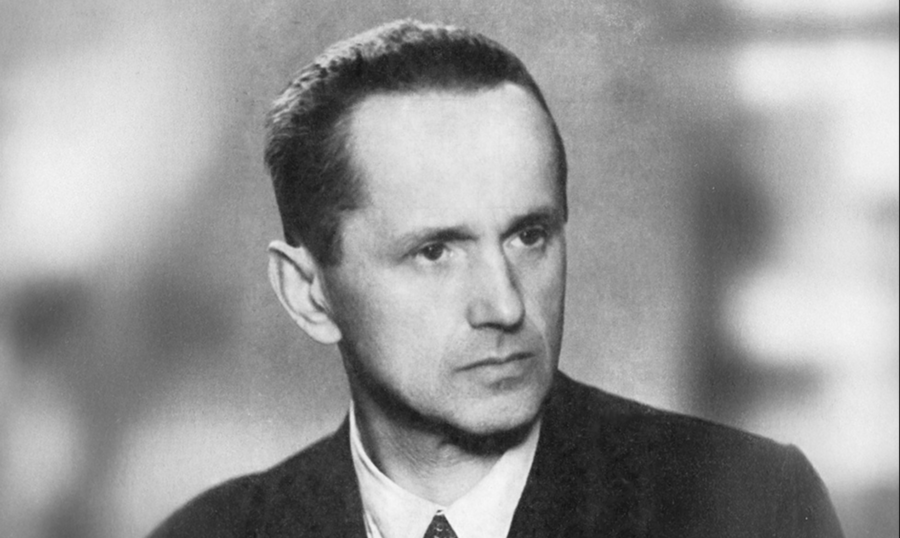
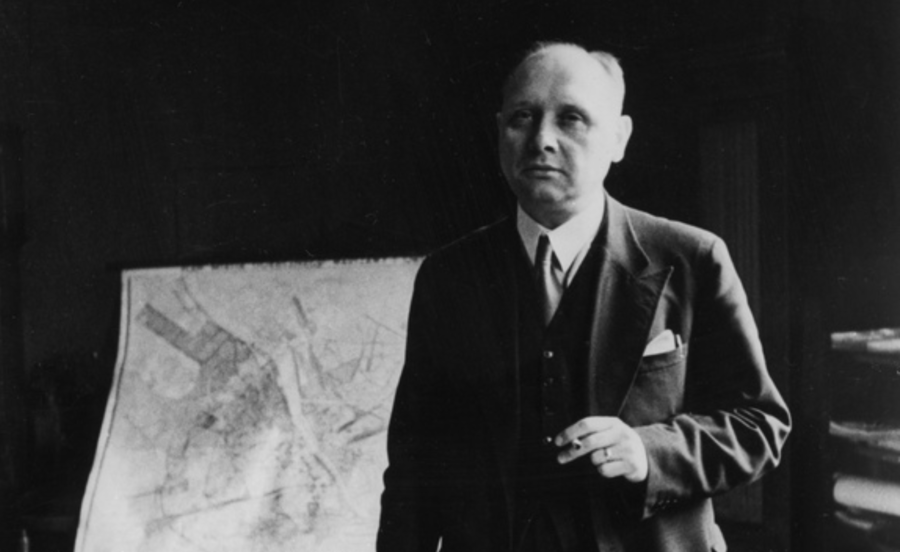
A Polish-Jewish MP, Apolinary Hartglas (often misspelt “Hardglas”), became one of the earliest and most insistent voices arguing that the Białystok pogrom of 14–16 June 1906 was not a spontaneous outbreak of “crowd violence”, but a political operation enabled by the Russian authorities.
At the time, he was not yet a parliamentarian in the Polish sense; he was a young Jewish political activist and publicist who moved quickly to gather facts and reveal the truth that was contrary to the official, Tsarist version of events. The context mattered: Białystok lay inside the Russian Empire’s western borderlands, at the height of revolutionary turmoil, when the state had strong incentives to redirect social anger away from the regime.
Hartglas’s investigation began most practically: by going to the city and collecting testimonies, describing the sequence of events, and documenting the behaviour of police and soldiers. His reportage was published in the Polish-language Zionist press, notably in Głos Żydowski in 1906, and it treated the pogrom as a matter of public accountability rather than communal “misfortune”.
The core of Hartglas’s argument was grounded in observable patterns: the violence, he suggested, had the signature of coordination, rapid escalation at a politically useful moment, a targeted rather than random character, and above all, the failure of state forces to suppress the attacks, despite their capacity to do so.
Contemporary and later descriptions of the pogrom frequently emphasise the participation or tolerance of uniformed men, and the fact that, once underway, the attacks increasingly resembled an organised action rather than a brief riot. Such features were consistent with what critics of the regime elsewhere called “pogrom technology”: violence permitted (or guided) as a tool of intimidation and distraction.
In this framing, “provocation” did not have to mean that every assailant took orders from the secret police; it meant that the state created the conditions, supplied the impunity, and benefited politically. Hartglas pointed to how official explanations tried to shift blame onto local non-Russian groups and onto Jewish “revolutionaries”, thereby deepening hostility between communities and weakening broader anti-Tsarist solidarity.
Accounts of the aftermath note that Russian authorities attempted to portray the pogrom as the work of local Poles, while survivors insisted that many Poles in fact sheltered Jews.
Although Hartglas later became a Polish MP in the interwar Sejm, the importance of his Białystok intervention lies in how early he articulated a state-responsibility thesis: that mass antisemitic violence in the western provinces was managed by an autocratic regime and its security apparatus.
The Kingdom of Poland (Congress Poland), although possessing nominal autonomy after 1815, underwent systematic Russification and a crackdown on all personal freedoms, especially after the January Uprising (1863–64). Russian administrative, legal, and policing systems were imposed.
Antisemitic policies in this region were therefore largely an extension of imperial legislation that included the application of residency and property restrictions, enforcement of educational quotas and police surveillance of Jewish political life.
It is historically significant that modern political antisemitism in these territories intensified in the late 19th century under imperial governance, contrasting with earlier periods of institutional protection in the Polish–Lithuanian Commonwealth.
Source: British Poles
Photo: X/@can_throwaway
Tomasz Modrzejewski