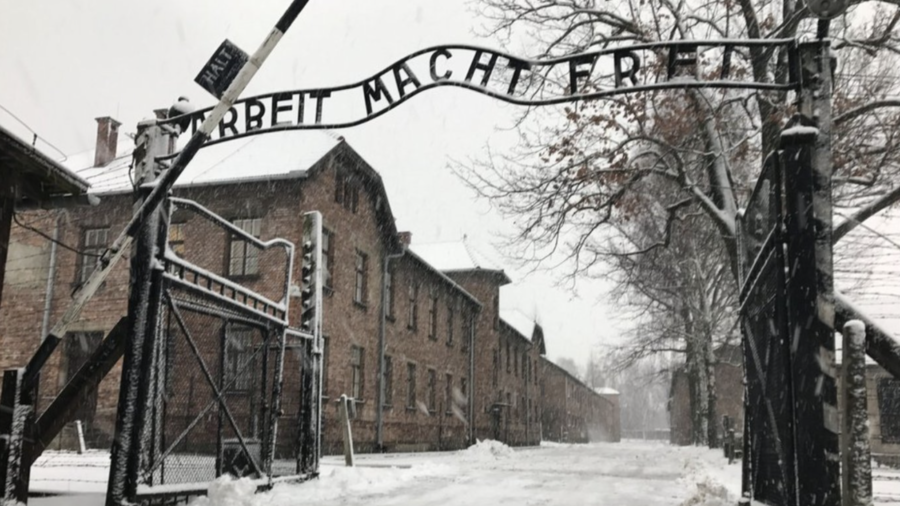
The Polish Supreme Court overturned an appeal court decision rejecting a lawsuit by a former Auschwitz German death camp prisoner against a German news website for the use of the term: ‘Polish death camp’. The appeal court is to review once again whether a Polish court could deal with disturbing cases that still occur worldwide.
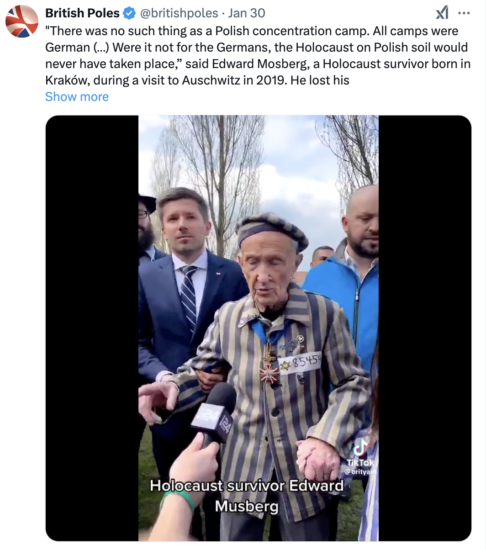
The case for the new legal approach to history distortion was submitted to the court in 2017 when the regional Bavarian portal Mittelbayerische used the term ‘Polish camp’ on its pages about the Treblinka death camp. The president of the Association of Former Political Prisoners of Nazi Prisons and Concentration Camps, former Auschwitz prisoner Stanislaw Zalewski – now 99 years old – felt personally offended by the statement.
His lawyers have filed a lawsuit against the portal’s publisher on his behalf, demanding an apology and a contribution of PLN 50,000 to a social cause.
The German attorneys questioned the right of the Polish court to rule on the case. They pointed out that the trial should take place before the German judiciary. The Court of Appeal in Warsaw decided to send a preliminary question to the CJEU in this case.
The CJEU’s June 2021 ruling implied that a Polish citizen could not pursue a claim before Polish courts for the phrase ‘Polish camps’ in German media if he or she was not mentioned by name in the media.
Now the CJEU’s interpretation was partly questioned by the Polish Supreme Court.
The Polish Supreme Court pointed out that the CJEU’s ruling concerned the issue of the so-called ‘full jurisdiction’, ‘adjudicating on the entirety of the harm and damage suffered’, but did not exclude the consideration by a national court of the harm that the publication may have caused in that particular country.
Judge Roman Trzaskowski noted in the Supreme Court’s order that „there is no doubt the CJEU only addressed the so-called full jurisdiction.”
He pointed out that this did not exempt the appellate court from considering ex officio the possibility of jurisdiction relating to the part of the case concerning possible damage that occurred in Poland.
The controversy surrounding terms like „Polish death camps” stems from their potential to mislead audiences into believing that Poland, rather than Germany, was responsible for establishing and operating extermination camps on Polish soil.
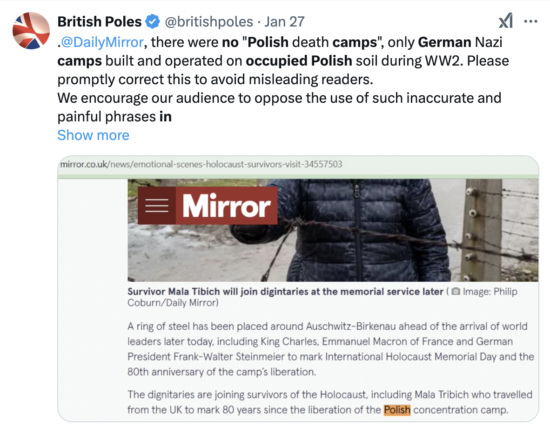
Poland was occupied by Germany during World War II, and the camps were built and managed by the Germans without Polish collaboration.
The Polish government has long contended that such misrepresentations distort historical facts and unjustly implicate the Polish nation in German atrocities.
Supporters of the ruling assert that it is a necessary measure to combat historical inaccuracies and to defend Poland’s reputation on the international stage.
The British Poles always stand on the side of historical truth and keeps defending the good name of Poland. We have successfully intervened in many cases of intended and unintended distortions of history and will continue to do so.
Source: Dzieje.pl
Photo: X @auschwitzmuseum
Tomasz Modrzejewski