The Constitution of 3rd May was a document seeking reform to Poland’s political system, which made it valuable for neighbouring absolutist powers. The new law secured personal freedoms but also extended the King’s prerogatives to lead the nation.
The Constitution of 3 May 1791 marked the crowning achievement of King Stanisław August Poniatowski’s reign—an era largely devoted to attempts at state reform.
Yet its origins run far deeper. As early as the beginning of the 18th century, Polish thinkers had been formulating bold visions for political transformation. Enlightenment-era writers such as Stanisław Dunin-Karwicki, Jan Stanisław Jabłonowski, Stanisław Leszczyński and Stanisław Konarski openly criticised the Republic’s political system, particularly the paralysing liberum veto and the weakness of executive power. In their works, they laid out new concepts for governance, sowing the intellectual seeds that would eventually blossom into one of Europe’s earliest constitutional milestones.
Poland in the 18th century was a shadow of its former self. Already by the late 1600s, the once-mighty Commonwealth had ceased to function as a sovereign power. Under the Saxon dynasty, it slipped into the orbit of Imperial Russia, which cloaked its growing dominance in rhetoric about “eternal guarantees” of liberty and protection. In reality, Polish politics descended into chaos, hamstrung by internal divisions and the paralysing mechanism of the liberum veto, which allowed any deputy to block legislation single-handedly.

The rot was visible to many. “The Polish nation in its final stage of collapse,” declared Monitor, a leading reformist periodical, as early as 1763. The dysfunction became particularly evident during the Bar Confederation in the late 1760s, when an increasingly restive nobility resisted Russian influence, ultimately to no avail.
The First Partition of Poland in 1772 marked a turning point. Though it brought humiliation, it also provoked urgent reflection. The Partition Sejm—now infamous for Tadeusz Rejtan’s dramatic protest—was more than a rubber stamp for foreign aggression. It also gave rise to the Commission of National Education, a pioneering institution seen by many as Europe’s first ministry of education. Four of the Constitution’s key architects had ties to this Commission. Other reformist institutions followed, including the Royal Military School (Szkoła Rycerska), which helped shape a new generation of civic-minded elites.
But Russian oversight remained ever-present. The Permanent Council (Rada Nieustająca), created at Russia’s insistence, acted as a quasi-cabinet intended to curb royal power and block further reforms.
By the late 1780s, the international balance began to shift. The war between Russia and the Ottoman Empire, with Austria drawn into the conflict, diverted attention away from Poland. Sensing an opening, King Stanisław August Poniatowski sought to reassert Polish sovereignty. A Sejm convened in 1788—originally to ratify a Polish-Russian alliance—quickly transformed into something quite different.
A wave of anti-Russian sentiment swept through the nobility. The first decisive act was to abolish the Permanent Council. The Sejm, sitting in confederated form and thus immune to the liberum veto, embarked on an ambitious programme of reform. By the end of 1788, it passed a bill expanding the army from 20,000 to 100,000 soldiers.
Public pressure also mounted. In 1789, the so-called “Black Procession” of burghers took to the streets of Warsaw, demanding equal rights with the nobility. The momentum for reform was unmistakable.

On the evening of 2 May 1791, tensions in Warsaw were reaching a boiling point. Inside the Radziwiłł Palace—today the Presidential Palace—the final draft of the Government Act was read aloud to leading reformers. Just across the city, in the residence of Russian ambassador Yakov Bulgakov, their opponents were plotting. Fearing that Russian-backed agents were preparing to derail the process, the reformers decided to act fast.
Originally, the vote on the Constitution had been scheduled for 5 May. But that would be too late.
At daybreak on 3 May, the Sejm convened in the Royal Castle under heightened alert. Carefully selected diplomatic reports were read aloud, painting a dire picture: Poland, the deputies were warned, stood on the brink of another partition. The sense of urgency was palpable.
One of the Constitution’s leading authors, Ignacy Potocki, turned to King Stanisław August Poniatowski and made a dramatic appeal: “Reveal to us your intentions for saving the fatherland.” The King’s answer was equally decisive: the time had come to adopt the great reform.
The Assembly moved swiftly. Without delay, the deputies voted to pass the Government Act. The King took an oath to uphold the new Constitution, declaring: “I have sworn to God—I shall never regret it.”
But the test of that promise would come sooner than expected, as the events of 1792 would reveal.
While debates raged inside the Castle, outside its gates, a very different scene was unfolding. Crowds had begun to gather in Castle Square, where the Warsaw garrison—under the command of Prince Józef Poniatowski—stood guard to ensure security.
That evening, in a solemn and symbolic gesture, the deputies led by Marshal Stanisław Małachowski processed to the nearby Cathedral of St John to swear an oath to the new law. The King, concerned for his safety amid the crowd, made his way to the cathedral via a private passage linking it to the Castle.
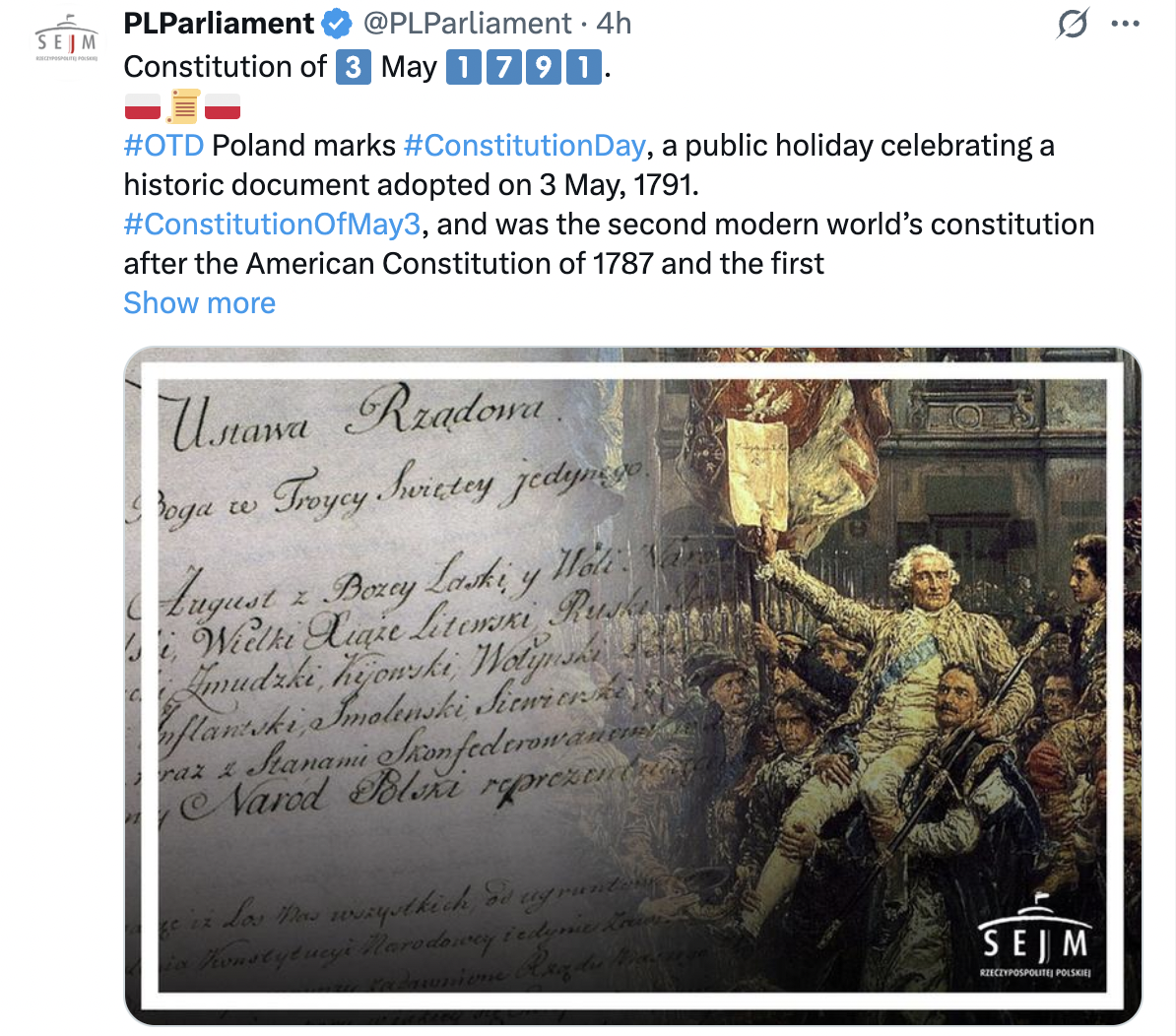
Jan Matejko’s famous painting, The Constitution of 3 May 1791, immortalises this moment—but with a twist. In his dramatic vision, the artist depicts the King boldly pushing his way through a jubilant crowd outside the cathedral—a scene more poetic than factual, but no less powerful in its symbolism.
Unfortunately, the reformist spirit in Poland was put down by another Russian intervention, which led to the final partition of Poland between Prussia, Russia and Austria.
Source: Dzieje.pl
Photo: Painting The Constitution of 3 May 1791 by Jan Matejko, 1891, Royal Castle in Warsaw. Public domain
Tomasz Modrzejewski