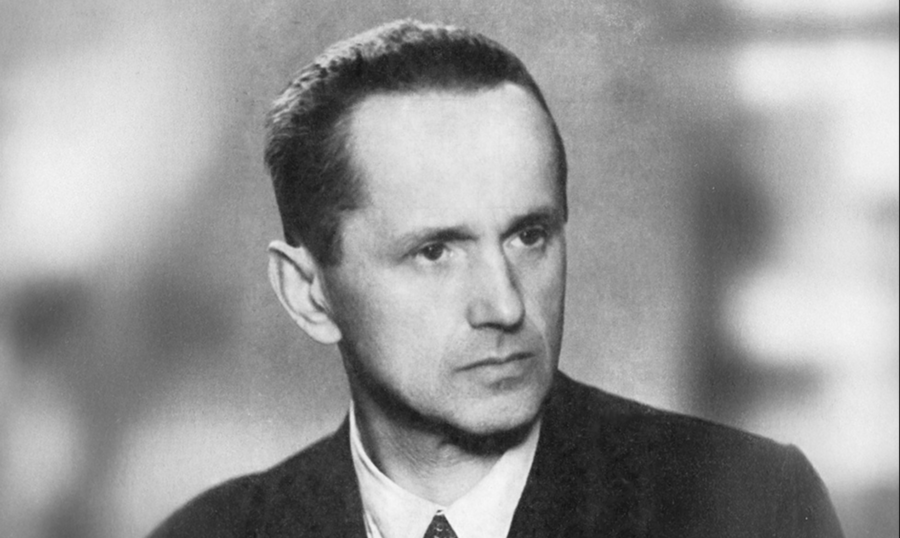
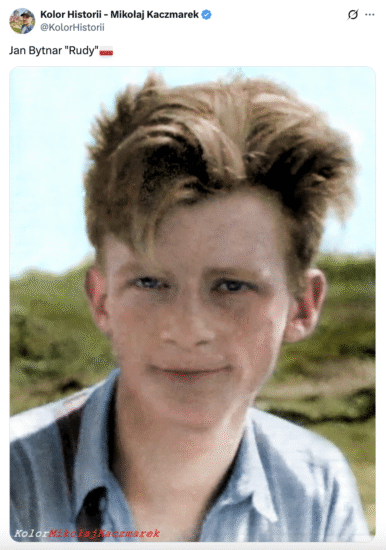
Born on 6 May 1921 in the small town of Kolbuszowa, Jan Bytnar grew up in a patriotic household. His parents were both teachers, and his father had served in the Polish Legions during the fight for national independence. After moving to Warsaw, Bytnar attended the prestigious Stefan Batory State Gymnasium and Secondary School, where he formed lifelong friendships with future resistance fighters Tadeusz Zawadzki and Maciej Aleksy Dawidowski. All three were members of the 23rd Warsaw Scout Troop, nicknamed the “Pomarańczarnia”.
Bytnar completed his final exams just as war engulfed Poland in 1939.
When Germany invaded Poland, Bytnar and his fellow scouts set off east in September 1939, returning to Warsaw only after the city capitulated. Almost immediately, he joined the resistance. Initially involved with the Polish People’s Independence Action (PLAN), Bytnar later became a member of the „Odwet” organisation.
He soon took part in the prison section of the Union of Armed Struggle (ZWZ), smuggling messages from inmates held in Pawiak Prison. By March 1941, he was active in the underground Grey Ranks (Szare Szeregi), a scouting resistance movement. As commander of the Ochota district, he led small sabotage operations under the “Wawer” organisation.
Among his notable inventions was the so-called „eternal pen,” a device for swiftly inscribing graffiti slogans and symbols on city walls. Using this tool, Bytnar painted a large anchor—the emblem of the Polish resistance—on the pedestal of Warsaw’s Aviator Monument in Ochota on the eve of 3 May 1942.
By November that year, Bytnar—by now known under his nom de guerre “Rudy” (Ginger)—was leading the “South” unit of the Grey Ranks’ elite Assault Groups, part of the “Jerzy” Special Unit under the Home Army’s Kedyw division.
In 1943, he completed an officer training course and took part in several major operations, including “Wieniec II” and “Bracka,” during which he was wounded.
Tragedy struck on the night of 18–19 March 1943 when the Gestapo arrested Henryk Ostrowski “Heniek,” commander of the “Praga” unit, at a flat in Warsaw’s Grochów district.
During the search, the Germans discovered documents with Bytnar’s address. Days later, on the night of 22–23 March, the Gestapo raided his apartment on Aleja Niepodległości. They found incriminating materials, including a British pressure detonator, and arrested him.
Bytnar’s capture triggered a rapid response from the resistance. Fellow commander and close friend Tadeusz Zawadzki “Zośka” declared a full alert and began planning a rescue. The rescue plan was coordinated with senior leaders of the Grey Ranks, including Florian Marciniak and Stanisław Broniewski, “Orsza.” Although the plan hinged on the assumption that Bytnar would be transferred to Pawiak Prison the same day, the leadership gave it provisional approval.
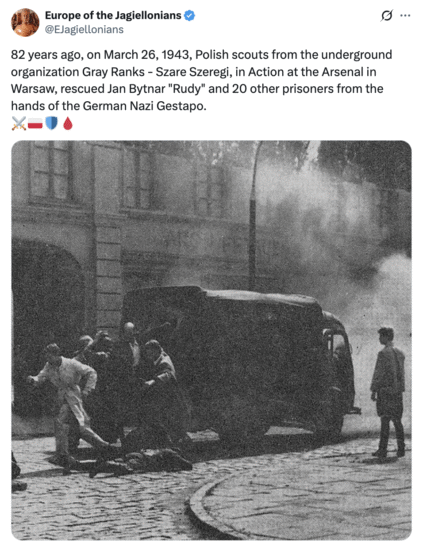
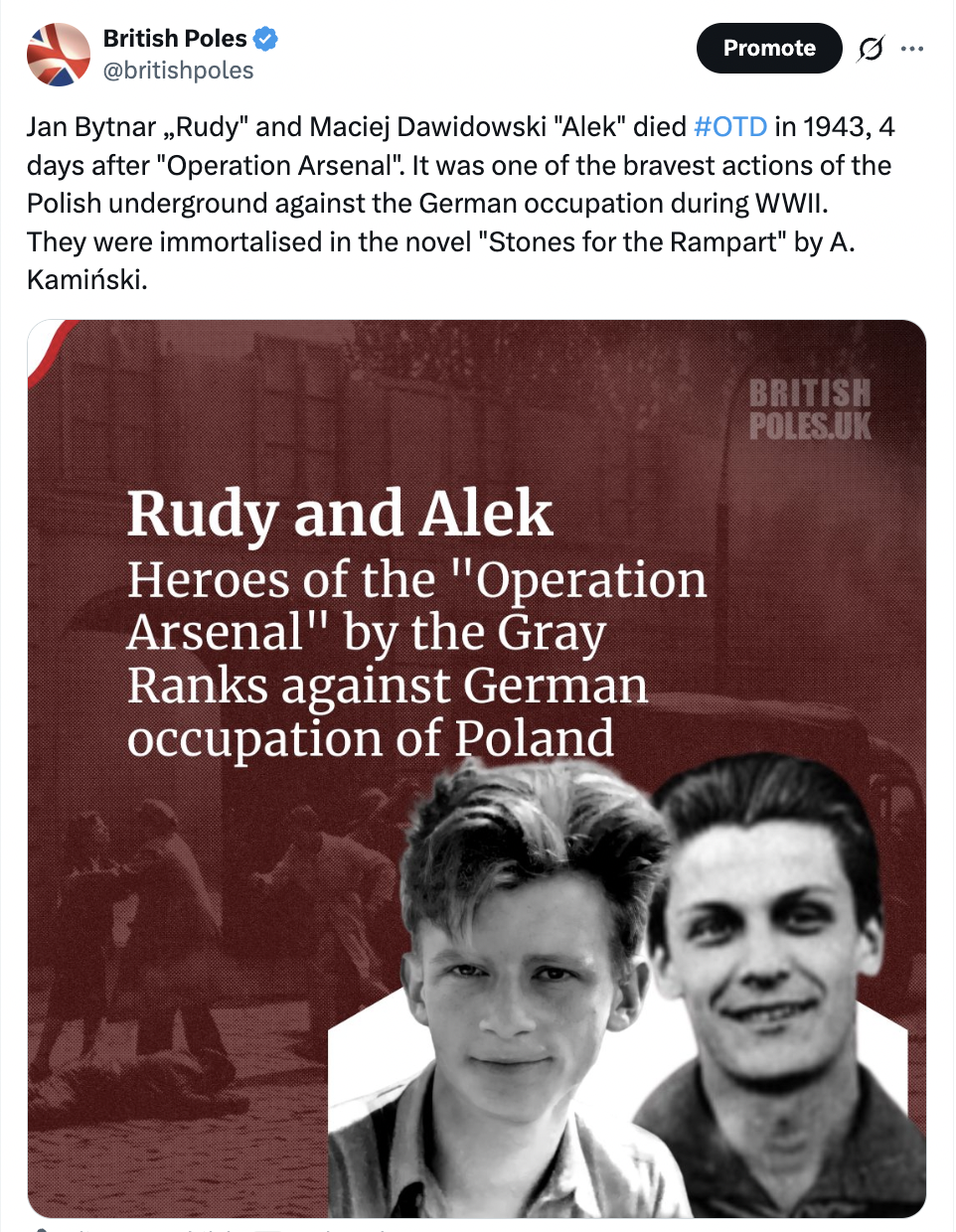
After several delays, the operation—codenamed “Arsenal”—was launched on 26 March 1943 at 5:30 p.m. In a fierce confrontation near Warsaw’s Arsenal building, 28 resistance fighters freed 21 prisoners, including both Bytnar and Ostrowski.
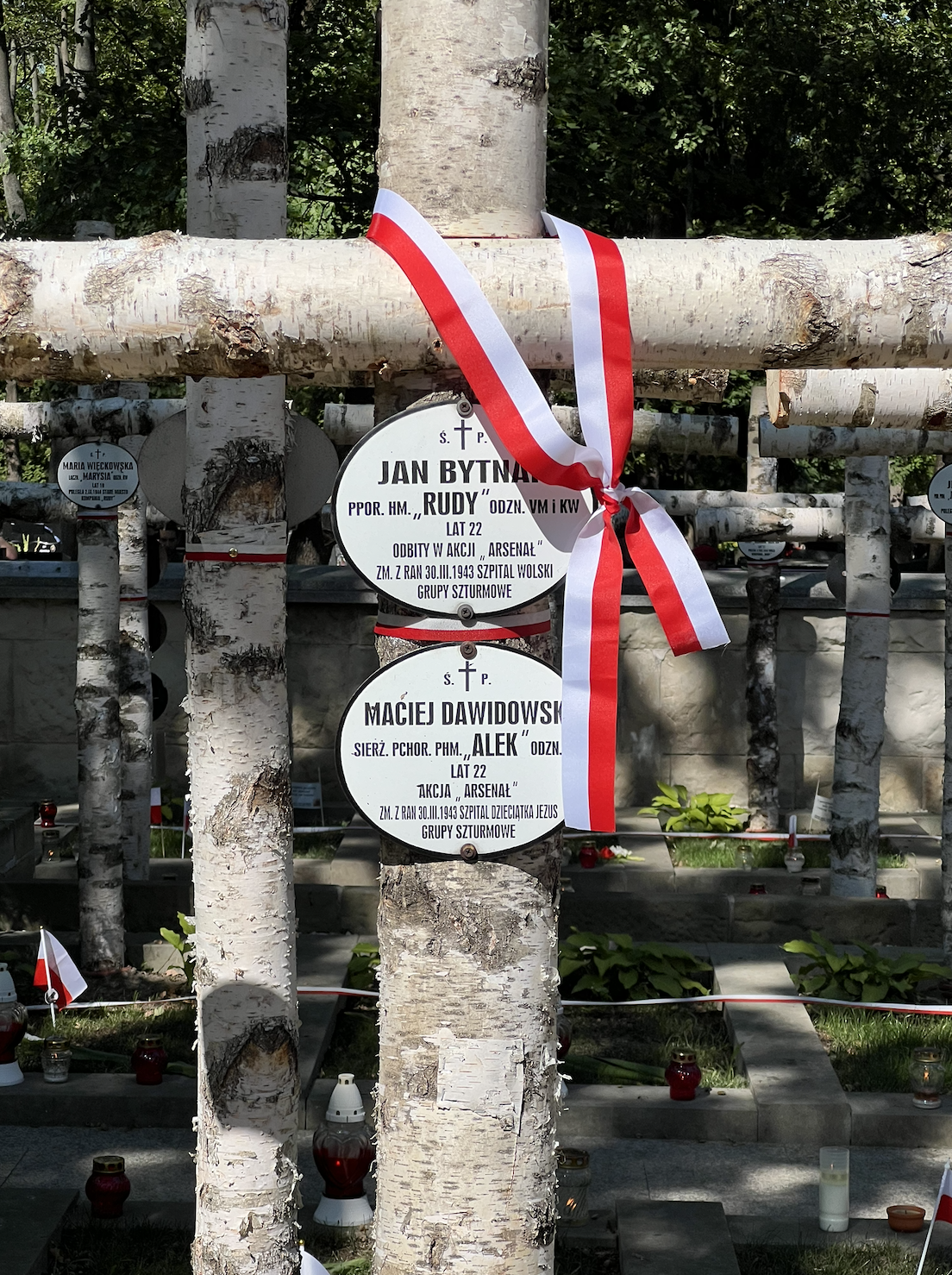
The cost, however, was devastating. A member of the assault squad, Hubert Lenk “Hubert,” was captured and later tortured to death by the Gestapo. Two others—Maciej Dawidowski “Alek” and Tadeusz Krzyżewicz “Buzdygan”—were wounded. Both “Alek” and “Rudy” succumbed to their injuries on 30 March; “Buzdygan” died in the hospital on 2 April. The Germans suffered four fatalities and nine injuries. In brutal retaliation, German forces executed 140 Polish and Jewish prisoners in Pawiak the following day.
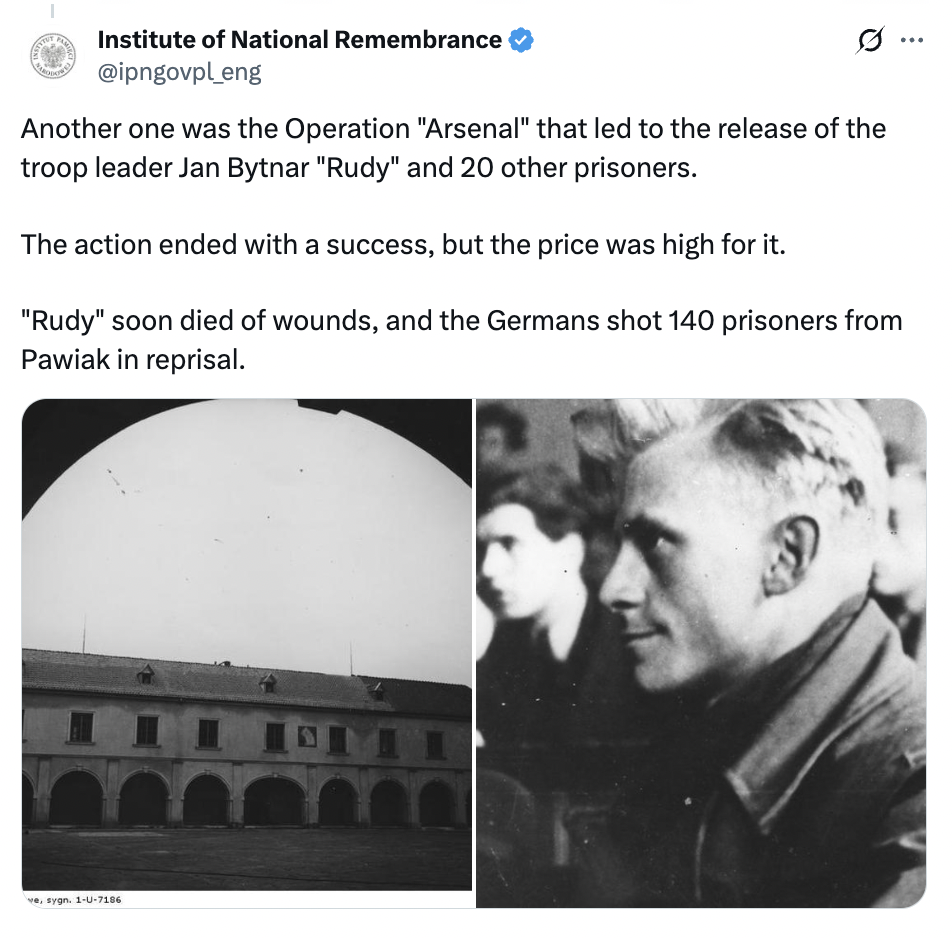
Posthumously promoted to scoutmaster and lieutenant in the Home Army, Jan Bytnar was awarded the Cross of Valour in 1943. He was buried in the “Zośka” Battalion section of the Powązki Military Cemetery in Warsaw.
In 2009, Poland honoured him again—this time with the Commander’s Cross with Star of the Order of Polonia Restituta, a symbol of a life sacrificed in the name of freedom.
The wartime story of Jan Bytnar “Rudy”, Tadeusz Zalewski “Zośka” and Maciej Dawidowski “Alek” was described by Aleksander Kamiński in his famous book “Kamienie na szaniec” (Stones for the Rampart).
Source: Dzieje.pl
Photo: @Leszek10606840
Tomasz Modrzejewski