Britain is bracing for a sharp rise in small boat crossings in the coming years, with migration analysts warning that the country’s asylum system risks being overwhelmed unless sweeping reforms are made.
The new alarming prognosis comes after concluding a new migrant agreement between Prime Minister Sir Keir Starmer and French officials. The deal, dubbed a “one in, one out” policy, would see Britain return an asylum seeker with a weak claim in exchange for one deemed to have a stronger case.
Critics have dismissed it as a superficial fix, with GB News columnist Dr Azeem Ibrahim warning that the volume of migrants making the perilous journey across the English Channel could cripple the system.
PM Starmer has yet to confirm the scale of returns under the proposed scheme, but Conservative Shadow Home Secretary Chris Philp argued it would amount to returning just “one in every 17 illegal immigrants” arriving in Britain. This figure is backed by research from the think tank Facts4EU, which claims that the flow of migrants to the UK is unlikely to slow unless the government introduces more radical measures.
Drawing on migration data from across Europe, Facts4EU suggests that the UK is experiencing the aftershocks of wider continental trends. Although it’s difficult to obtain precise figures from all 27 EU member states due to variations in national data collection methods, the think tank used aggregated statistics, including net migration, to offer a broader view.
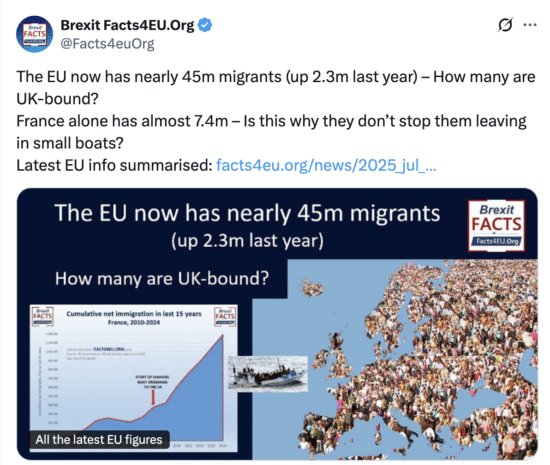
Recent EU population figures reveal a significant rise: 2.3 million more non-EU nationals were recorded across the bloc last year, bringing the total to 44.7 million – almost 10% of the EU’s entire population. For the first time since Brexit, the EU’s combined population has surpassed 450 million.
According to Facts4EU, this growth is driven almost entirely by migration, as the bloc continues to experience a natural population decline as deaths have outnumbered births for the past 13 years.
The group also notes that the EU’s population figures might have been even higher if not for the nearly seven million EU nationals who migrated to the UK while Britain was still part of the EU, taking advantage of Freedom of Movement rules.
Among EU countries, France hosts the largest migrant population, with nearly 7.4 million foreign-born residents.
As Britain grapples with the knock-on effects of European migration patterns, the spotlight now turns to whether Starmer’s new deal can meaningfully ease pressure on the UK’s border infrastructure – or whether, as some argue, it is too little, too late.
Source: GBNews
Photo: X/@InfoMigrants
Tomasz Modrzejewski