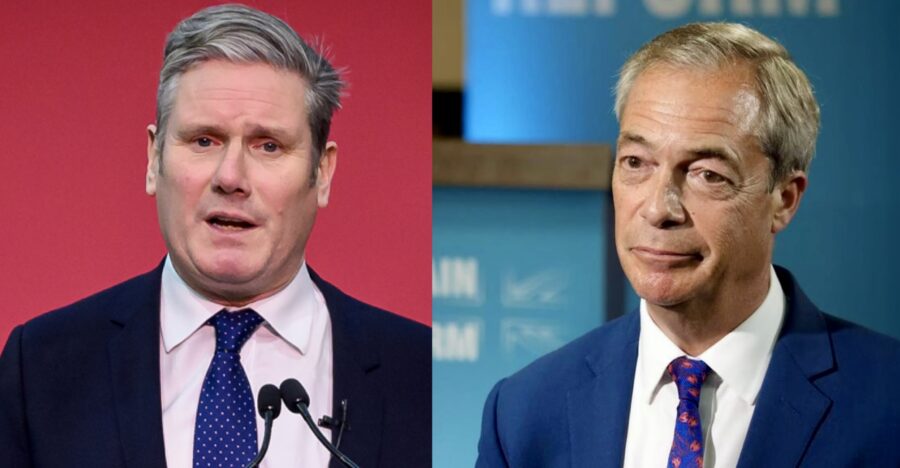
Britain’s local elections have delivered a sharp political warning to Prime Minister Keir Starmer and the governing Labour Party, as early results indicate major gains for the right-wing populist Reform UK and significant losses for Labour across England.
Partial results from Thursday’s elections suggest that Reform UK has emerged as the strongest challenger to Britain’s traditional two-party system. With votes counted in 45 out of 136 local authorities, the party has won 388 council seats, most of them taken from Labour and Conservative representatives. The party, led by Nigel Farage, has also secured outright control in several councils, including the London borough of Havering.
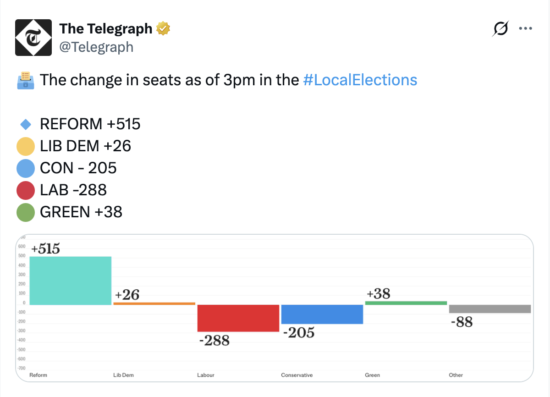
Labour, which won a landslide general election victory in 2024, has suffered a dramatic reversal in fortunes. According to the latest figures, the party has lost more than 250 council seats while retaining fewer than it held previously. In several previously reliable Labour strongholds, including Oxford, Exeter and Hartlepool, the party lost control of local authorities. However, Labour managed to retain power in areas such as Plymouth and Reading.
The results are widely seen as a referendum on Starmer’s government, less than two years after it entered office. Public frustration over the economy, public services and immigration appears to have weakened Labour’s support base, while Reform UK has capitalised on anti-establishment sentiment and criticism of large-scale migration.

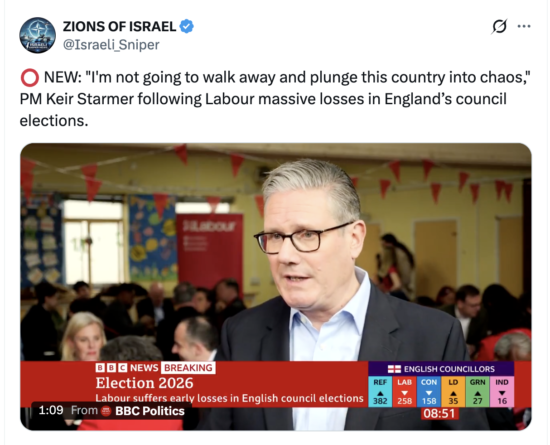
Speaking after the first wave of results, Starmer admitted the outcome was “painful” for his party but insisted he would remain in office and continue pursuing his programme of reforms.
“We have lost excellent Labour councillors across the country, people who gave so much to their communities and to our party. That hurts, and it should hurt. I take responsibility for it,” the Prime Minister said.
Despite growing speculation about his leadership, senior ministers rallied behind him.
Deputy Prime Minister David Lammy dismissed suggestions of replacing Starmer, saying: “You do not change the pilot during a flight.”
Defence Secretary John Healey also warned that a leadership contest would create unnecessary instability.
The elections also exposed continuing difficulties for the Conservative Party, which lost more than 100 council seats in the early counts. Meanwhile, the Liberal Democrats and the Green Party of England and Wales both made steady gains, reinforcing the impression that British politics is becoming increasingly fragmented.
Farage described the results as a “historic transformation” in British politics, arguing that Reform UK is now capable of defeating both Labour and the Conservatives in areas traditionally dominated by either party.
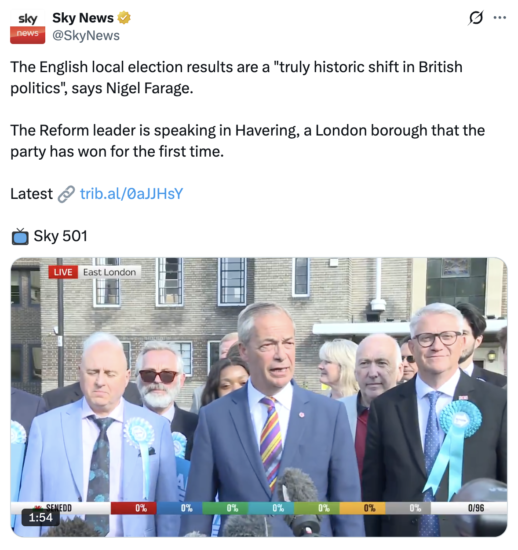
“For decades, people thought in terms of left versus right,” Farage said.
“But Reform UK is winning in places where Conservatives always won, and also in communities that Labour has controlled since the end of the First World War.”
Political analysts believe the elections may mark a decisive shift away from the dominance of Labour and the Conservatives that has shaped British politics for generations. Although Reform UK currently has only a small number of MPs in Westminster, opinion polls increasingly place the party among the country’s most popular political forces.
More results are expected later, including from London boroughs and other major councils, which could further reshape the political picture ahead of the next general election due by 2029.
Photo: X
Tomasz Modrzejewski