Russia has issued one of its most explicit warnings yet against Britain, threatening possible attacks on British military targets in response to Ukraine’s use of UK-supplied long-range missiles.
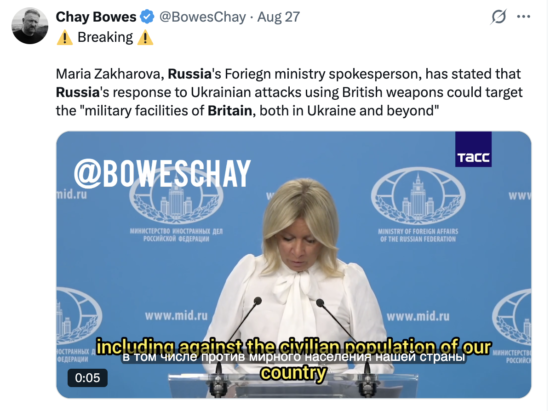
Russian Foreign Ministry spokeswoman Maria Zakharova said Moscow could regard British military installations and equipment both inside Ukraine and beyond its borders as potential targets if Ukrainian forces continued to strike Russian territory with British weapons. The warning represents a significant escalation in the Kremlin’s rhetoric towards one of Ukraine’s most important European allies.
Speaking in Moscow, Zakharova accused Britain and France of “playing with fire” by transferring sensitive missile technology to Kyiv and warned that their decisions could have serious consequences for London and Paris.
The threat follows the British government’s decision to help Ukraine develop its ability to manufacture long-range cruise missiles. Prime Minister Andy Burnham announced during a visit to Kyiv that Britain would facilitate the sharing of classified technical information relating to components of the Anglo-French Storm Shadow/SCALP missile system. France has also authorised the transfer of relevant technology.
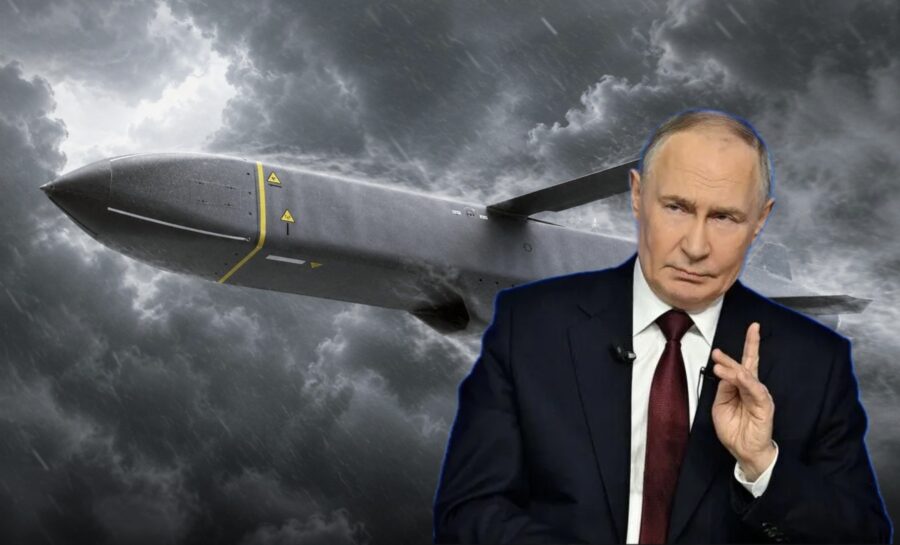
Storm Shadow is an air-launched precision cruise missile capable of striking targets more than 250 kilometres away. Ukraine has already used the weapon against Russian and Russian-controlled targets, making it a persistent source of tension between Moscow and Western governments.
The Kremlin reacted angrily to the latest British decision. Kremlin spokesman Dmitry Peskov accused London of adding “fuel to the fire”, while Russian officials said the country’s armed forces were identifying facilities connected with the production and deployment of such weapons.
Zakharova went considerably further, suggesting that British military assets outside Ukraine could also become legitimate targets from Moscow’s perspective.
The UK Ministry of Defence has rejected Moscow’s attempts to intimidate Britain into reducing its support for Ukraine, while Burnham has publicly condemned what he described as Russia’s “outrageous threats”. Britain has repeatedly maintained that Ukraine has the right to defend itself against Russia’s invasion.
Russia’s latest language matters because it shifts the focus from retaliation against weapons or facilities inside Ukraine towards potential British targets elsewhere.
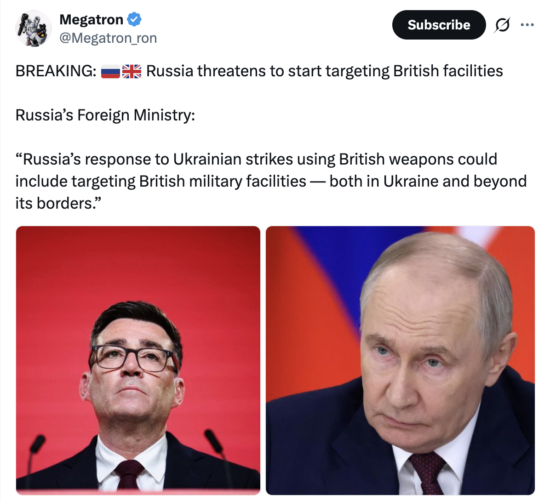
Any deliberate Russian military attack against British territory or forces in a NATO member state could dramatically widen the conflict and raise questions about the alliance’s collective defence commitments.
At the same time, Western governments have long accused Moscow of deliberately using threats of escalation, including references to nuclear weapons and attacks on NATO countries, to discourage European governments from providing increasingly sophisticated military assistance to Ukraine.
Polish Foreign Minister Radosław Sikorski has now argued that Europe should resist precisely that pressure.
Writing in *The Economist*, Sikorski warned against beginning political negotiations with Moscow before Russia’s strategic position has been sufficiently weakened.
“Russia considers us an enemy and wants to destroy our democratic civilisation,” the Polish foreign minister argued, adding that Europe should not rush to appease Vladimir Putin in the hope that concessions would produce peace.
According to Sikorski, repeated Western attempts to build a constructive relationship with post-Soviet Russia have failed. Successive American administrations sought to incorporate Moscow into international structures, while European countries attempted their own forms of engagement.
Poland itself once pursued a policy intended to improve relations with Moscow. Sikorski recalled initiatives including Vladimir Putin’s invitation to Westerplatte for the 70th anniversary of the outbreak of the Second World War and the introduction of local border traffic arrangements with Russia’s Kaliningrad region.
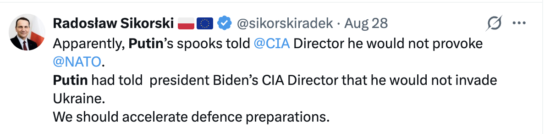
His conclusion is that those attempts did not alter the fundamental direction of Russian policy.
Sikorski also rejected two arguments frequently made in favour of an early accommodation with Moscow: that Russia must not be weakened too far for fear of its internal collapse, and that applying greater pressure risks provoking an uncontrollable, possibly nuclear, escalation.
The Polish minister argued that Russian threats of escalation have themselves become an instrument of policy, designed in part to test Western resolve.
His warning is particularly relevant in the context of Moscow’s latest statements towards Britain.
From the Polish perspective, treating threats such as Zakharova’s as a reason to reduce assistance to Ukraine could have the opposite effect to the one intended. Rather than lowering tensions permanently, concessions made under pressure could persuade the Kremlin that increasingly aggressive threats are an effective means of influencing NATO governments.
Sikorski argued that political dialogue resumed from a position of Western weakness could strengthen the Kremlin domestically, encourage further hybrid operations, weaken European support for Ukraine and deepen divisions among Western democracies.
Instead, he believes Europe may have to accept greater short-term risks to prevent a much more dangerous strategic situation from developing later.
His central argument is that deterrence cannot consist simply of avoiding escalation. European governments must convince Moscow that escalation will not produce political rewards.
Britain has become one of the central targets of Russian criticism because of the scale and nature of its support for Kyiv.
London was among the earliest Western governments to provide Ukraine with long-range cruise missiles and has increasingly moved towards deeper technological and industrial cooperation with the Ukrainian defence sector.
The latest agreement goes further than simply supplying weapons from British stocks. By providing technology that could help Ukraine manufacture long-range systems itself, Britain is contributing to Kyiv’s ability to maintain its strike capability over the longer term.
That development helps explain the severity of Moscow’s reaction.
It does not, however, mean that a Russian attack against Britain is imminent. Western officials continue to assess that the Kremlin has powerful reasons to avoid a direct military confrontation with NATO. But Moscow’s willingness to name British targets explicitly raises the political stakes and adds another element to the increasingly confrontational relationship between Russia and Europe.
For Sikorski, the appropriate European response is therefore not to search for reassurance in Moscow’s rhetoric, but to demonstrate that threats will not divide the alliance.
As he put it, the fundamental responsibility of European leaders is to protect their own citizens from Russian threats “not to protect Russia from itself”.
Photo: X @UKDefJournal
Tomasz Modrzejewski