Britain has firmly rejected a renewed Argentine challenge to its position on the Falkland Islands after President Javier Milei claimed that changing international circumstances were increasingly favourable to Buenos Aires’ sovereignty ambitions.
British Defence Secretary Wes Streeting responded by insisting that the future of the South Atlantic archipelago must be determined by the people who live there.
“The Falklands are British because Falkland Islanders choose to be British,” Streeting said, describing the United Kingdom’s commitment to the territory as “absolute and unshakeable”.
He also suggested that Milei’s latest intervention reflected Argentina’s domestic political situation more than any change in the status of the islands. Argentina is due to hold presidential elections in 2027.
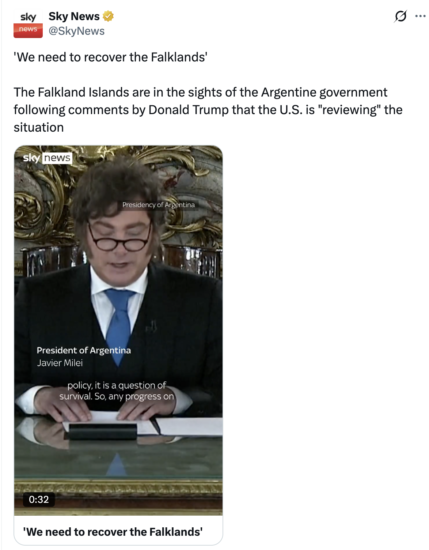
Milei used a televised national address to reiterate Argentina’s historic claim to the islands, which Buenos Aires calls Las Malvinas.
The Argentine president argued that global political developments were beginning to strengthen his country’s position, declaring that “winds of change” were blowing in favour of Argentina’s cause.
His comments came after US President Donald Trump raised questions about Washington’s future position on the dispute. The United States has traditionally avoided formally taking sides on the question of sovereignty, although it supported Britain during the 1982 Falklands War.
Trump recently indicated that the US position could be reviewed and, in an interview with GB News, declined to commit Washington to supporting Britain in the event of another confrontation with Argentina. He linked his reservations to what he regarded as insufficient British support for US operations involving Iran.

Milei seized on the remarks as evidence that the international environment surrounding the Falklands dispute could be changing.
However, no formal shift in US policy on the sovereignty of the islands has so far been announced.
The latest confrontation is not limited to diplomatic rhetoric.
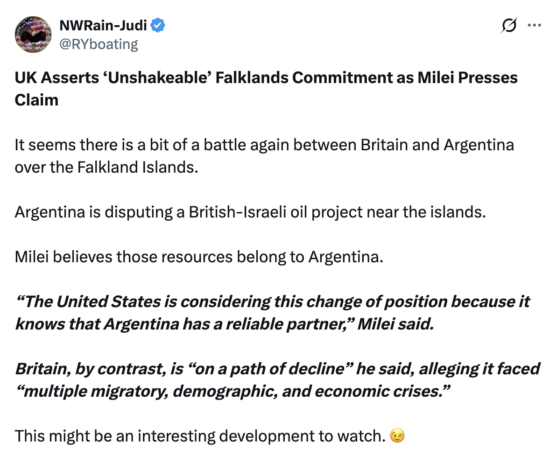
Milei announced plans to strengthen sanctions against foreign companies involved in oil exploration and production around the Falklands. Argentina regards such activities as an exploitation of natural resources in territory over which it claims sovereignty.
The measures are particularly focused on the Sea Lion oil development north of the islands, involving Israeli-owned Navitas Petroleum and Britain’s Rockhopper Exploration.
Buenos Aires says companies operating in the area without Argentine authorisation are violating its sovereignty and has promised to use diplomatic, economic and legal measures against them.
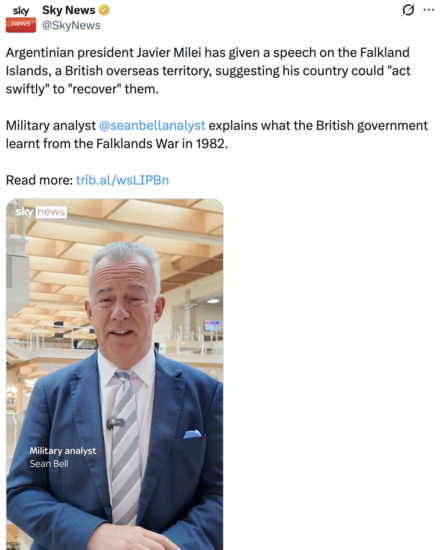
Milei said his government would seek stronger legislation allowing Argentina to punish businesses involved in what it considers unauthorised exploitation of offshore resources.
The Falkland Islands Government and Britain reject Argentina’s jurisdiction over the territory and maintain that companies operating under licences issued by the islands’ authorities are acting lawfully.
The prospect of significant oil production has nevertheless given the decades-old sovereignty dispute a new economic dimension, alongside its longstanding historical and strategic importance.
Argentina has claimed sovereignty over the Falklands for generations, arguing that it inherited rights to the islands from Spain and that British control established in the nineteenth century amounts to an illegal occupation.
Britain, by contrast, bases its modern position largely on the principle of self-determination, arguing that the wishes of the islands’ inhabitants should determine their political status.
The dispute led to war in April 1982 when Argentine forces invaded and occupied the islands. Britain sent a naval task force to the South Atlantic and regained control after a conflict lasting 74 days.
The war remains a powerful element of political memory in both countries and continues to shape their approaches to the sovereignty question.
In a referendum held in 2013, 99.8 per cent of Falkland Islanders who voted supported remaining a British Overseas Territory.
Argentina does not recognise the referendum as resolving the sovereignty dispute. Buenos Aires argues that the present population largely descends from settlers introduced after Britain established control of the islands in 1833 and therefore should not be treated as a colonised population exercising a right to external self-determination.
Britain rejects that interpretation and insists that there can be no negotiations over sovereignty unless the Falkland Islanders themselves want them.
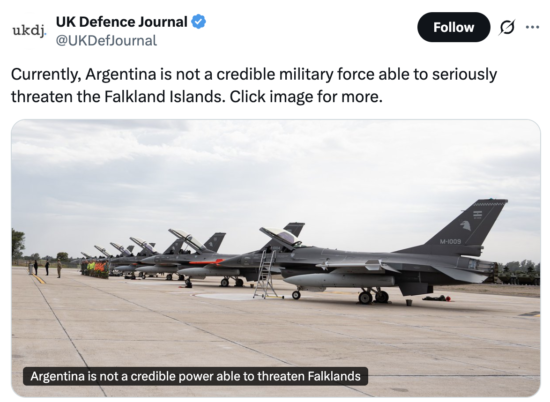
The exchange therefore represents more than another repetition of two familiar positions. Milei is attempting to combine Argentina’s traditional sovereignty claim with economic pressure over offshore oil and the possibility of a more sympathetic government in Washington.
London’s response indicates that, regardless of shifts elsewhere in international politics, the British government currently sees no reason to reconsider its fundamental position: the political future of the Falklands rests with the people who live there.
Photo: X/ @BasilTheGreat
Tomasz Modrzejewski