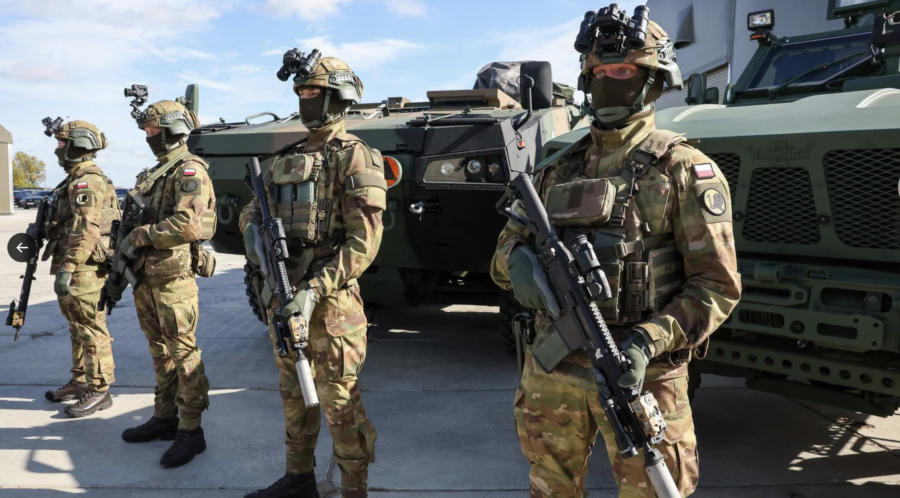
Poland’s armed forces are to receive a new generation of tactical uniforms, with the Defence Ministry pledging to spend at least PLN 1 billion next year on replacing the army’s current camouflage kit.
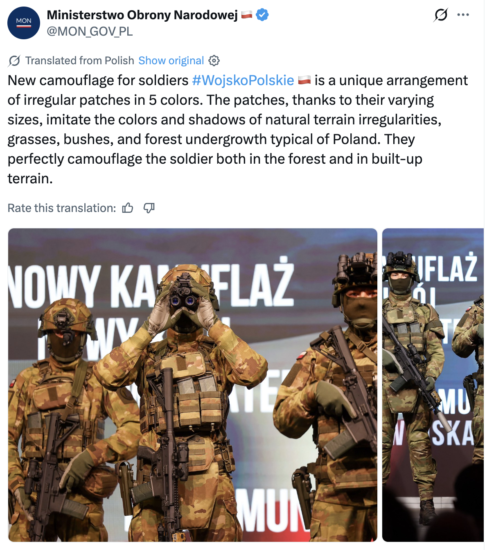
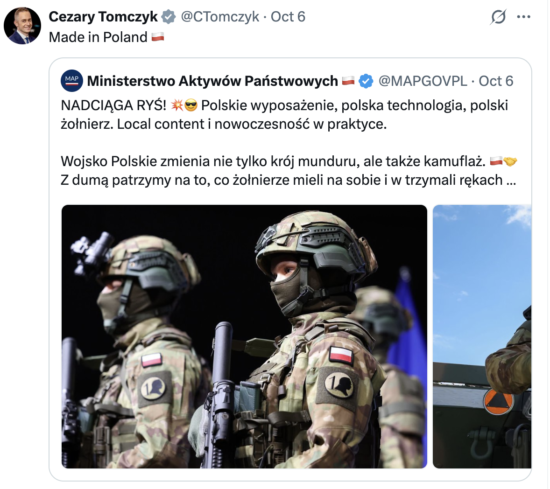
The new uniform, featuring the KO3 “Ryś” camouflage pattern, was unveiled on Monday at the headquarters of the 1st Legions Infantry Division in Ciechanów.
Deputy Prime Minister and Defence Minister Władysław Kosiniak-Kamysz described the change as a major step for the Polish Army, arguing that the safety, effectiveness and comfort of soldiers had to remain the ministry’s priority.
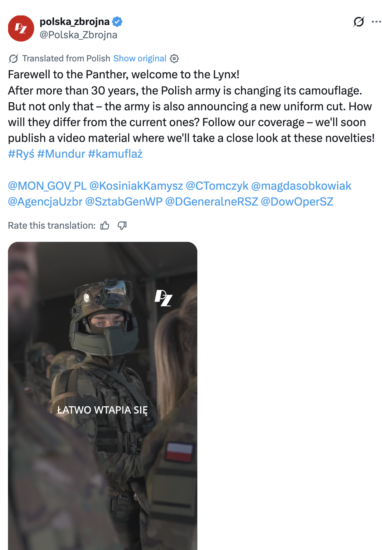
The new design will gradually replace the long-serving “Pantera” camouflage, which has been in use for 33 years.
According to the Defence Ministry, testing showed that the new camouflage makes soldiers significantly harder to detect in the field, both during the day and at night.
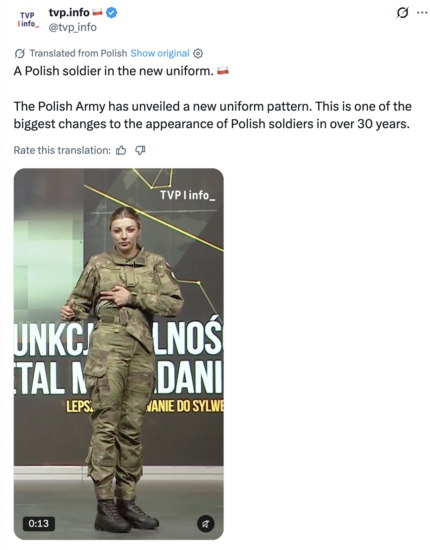
Officials also said the uniform was more comfortable than its predecessor and had been designed separately for male and female personnel.
Mr Kosiniak-Kamysz presented the first new uniform to the Chief of the General Staff of the Polish Armed Forces, General Wiesław Kukuła.
He stressed that the uniform had been designed in Poland, tested by Polish soldiers and would be manufactured entirely by Polish producers.
The rollout is expected to take place in stages. Around 7,500 sets are due to be delivered this year, with the number potentially rising further before the end of the year.
The Defence Minister said one new tactical uniform would cost about PLN 1,000.
He announced that at least PLN 1 billion would be spent next year on equipping soldiers with the new kit.
“We will invest in this because their safety, their ability to conceal themselves and their comfort in service are absolutely crucial to us,” he said.
Military officials said the new uniforms offer roughly 30 per cent better camouflage performance than the existing model.
The fabric is also said to be around 30 per cent more resistant to tearing and seven times more resistant to abrasion.
The new material is expected to retain its camouflage colours for longer and provide greater flexibility, improving freedom of movement in the field.
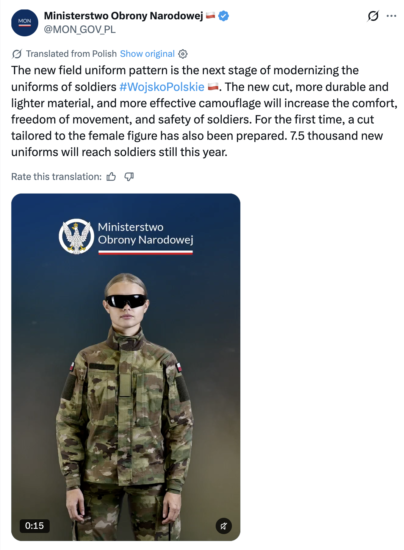
For the first time, the design has also been produced in dedicated male and female versions.
The patterns have been patented and legally protected in both Poland and the European Union.
Mr Kosiniak-Kamysz emphasised that the decision to adopt the new uniform was based on expert assessments rather than political considerations.
The kit was tested for more than a year by both male and female soldiers.
Deputy Defence Minister Cezary Tomczyk said 500 troops from more than 30 military units had taken part in trials under a wide range of conditions, including field exercises.
He said the Defence Ministry intended every Polish soldier to receive the new uniform by the end of 2028.
Deputy Defence Minister Magdalena Sobkowiak-Czarnecka said one of the most important aspects of the project was the introduction of a uniform specifically designed for women.
She noted that female soldiers would no longer have to rely on male uniforms and choose whichever sizes fitted them best.
“For the first time in the history of the Polish Army, female soldiers will have a uniform designed specifically for them,” she said.
She added that tests were also under way on body armour designed for women.
Women currently account for about 16 per cent of personnel in the Polish Armed Forces and more than 20 per cent of soldiers in the Territorial Defence Forces.
Ms Sobkowiak-Czarnecka said women were just as important to Poland’s national security system as men and strongly rejected attempts to undermine their role in the military.
She also announced plans for a new “Women to the Shooting Range” programme, under which she intends to visit locations across Poland and encourage women to take part in firearms training.
General Kukuła said the implementation of the new camouflage would begin in 2026, starting with Tier 1 units before being introduced more widely, including eventually to special forces.
He said the timing was right for the armed forces to adopt a new multi-environment camouflage system intended to improve soldiers’ protection and restore Poland’s competitiveness in military uniform technology.
The design work was carried out with the involvement of the Military Research and Implementation Centre for Uniform Services in Łódź.
A key element of the new uniform is its five-colour camouflage print, made up of irregular shapes in different sizes.
The pattern is designed to reflect the colours and shadows commonly found in the natural environment and to improve concealment in both wooded and built-up areas.
The Defence Ministry argues that the new system will mark a substantial improvement over the existing uniform, combining better protection, greater durability and a design more closely tailored to the needs of modern Polish soldiers.
Andrzej Domaniewski
Photo: X @Kosiniak-Kamysz