An emotionally-charged apartment scandal has stymied the campaign momentum of the right-wing opposition presidential challenger to the liberal-centrist ruling party’s candidate, who remains the favourite to win. But the election outcome is likely to depend on the extent to which it becomes a referendum on an unpopular government, and how the third placed candidate’s votes transfer.
A crucial election
On May 18th Poland will hold a presidential election, with a second round run-off a fortnight later between the top two candidates if none secures more than 50%. In December 2023, a coalition government led by Donald Tusk, leader of the liberal-centrist Civic Platform (PO) which once again became the country’s main governing party, took office following eight years of rule by the right-wing Law and Justice (PiS) party. However, the Tusk government has had to ‘cohabit’ with Law and Justice-aligned President Andrzej Duda, and lacks the three-fifths parliamentary majority required to over-turn his legislative veto. This means that the presidential election will have huge implications for whether the ruling coalition can govern effectively during the remainder of its term of office, which is set to run until autumn 2027.
The two front-runners are: Civic Platform deputy leader and Warsaw mayor Rafał Trzaskowski, who lost narrowly to Mr Duda in 2020; and Law and Justice-backed head of the state Institute of National Remembrance (IPN) Karol Nawrocki. Mr Trzaskowski has led in every opinion survey throughout the campaign (except for one or two outliers) in both the first and second rounds; according to the ‘Politico Europe’ poll aggregator he is currently averaging 31%. Mr Trzaskowski has, therefore, run his campaign assuming that he will make the second round and from the outset pitched his message to more centrist and socially conservative Poles living beyond the relatively liberal metropolitan areas whose votes he will need to win a run-off. This has included talking tough on issues such as migration and security. The risk here is that, given Mr Trzaskowski’s previous association with liberal-left policies and causes, conservative voters will doubt his sincerity, whilst his more socially and cultural liberal core supporters become alienated and de-mobilised.
The battle for second place
Mr Nawrocki has been consistently in second place and his support now averages 25%. But he made an awkward start and his campaign has been beset with mishaps and stumbles. Law and Justice originally presented him as a ‘civic’ candidate in order dis-associate him from the previous, unpopular Law and Justice government that was rejected decisively at the last parliamentary election. However, while more centrist voters have not been convinced by his non-partisan pitch, for a long time many core Law and Justice supporters also did not identify with him. His support has yet to match the 30% that the party is currently averaging in polls.
The ‘dark horse’ of the presidential election race has been the charismatic young entrepreneur Sławomir Mentzen, candidate of the radical right free-market Confederation (Konfederacja) grouping who is currently averaging 13%. At one stage it even appeared that Mr Mentzen could overtake Mr Nawrocki and make the second round run-off. However, his support has fallen back from a peak of 19% in early March, after an interview with the ‘Kanał Zero’ YouTube channel when he alienated some of his, predominantly younger, supporters by confirming that he wants all students to pay tuition fees (currently most study for free), and opposed allowing abortion in cases of rape, one of the few permitted exceptions in Poland’s already-highly restrictive law.
Mr Nawrocki gathers momentum
Moreover, as the campaign developed, Mr Nawrocki also began to make up ground on Mr Trzaskowski. For many commentators, the turning point was a pre-election debate that took place in Końskie, a small town which gained notoriety during the 2020 presidential election when Mr Trzaskowski failed to turn up for a TV debate, a mistake that proved fatal in the closely-fought campaign. In early April, Mr Trzaskowski challenged Mr Nawrocki to a one-on-one debate in Końskie which he organised with TVP, Poland’s state broadcaster, and the two largest private channels. Following days of criticism for not inviting all the candidates, two hours before the debate was due to start Mr Trzaskowski announced that all of them were now welcome to attend. In the meantime, the TV Republika broadcaster organised its own debate in the same town to which all candidates were invited but Mr Trzaskowski chose not to attend. All of this gave the impression that Mr Trzaskowski was indecisive and unwilling to participate in debates not under his control.
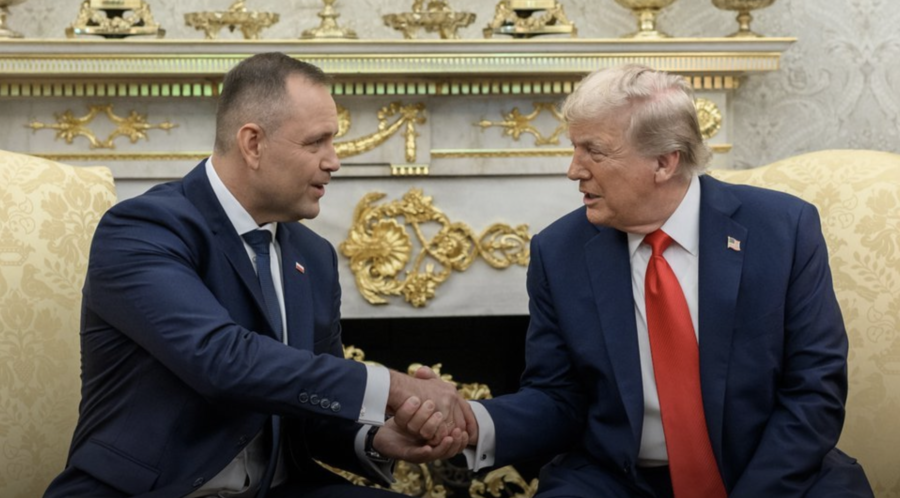
At the same time, Mr Nawrocki grew in confidence and his campaign started to gather momentum. A high profile endorsement by Mr Duda solidified the growing awareness among Law and Justice core voters that Mr Nawrocki was their candidate. A headline-grabbing Oval Office meeting with US President Donald Trump, re-inforced one of his key campaign messages: that only a Nawrocki presidency could maintain good relations with Poland’s most important security ally.
The apartment scandal throws Mr Nawrocki off-balance
However, the Nawrocki campaign then took a disastrous turn following allegations of dishonesty and neglect regarding an apartment that he purchased from an elderly neighbour. The scandal began when, during a televised debate, Mr Nawrocki expressed his opposition to a proposed property tax, saying that he was speaking on behalf of ordinary Poles who, like him, only owned one property. Shortly afterwards the Onet.pl news portal revealed that he actually had two. The second was acquired in 2017 from man known only as Jerzy Ż, one of Mr Nawrocki’s neighbours, who used money provided by him to purchase the property from the local authority five years earlier for 10% of its value under a discount scheme for long-term tenants. Jerzy Ż agreed to transfer the property after the necessary five-year grace period; in Mr Nawrocki’s original version of events in exchange for a promise of regular care and assistance.
However, further investigations cast doubt on Mr Nawrocki’s claim that he looked after Jerzy Ż, beyond paying bills for the apartment, when it emerged that the Law and Justice candidate did not know that the man had been placed in a state nursing home over a year ago. Only when Mr Nawrocki visited Jerzy Ż last Christmas did he realise that he was not there but did not then notify the authorities. Onet.pl also published an interview with a social worker who had been taking care of Jerzy Ż in 2022-2023 and claimed that Mr Nawrocki had never come to visit him. Doubts were also raised as to how the apartment was purchased. While Mr Nawrocki said that he paid Jerzy Ż 120,000 złoties for the property in instalments over 14 years (arguing that giving a vulnerable man so much money at once could have posed a threat to him), this appeared to contradict the notarial deed presented by his campaign staff.
Mr Nawrocki’s supporters argued that he mis-spoke in the heat of the moment during the presidential debate and the point he was trying to make was that he was like millions of ordinary Poles, not that he only had one apartment. They said that the property purchase and assistance that Mr Nawrocki provided to Jerzy Ż were separate matters and noted that, even after buying the apartment, he allowed his neighbour to continue to treat it as his own, paid the bills, and, for many years, was the only one caring for him. Mr Nawrocki’s supporters said that he had never received any information that Jerzy Ż was struggling, and claimed that the former carer was an unreliable source given that she had been highly critical of Law and Justice in her social media posts. The purchase of the apartment was, they argued, conduced in full accordance with the law and Mr Nawrocki included all information about the property in question (from which neither he nor his family received any income) in his financial assets declarations, which were vetted by the security services.
Why has the scandal cut through?
At the same time, Mr Nawrocki’s supporters argued that the charges against him had been manufactured by the security services as part of a co-ordinated smear campaign. However, the scandal also revealed both Mr Nawrocki and his campaign team’s lack of experience as they were unable to respond with a clear and coherent counter-narrative. Each delayed reaction and chaotic (and sometimes contradictory) version of events simply raised more questions and allowed the issue to spiral out of control. After three days of explanations, in an effort to draw a line under the scandal Mr Nawrocki announced that he was donating the apartment to charities helping support older, vulnerable people.
The scandal pushed Mr Nawrocki’s campaign onto the defensive at a critical point in the campaign and made it much harder for him to promote his own programmatic agenda. The issue is so emotionally resonant, even for those not particularly in politics, because it concerns the delicate sphere of inter-personal relations; Mr Nawrocki’s opponents argue that, whatever the legal situation, he took advantage of a sick, elderly man. Given the housing shortage and degree of public anger directed at property developers, this issue is a particularly sensitive and heated one in Poland.
In fact, polls conducted since the scandal broke suggest that it has not affected Mr Nawrocki’s first round support. Indeed, his campaign staff are hoping that the issue will lose momentum as other campaign themes emerge in the second round, and possibly even that Mr Nawrocki’s opponents’ negative campaigning might backfire if it creates the impression that he is being attacked obsessively by all sides. Nonetheless, the scandal has the potential to weaken Mr Nawrocki’s ability to reach out to voters beyond the Law and Justice core whose support he will need to win the run-off.
What will happen in the second round?
While Mr Trzaskowski remains the favourite, ultimately the election outcome is likely to be determined by two factors, both of which have been affected by the apartment scandal. Firstly, can Mr Nawrocki turn the election into a referendum on, and effectively channel growing societal discontent with, the Tusk administration? Most Poles feel that the government has failed to deliver on its election promises and Mr Nawrocki has been trying to pin this on to Mr Trzaskowski by dubbing him ‘Tusk’s deputy’. Or can Mr Trzaskowski turn it into a referendum on whether to remove the last vestiges of Law and Justice’s legacy, thereby re-kindling the huge electoral mobilisation that led to the party’s decisive rejection in 2023? The scandal may help to mobilise those Poles who voted for the current governing parties in 2023 at least partly because of Law and Justice’s alleged abuses of power (which the party denies vehemently). They may feel dissatisfied with the Tusk government but could be mobilised again to stop a politician linked to the former ruling party occupying the presidential palace.
Secondly, what will Mr Mentzen’s supporters do? Third placed candidates’ transfers had a decisive impact in three out of the last four presidential elections. In 2020, the first round votes of the Confederation candidate Krzysztof Bosak (who finished fourth) were divided evenly between Mr Duda and Mr Trzaskowski. In fact, polling has suggested that this time Mr Mentzen’s voters are more likely to support Mr Nawrocki. Civic Platform is now the incumbent (and increasingly unpopular) government, so more unambiguously represents the status quo and ruling political establishment. Indeed, without openly endorsing Mr Nawrocki, Confederation leaders have said that the grouping will do everything to stop Mr Trzaskowski becoming President, and throughout the campaign Mr Mentzen and the Law and Justice candidate have operated an informal non-aggression pact. However, following the outbreak of the apartment scandal, for the first tie Mr Mentzen launched an open and vigorous attack on Mr Nawrocki. This could make it much harder for the Law and Justice candidate to win over his voters in the second round.
Prof. Aleks Szczerbiak
This post originally appeared on the Polish Politics Blog. The opinions expressed in this article are the author’s own and don’t have to reflect the views of the British Poles Portal.
Aleks Szczerbiak is a Professor of at the University of Sussex. He is the author of Poland Within the European Union? New Awkward Partner or New Heart of Europe? (Routledge, 2012)
Picture: Pixabay