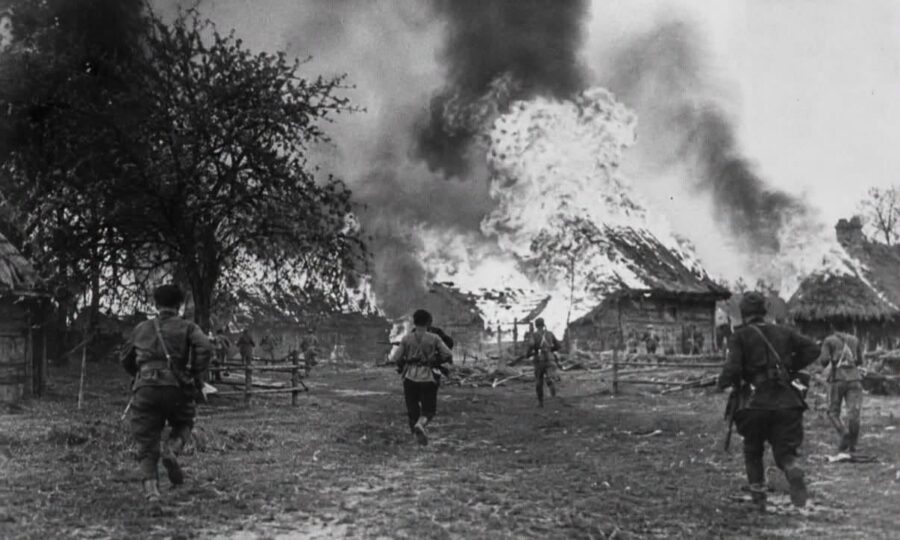
In the summer of 1945, just weeks after the guns of the Second World War fell silent, the forests and villages of northeastern Poland became the backdrop for a chilling episode of post-war repression. On 12 July, Soviet NKVD and SMERSH units launched a sweeping military operation that would come to be known as the Augustów Round-Up.
Its consequences still haunt Polish memory: approximately 600 people from the regions surrounding Augustów and Suwałki were arrested, forcibly taken away, and are presumed to have been executed. The mass disappearance stands as the largest unresolved crime committed on Polish soil in the immediate aftermath of the war.
By late 1944 and early 1945, the Red Army had taken control of the Augustów and Suwałki region. Yet despite this formal occupation, real authority in many rural areas remained in the hands of the Polish anti-communist underground. By May 1945, partisan groups had successfully dismantled nearly all local militia outposts (17 out of 18) and seized control of most commune offices (12 out of 14) in the Suwałki district.
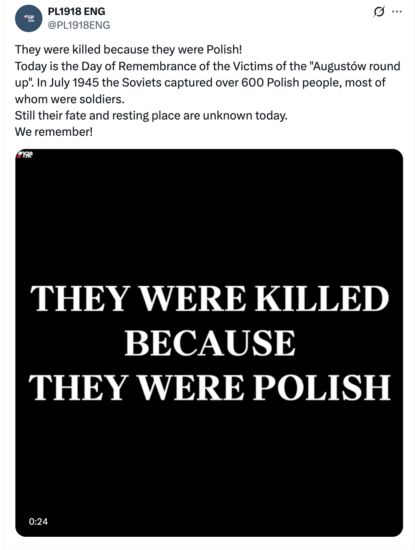
The inability of Moscow-backed authorities to establish firm control in these strategically sensitive borderlands was likely one of the triggers for the crackdown. The region’s proximity to the newly redrawn Soviet border, combined with continued underground resistance, represented a challenge to Stalin’s designs. One theory posits that the Soviet leadership viewed this area as a candidate for incorporation into the USSR and sought to “cleanse” it of hostile elements ahead of any such move.
In response, the Soviets unleashed a force of staggering size. Nearly 40,000 troops were deployed from the 50th Army of the 3rd Belorussian Front and the 62nd Internal Troops Division of the NKVD. Polish army units and local militia supported them. Command of the operation was given to General Ivan Gorgonov, then deputy head of SMERSH—the Soviet military counterintelligence agency. (Gorgonov would later be dismissed and demoted following Stalin’s death.)
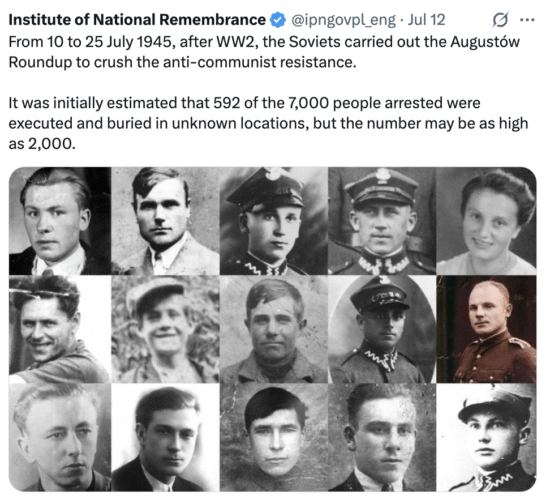
Between 10 and 25 July 1945, Soviet forces swept across Suwałki, Augustów, Sokółka, and Dąbrowa Białostocka, rounding up an estimated 7,000 people. Many were held in makeshift camps, subjected to brutal interrogations, and accused of aiding or being part of the underground resistance. After a time, the majority were released, but hundreds were selected and murdered by the Soviets.
According to investigations by Poland’s Institute of National Remembrance (IPN), at least 592 individuals never returned home. Their fate remains shrouded in mystery. With Russian archives still sealed and cooperation withheld, the official investigation, suspended in 2022, the full picture of the crime remains secretive. However, the prevailing assumption is grim: the victims were taken across the Soviet border, likely near Grodno (now in Belarus), and executed in secret.
Some mass graves of the victims were discovered and secured in the late 1980s.

Eighty years on, the Augustów Round-Up remains a painful and unresolved chapter of Polish history and a postscript to the war that for many came not with liberation, but another totalitarian occupation.
Source: Dzieje
Photo:x/@paweljablonski_
Tomasz Modrzejewski