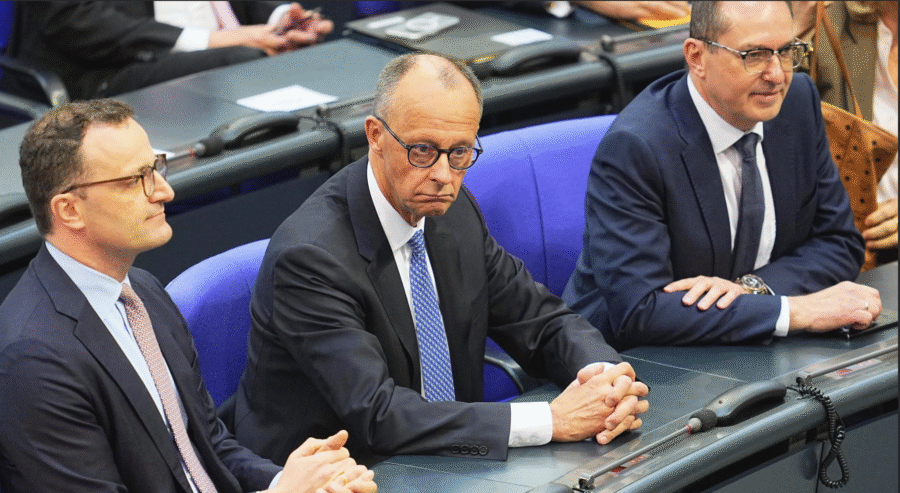
The initial failure of Chancellor-designate Friedrich Merz to secure a majority in the Bundestag has plunged Germany into uncharted political territory. It is, as Süddeutsche Zeitung puts it, a moment without precedent in the history of the Federal Republic. Regardless of how events unfold from here, the damage—both political and symbolic—has already been done. The new chancellor secured his position only in the second vote.
During the vote in the morning, only 310 parliamentarians supported Merz, which meant that 18 deputies from the new coalition refused to vote in favour of the new government.
„Even if Merz manages to scrape through in subsequent rounds, his tenure will go down in history for all the wrong reasons,” writes Süddeutsche’s Nicolas Richter.
„To begin a chancellorship without the full backing of one’s coalition is a damning indictment of his authority.”

Instead of embarking on a diplomatic tour to Paris and Warsaw, Merz is now staring down the barrel of a bruising second vote. „It is a humiliation—not just for Merz personally, but for the entire Federal Republic,” the paper argues.
Party leaders from the CDU/CSU and the Social Democrats, who had publicly championed unity, appear to have misjudged the simmering discontent within their ranks.
“The quiet rebellion,” Richter suggests, “is almost certainly linked to Merz himself.”
Known for his divisive style, Merz has drawn criticism for his confrontational stance on irregular migration—an issue that has soured relations with the SPD, now his uneasy coalition partner.

“It’s possible some Social Democrats haven’t forgiven him,” Richter notes.
With the vote conducted in secret, it remains unclear where exactly the dissent came from—or why. Yet all signs point to a pocket of resistance within the SPD’s parliamentary group.
„The democratic centre, already weakened after the federal elections, has now taken another serious hit,” concludes the Süddeutsche Zeitung.
The CDU/CSU-SPD coalition may well be democracy’s last line of defence. Only through effective and stable governance, the paper warns, can Germany hope to keep the far-right Alternative für Deutschland from becoming the dominant force at the next election.
Friedrich Merz’s failure to secure the Bundestag’s backing for his chancellorship bid represents an “absolutely unprecedented situation in post-war German history,” according to Bartłomiej Kot, an analyst with the Kazimierz Pułaski Foundation. Speaking to the Polish Press Agency (PAP) on Tuesday, Kot highlighted the extraordinary nature of the Bundestag vote that left Merz without the required majority.
“There were immense expectations placed on the incoming government under Merz—not only within Germany but also among its allies,” Kot noted, underlining the broader geopolitical weight of the unfolding political crisis.
Germany’s parliament is set to hold a second vote on the chancellorship of CDU leader Friedrich Merz on Tuesday afternoon after the failure to secure a majority in the initial round.
„The Christian Democrats of both the CDU and CSU stand firmly behind our candidate, Friedrich Merz,” Spahn declared. „The entire coalition will once again nominate him for chancellor. I call on all members to recognise the gravity of this moment and the special responsibility that comes with their vote.”
He emphasised the broader significance of the decision: „All of Europe—and perhaps the entire world—is watching this second round.”
According to the Bundestag, Merz was finally elected as Germany’s Chancellor during the second vote. This time, Merz received 325 coalition votes (total number for coalitions stands at 328) of the CDU, CSU and SPD.
Source: PAP
Photo: @MaciekAntczak
Tomasz Modrzejewski