In an emotionally charged session, the House of Commons has voted in favour of legalising assisted dying for terminally ill adults in England and Wales. The controversial bill passed on Friday with a narrow majority of 23, securing 314 votes in favour and 291 against. The proposed legislation will now proceed to the House of Lords for further scrutiny.
The Assisted Dying for Terminally Ill Adults Bill, tabled by Labour MP Kim Leadbeater, would permit mentally competent adults over the age of 18, diagnosed with a terminal illness and with a prognosis of no more than six months to live, to choose to end their lives in a medically supervised process. The bill applies to residents of England and Wales who have been under the care of a doctor for at least a year.
To be eligible, individuals would be required to make two formal requests—both voluntary and free from external pressure—separated by a minimum of seven days. Each request must be approved by two independent physicians. While a doctor would prescribe the life-ending medication, the patient would be required to self-administer the drug.
Safeguards are embedded in the proposed law to prevent abuse. Coercing someone into seeking assisted death would be treated as a serious criminal offence, carrying a maximum penalty of 14 years in prison.

Prior to the vote, the bill underwent its third reading in the Commons, followed by several hours of heated debate. MPs approved a key amendment extending the prohibition on advertising assisted dying services across the entire United Kingdom. Another proposed amendment—to disqualify individuals seeking assisted death primarily due to feelings of being a burden on loved ones—was narrowly rejected.
In response to concerns about end-of-life care, the government committed to publishing a comprehensive report on palliative care within a year of the bill’s enactment.
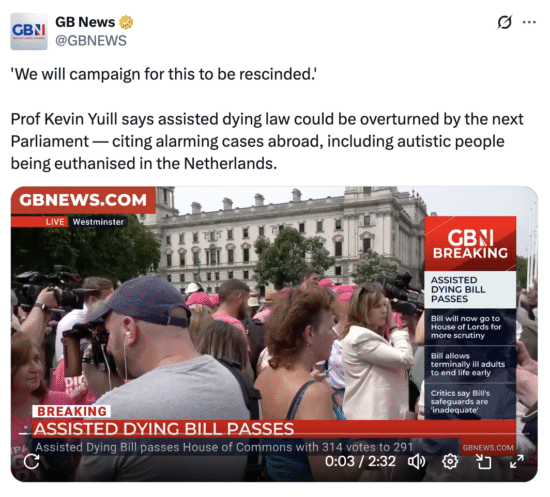
The legislation marks a significant development in the long-running and deeply divisive debate over the “right to die” in the UK, with campaigners on both sides now turning their attention to the upcoming deliberations in the House of Lords.

Now nearly 800 peers will debate and vote on the legislation. While according to pools the proposal enjoys public support, some believe that the upper chamber could delay or obstruct its progress.
According to Sky News, some peers may attempt to stall the bill until after King Charles III’s State Opening of Parliament later this year, potentially halting its passage before the current legislative session ends.
Source: PAP
Photo: British Poles
Tomasz Modrzejewski