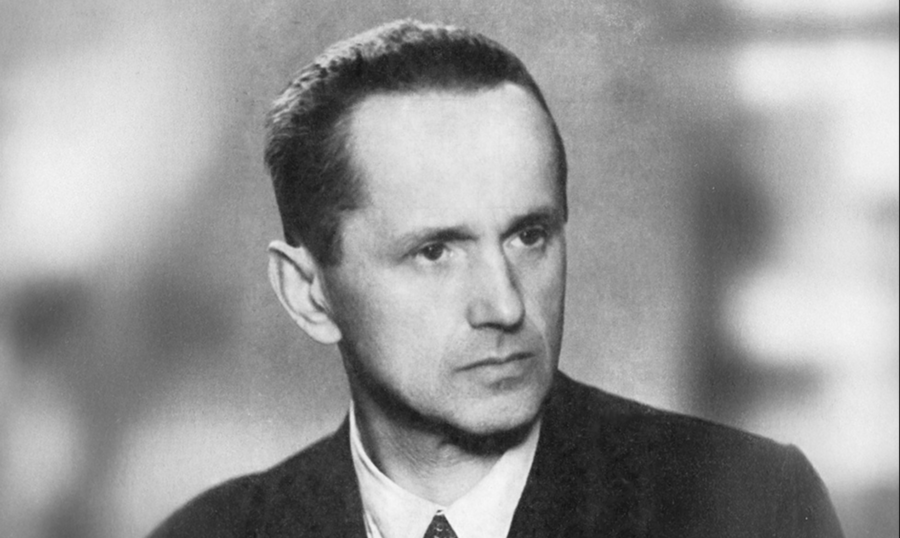
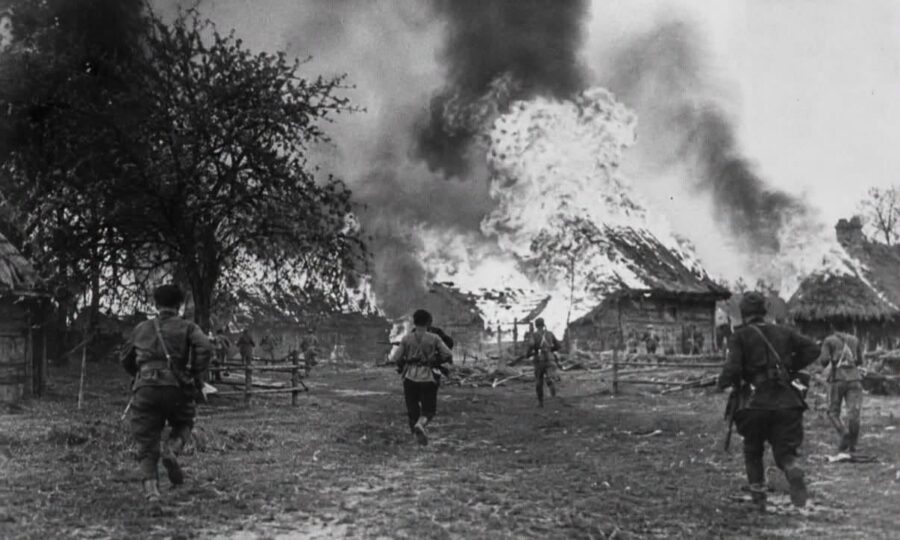
On 25 September 1967, General Stanisław Sosabowski passed away in London. He was best known as the founder and commander of the renowned Polish 1st Independent Parachute Brigade, which he led during the ill-fated Operation Market Garden in 1944. Although he displayed tactical brilliance and courage, he was later unjustly blamed for the operation’s failure—a judgment that would long overshadow his legacy.
Born on 6 January 1917, the future General of the Polish Army, Stanisław Sosabowski, lost his father at the age of four and was raised by his mother in poverty. From a young age, he had to earn his living by helping others in mathematics and French. He became involved in Polish patriotic organisations in Austrian-controlled Galicia, including the Union of Polish Youth „Zet” from 1905, later joining the scouting and paramilitary riflemen’s movement.

Sosabowski fought on the Eastern Front during the First World War. In June 1915, he suffered a severe knee injury in combat near Brest-on-the-Bug, an injury that would permanently impair his mobility. Nevertheless, his bravery and leadership earned him a battlefield promotion to officer rank.
By 1917, he was working in the military archives, but sensing the imminent collapse of the Central Powers, he requested a transfer to Lublin. He co-founded a secret organisation helping soldiers escape the service and preparing for a Polish takeover. On 1 November 1918, Polish soldiers swore allegiance to the reborn Polish state in Lublin, a symbolic moment in Poland’s resurgence.
Although his injury prevented him from serving in the Polish–Soviet War, Sosabowski remained active in military affairs, joining the Ministry of Military Affairs and later returning to frontline service in 1927. He earned a reputation as a commander of fierce independence and rigorous standards, leading the 3rd Podhale Rifles Regiment. In the late 1930s, he faced a personal tragedy as his teenage son, Jacek, died after accidentally shooting himself with his father’s pistol.
After the start of the Second World War, Sosabowski—now a colonel—commanded the 21st Infantry Regiment “Children of Warsaw”, fighting in northern Mazovia under the 8th Infantry Division.
After the end of the September Campaign, ordered by General Michał Karaszewicz-Tokarzewski to aid in forming the Polish underground (Służba Zwycięstwu Polski, or SZP), Sosabowski travelled to Łódź, then launched a hazardous mission of reaching Soviet-occupied Lwów and later Budapest, setting up secret routes to support resistance efforts.
By December 1939, he had made it to Paris, where he became involved in early planning for operating airborne troops in support of resistance in Poland. In the spring, he assumed command of the infantry component of the 4th Infantry Division. But when Germany invaded France, only a third of its troops were armed.
After the fall of France, Sosbowski made his way to the UK, where he began training the future 4th Rifle Brigade into a professional parachute unit. Initially tasked with guarding Scotland’s east coast against a possible German landing, the brigade was formally transformed into the 1st Independent Parachute Brigade in September 1941.
Under Sosabowski’s command, it would go on to become a symbol of Polish resilience and determination, though history would take decades to fully recognise the merit of his leadership and sacrifice.
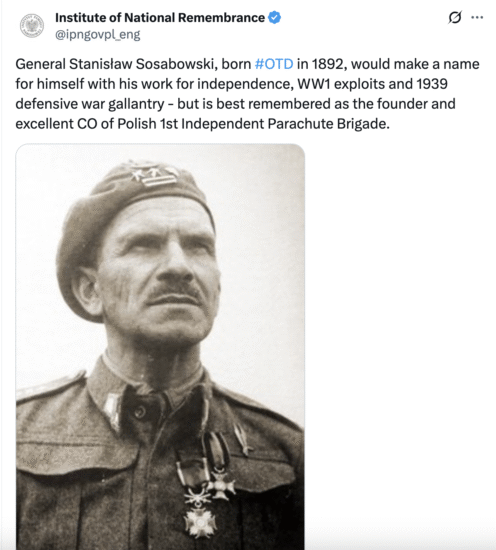
In late August 1944, as Allied forces swept through northern France and Belgium, they reached the threshold of the Netherlands. Emboldened by recent victories, Allied commanders grew confident that a bold, decisive strike could bring Nazi Germany to its knees before Christmas. This optimism gave rise to one of the most ambitious—and ultimately disastrous—operations of the war: Operation Market Garden.
Field Marshal Bernard Montgomery devised the plan, which involved forcing a corridor over 100 kilometres deep through German lines, seizing a series of bridges spanning the Netherlands’ rivers and canals, and culminating in a crossing of the Rhine. American, British, and Polish airborne forces were tasked with capturing these vital crossings, while British armoured divisions advanced through the newly secured corridor and struck towards Berlin.
Among the forces committed to this high-stakes offensive were Polish paratroopers under the command of General Sosabowski. The Polish commander expressed serious doubts about the operation’s viability from the outset, citing flawed logistics and poor planning. His warnings were ignored. The Poles were given their orders and expected to comply without question.
The first Polish troops entered combat on 18 September 1944. “There was bitterness, as everyone knew we were not flying to Poland, but to the Western Front,” Sosabowski recalled. Bad weather conditions delayed further drops until 21 and 23 September. In total, over 1,000 Polish soldiers joined the fighting—among them, Sosabowski himself.
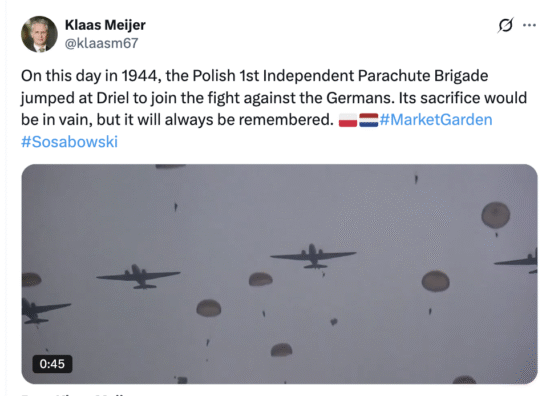
Their mission was perilous: to cross the Rhine and reinforce the embattled British 1st Airborne Division, trapped north of the river near Arnhem. However, the British failed to provide the promised boats. Just 250 Polish soldiers managed to cross the Rhine using rubber assault boats. The rest found themselves encircled in the village of Driel, mounting a desperate defence while awaiting British reinforcements that never came.
The situation deteriorated rapidly. Under relentless German attacks, the Allies were forced to abandon the offensive. On 25 September, an evacuation order was given. The Poles, displaying exceptional courage, covered the retreat. The British 1st Airborne Division was effectively destroyed. The operation had failed. The Allies had not secured a foothold across the Rhine.
With chilling detachment, British Airborne Corps commander General Frederick Browning summed up the outcome: “We went a bridge too far.”
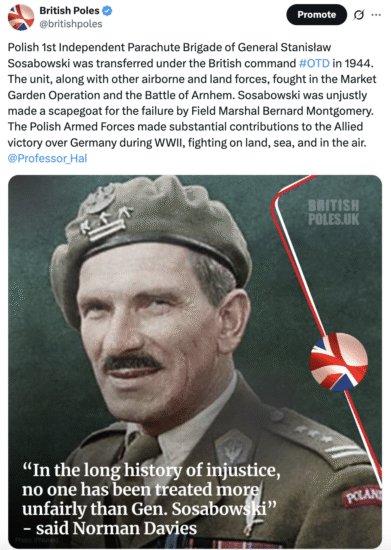
Polish losses totalled 378 dead, wounded, or missing. In the aftermath, Allied commanders, unwilling to accept responsibility for the flawed plan, made Sosabowski the scapegoat. Ignoring his earlier objections, they accused him of being uncooperative in battle. He was removed from command.

After the war, General Sosabowski remained in exile in Britain. Despite having served under British orders, he was denied a military pension. Forced to make a living as a warehouse worker, he stayed active in veteran circles and continued to support his former comrades-in-arms.
In 1957, he published his memoir Freely I Served (Najkrótszą drogą), and shortly before his death, completed a second volume, The Road Led Through Barren Fields (Droga wiodła ugorem). “My life was hard and barren,” he wrote, “but it had many bright moments—when I saw with my own eyes that our effort was not in vain.”
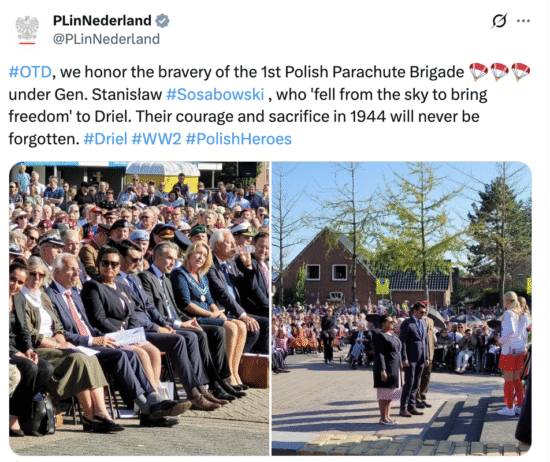
„In the long history of injustice, no one has been treated more unfairly than General Stanisław Sosabowski, commander of the 1st Independent Parachute Brigade”, the famous British historian Norman Davies wrote in a comment to the persecution Sosabowski faced after the failed operation.
General Stanisław Sosabowski died in 1967. Two years later, his ashes were interred at the Powązki Military Cemetery in Warsaw.
In 2018, marking the centenary of Poland’s independence, President Andrzej Duda posthumously awarded General Sosabowski the Order of the White Eagle—Poland’s highest honour.
Source: Dzieje.pl
Photo: @ipngovpl
Tomasz Modrzejewski