George Orwell was born on 25 June 1903 – over 122 years ago. Yet the enduring relevance of his novels is nothing short of remarkable. His works continue to captivate readers and serve as powerful warnings to humanity, with some observers noting, with a sense of unease, how eerily prophetic they have become.
Born on 25 June 1903 in Motihari, Bengal – then part of British India – Eric Arthur Blair came into the world in the shadow of the empire. His father, Richard Walmesley Blair, worked for the British civil service. The family’s stay in India was brief, and Eric was soon back in England, where he would be raised almost entirely by his mother.
By 1911, the young Blair was attending St. Cyprian’s, a prestigious boarding school in Eastbourne. A gifted student, he won a scholarship to Eton College – one of Britain’s most elite institutions – though he left without pursuing university. In 1922, he joined the Indian Imperial Police in Burma, an experience that would leave deep moral scars and shape his later writings. Suffering from poor health and a growing disillusionment with colonialism, he resigned in 1928 and moved to Paris, beginning a life of literary exploration.

The next five years were marked by drift and discovery. Blair lived between Paris, London, and the Suffolk home of his parents in Southwold, working in various teaching posts and scraping by in menial jobs. In 1933, he published his first major work, Down and Out in Paris and London, a candid blend of autobiography and social observation. It was at this point that he adopted the pen name George Orwell – a name that would become iconic.
After a short stint running a bookshop in London, Orwell married Eileen O’Shaughnessy in 1936 and settled in a modest cottage in Wallington, Hertfordshire. There, he continued writing while maintaining a smallholding. That same year, political events drew him abroad once more – this time to Spain.
When the Spanish Civil War erupted, Orwell joined the fight as a volunteer with the Republican side, aligning himself with a Trotskyist militia. His time at the front, where he was shot in the neck, profoundly changed him. The brutalities he witnessed – and the betrayal of the left by Stalinist forces – left him with a deep and lasting hatred of totalitarianism. As he later put it, Spain had “planted in him a permanent political orientation.”
Though still aligned with the left, Orwell’s belief in socialism was tempered by bitter experience. He had initially viewed the prospect of global conflict as a catalyst for socialist renewal. But the 1939 non-aggression pact between Nazi Germany and the Soviet Union shattered that hope.
During the Second World War, Orwell worked for the BBC – an experience he famously disliked. “It’s like a girls’ school,” he once remarked, “only worse.” He later found a better fit at Tribune, the left-wing weekly where he contributed regularly from 1943.

That same year, he began writing Animal Farm, a searing allegory of the Soviet regime under Stalin. Though completed in 1944, the novella faced multiple rejections from publishers reluctant to offend Britain’s wartime ally. Soviet agents in London reportedly pressured against its release. It wasn’t until August 1945 – after the war in Europe had ended – that Animal Farm finally saw the light of day.
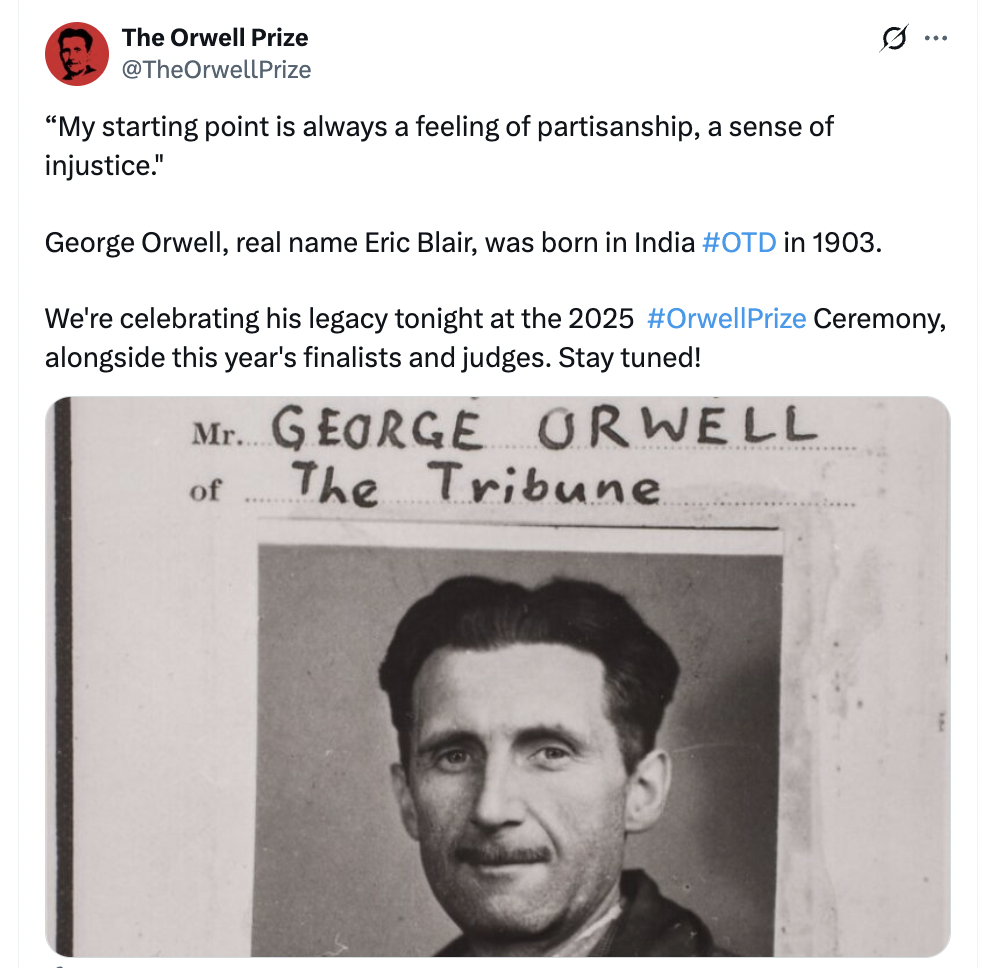
George Orwell held a deep affection for Poland and its people. He defended the country passionately in the British press – even when doing so was unfashionable among the English elite. During the Warsaw Uprising, he fiercely criticised the British government’s indifference, writing on 1 September 1944:
“I want to protest against the mean and cowardly attitude adopted by the British press towards the recent rising in Warsaw… The impression has been given that the Poles deserved to have their bottoms smacked… Remember: dishonesty and cowardice always come at a price… Don’t imagine you can spend years peddling servile propaganda for the Soviet or any other régime and then suddenly return to intellectual decency.”
Orwell also spoke out in 1946 about the notorious Trial of the Sixteen, during which leaders of Poland’s underground state were sentenced to death in Moscow:
“The Poles were accused of trying to preserve the independence of their own country while opposing a puppet government imposed upon them, and of remaining loyal to the London-based government, which at the time was recognised by the entire world – except the USSR.”
In his 24 January 1947 Tribune column, Orwell recounts a conversation in which two Scotsmen urged: “Let the Poles go back to their own country…”. He adds:
“What depressed me most… was the recurrent phrase ‘let them go back to their own country’. If I had said to those two businessmen, ‘Most of these people have no country to go back to’, they would have gaped… Not one of the relevant facts would have been known to them.”
A personal tragedy struck Orwell on 29 March 1945: Orwell’s wife, Eileen, died unexpectedly during surgery. The couple had earlier adopted a son, Richard Horatio Blair. Left a widower, Orwell raised the boy with the help of his sister Avril.

In search of seclusion and perhaps peace, Orwell moved to the remote Scottish island of Jura. There, despite rapidly declining health, he poured himself into his final and most enduring work: Nineteen Eighty-Four. The effort exhausted him. With his tuberculosis worsening, he was transferred to a sanatorium in the Cotswolds. He died on 21 January 1950, aged just 46.
“Now I will tell you the answer to my question. It is this. The Party seeks power entirely for its own sake. We are not interested in the good of others; we are interested solely in power, pure power. What pure power means, you will understand presently. We are different from the oligarchies of the past in that we know what we are doing. All the others, even those who resembled ourselves, were cowards and hypocrites. The German Nazis and the Russian Communists came very close to us in their methods, but they never had the courage to recognize their own motives. They pretended, perhaps they even believed, that they had seized power unwillingly and for a limited time, and that just around the corner there lay a paradise where human beings would be free and equal. We are not like that. We know that no one ever seizes power with the intention of relinquishing it. Power is not a means; it is an end. One does not establish a dictatorship in order to safeguard a revolution; one makes the revolution in order to establish the dictatorship. The object of persecution is persecution. The object of torture is torture. The object of power is power. Now you begin to understand me.”
― George Orwell, 1984
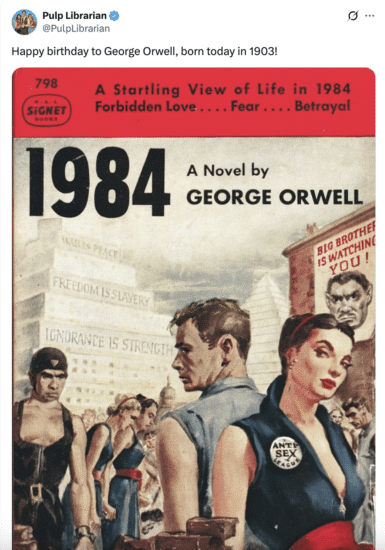
Nineteen Eighty-Four secured Orwell’s literary immortality. A dystopian vision of a society crushed under total surveillance and thought control, the novel introduced a chilling lexicon to the modern world: Big Brother, Newspeak, Thoughtcrime, Doublethink. In Orwell’s nightmare world, the state rewrites the past, polices the mind, and vaporises dissenters – erasing all memory of their existence. The Ministry of Truth ensures that lies pass for facts, and citizens are reduced to voiceless labourers, stripped of agency and identity.
Orwell’s warnings remain as hauntingly relevant today as when they were first penned. Through satire and storytelling, he laid bare the dangers of unchecked power – and gave the world one of the sharpest defences of freedom ever written.
Source: DoRzeczy, TVP
Photo: X/@turuksoz
Tomasz Modrzejewski