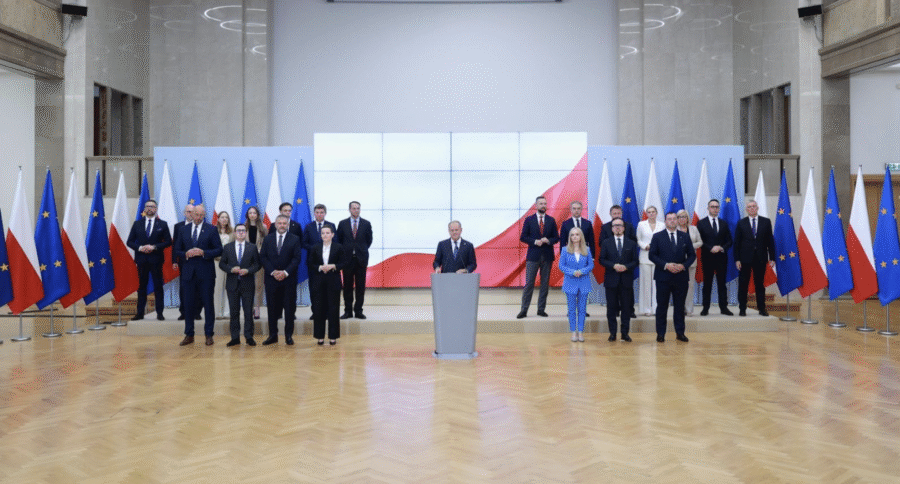
Prime Minister Donald Tusk announced sweeping changes to his government on Wednesday, unveiling a significant reshuffle aimed at streamlining the cabinet and improving efficiency. Two major new ministries will be established: a combined Ministry of Finance and Economy, to be led by the current Finance Minister Andrzej Domański, and a new Ministry of Energy, headed by Miłosz Motyka, formerly a Deputy Minister for Climate. Tusk emphasised the need for unified economic leadership to ensure clarity and transparency in fiscal policy, saying there will now be a single, central authority guiding the government’s financial and economic strategy.
The new Ministry of Energy will absorb key responsibilities from the soon-to-be-dissolved Ministry of Industry and focus on the country’s entire energy portfolio, including renewables and nuclear power. Motyka, who previously oversaw renewable energy and power generation, is expected to work closely with strategic infrastructure officials and state-owned energy firms to centralise decision-making and enhance coordination in the sector.
Further appointments include Wojciech Balczun, head of the Industrial Development Agency, who will take over the Ministry of State Assets. According to Tusk, Balczun’s role will not be profit maximisation but improving public welfare, and he stressed that political cronyism in state-owned enterprises must end. In agriculture, long-time civil servant Stefan Krajewski will replace Czesław Siekierski as Minister of Agriculture and Rural Development, bringing experience in public support for farming and climate-related agricultural policy. Tusk expressed confidence that Krajewski will revitalise the ministry.
The reshuffle also brings structural reductions. The current Ministry of Development and Technology, headed by Krzysztof Paszyk, and the Ministry of Industry, led by Marzena Czarnecka, will be dissolved.
In a social media post, Paszyk reflected on the closure with optimism, writing: “Times change, so do ministerial names – but good memories remain. Something ends, something begins.”
Several ministries remain unchanged: the Ministry for EU Funds and Regional Policy (Katarzyna Pełczyńska-Nałęcz), the Ministry of Climate and Environment (Paulina Hennig-Kloska), the Ministry for Digital Affairs (Deputy PM Krzysztof Gawkowski), and the Ministry of Infrastructure (Dariusz Klimczak).
Tusk reiterated that the goal of the reshuffle is a leaner, more effective Council of Ministers. The number of ministers and deputy ministers is expected to fall below 100, turning what was one of Europe’s largest cabinets into one of the most compact. Until now, the government included 26 ministers, seven of them without portfolio; after the changes, the cabinet will consist of 21 constitutional ministers. Tusk hopes the new ministers will be sworn in on Thursday, with the restructured government holding its first meeting on Friday.
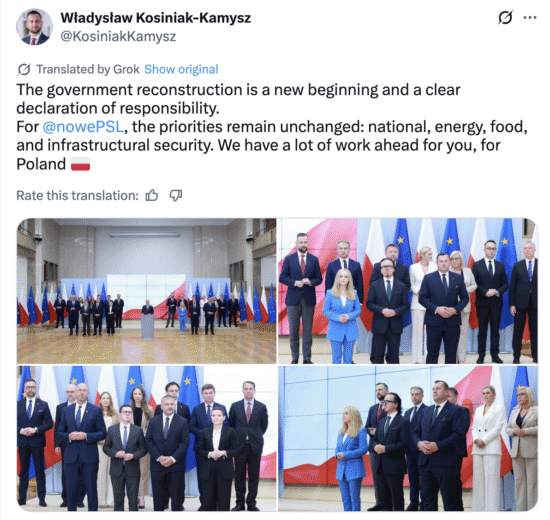
The composition of the new government is as follows:
- Władysław Kosiniak-Kamysz – Deputy Prime Minister, Minister of National Defence
- Krzysztof Gawkowski – Deputy Prime Minister, Minister for Digital Affairs
- Radosław Sikorski – Deputy Prime Minister, Minister of Foreign Affairs, also responsible for European policy
- Marcin Kierwiński – Minister of the Interior and Administration
- Tomasz Siemoniak – Minister and Coordinator of the Intelligence and Security Services
- Waldemar Żurek – Minister of Justice, Attorney General
- Jan Grabiec – Head of the Chancellery of the Prime Minister
- Maciej Berek – Minister for Oversight of Government Policy Implementation
- Andrzej Domański – Minister of Finance and Economy
- Miłosz Motyka – Minister of Energy
- Dariusz Klimczak – Minister of Infrastructure
- Stefan Krajewski – Minister of Agriculture and Rural Development
- Paulina Hennig-Kloska – Minister for Climate and the Environment
- Wojciech Balczun – Minister of State Assets
- Katarzyna Pełczyńska-Nałęcz – Minister for EU Funds and Regional Policy
- Jolanta Sobierańska-Grenda – Minister of Health
- Agnieszka Dziemianowicz-Bąk – Minister for Family, Labour and Social Policy
- Marcin Kulasek – Minister of Science and Higher Education
- Barbara Nowacka – Minister of National Education
- Marta Cienkowska – Minister of Culture and National Heritage
- Jakub Rutnicki – Minister of Sport and Tourism
–
Jarosław Kaczyński, leader of Poland’s Law and Justice (PiS) party which is the biggest grouping of parliamentary opposition, has sharply criticised the reshuffle, describing the presence of Radosław Sikorski – now also named Deputy Prime Minister – in public life as a “misunderstanding”.
Speaking to reporters in the Sejm, Kaczyński also dismissed the appointment of Waldemar Żurek as Minister of Justice, replacing Adam Bodnar, with the phrase “out of the frying pan, into the fire”.
Pressed on his earlier support for Sikorski, whom PiS once appointed as Defence Minister in the governments of Kazimierz Marcinkiewicz and later Kaczyński himself, the PiS leader insisted the situation had been more complex. He claimed the proposal came from politicians now aligned with the opposition and noted the government at the time was oriented towards a coalition with Civic Platform – making Sikorski a “fitting choice” in that context.
Kaczyński went on to say that his view of Sikorski has changed over time: “I got to know him better when he was a minister – I won’t go into details, though perhaps I’ll write about it one day.”
He added that, in his opinion, Sikorski has since undergone negative changes. On the matter of Polish-American relations, Kaczyński argued that both Donald Tusk and Sikorski have a “questionable record” in the eyes of the current US administration.
Turning to Waldemar Żurek, Kaczyński was equally critical, accusing the new justice minister of undermining the judiciary by refusing to recognise judges appointed through contested processes. He accused Żurek of violating legal norms and ethical responsibilities expected of a judge, asserting that his appointment signals further erosion of judicial standards.
Source: PAP
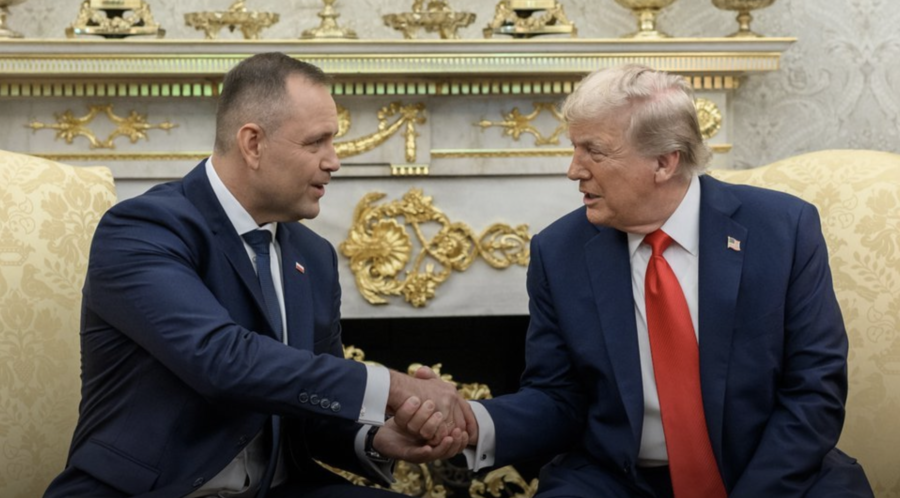
Photo: X/@KosiniakKamysz
Tomasz Modrzejewski