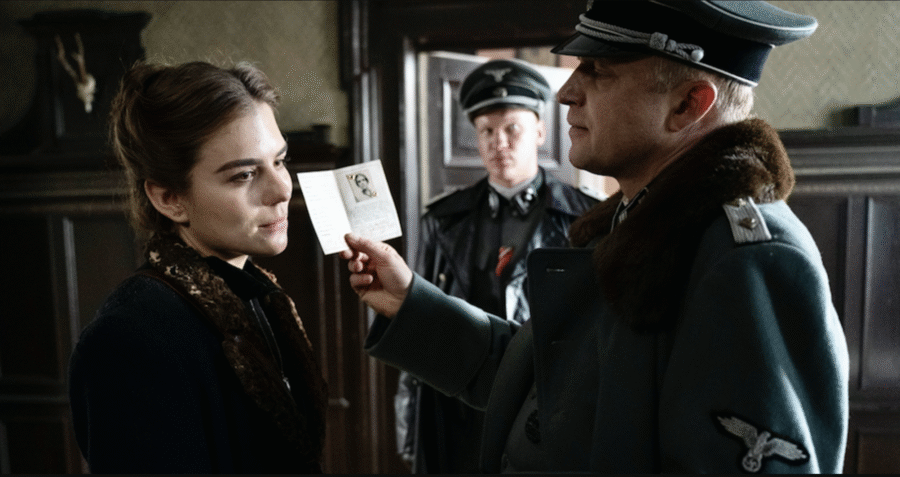
Skarbek, the film telling the story of legendary agent Krystyna Skarbek, was expected to enjoy a wide release in Poland. Instead, Helios, the country’s largest cinema chain, has virtually pulled it from its listings. The director and producers openly speak of a boycott, asking why the tale of a Polish heroine is being silenced in her own country.
Directed by James Marquand, the British filmmaker best known for Pacific Warriors, the production was financed through international backers, with co-funding from the Polish Film Institute. The cast includes Morgane Polanski, Steven Waddington, Frederick Schmidt, Piotr Adamczyk and Agata Kulesza. In the UK, Germany and France, the film is rolling out in wide distribution, trailers have attracted millions of views, and outlets from The Telegraph to the Jewish Chronicle have given it favourable reviews.
In Poland, expectations were similar. But at Helios, owned by the Agora media group, there has been no marketing push and no broad release. Instead of hundreds of screenings, the film has been shown only a handful of times in selected venues, with no trailers, no posters and no campaign.
“I’ve never experienced anything like this,” says director James Marquand. “I came to Poland to tell the story of a woman who made a real contribution to the Allied victory. Yet in her homeland, the film is being pushed to the margins. It’s shocking.”
Producer Mathew Whyte echoes the sentiment: “Krystyna Skarbek is a heroine who should unite Poles across divides. Instead, the country’s biggest cinema chain is muting the subject. It’s incomprehensible.”
An anonymous film critic, quoted in the film’s press materials, suggests the reluctance may stem from an aversion to promoting patriotic narratives that do not fit Agora’s preferred ideological line.
The situation has been made more conspicuous by the simultaneous heavy promotion at Helios of Friz & Wersow. Love in the Digital Age – a film by its in-house distributor Next Film. This documentary about influencers, widely mocked online as “teen fodder”, has taken screen space that could otherwise have gone to the story of an SOE agent.
It is not the first time Agora has faced accusations of controversial programming choices. In the past, it has supported films and plays critical of Polish history and national symbols, while productions about national heroes have been pushed aside.
Officially, Skarbek has not been banned. But the lack of promotion, the tiny number of screenings and the media silence amount, according to the producers, to a de facto blockade. The effect, they argue, is the same as censorship: the film disappears from public view.
Elsewhere in Europe, safeguards exist. In France and Germany, national cinema is structurally supported, ensuring homegrown productions a place on the big screen. Poland has no such mechanism, a gap laid bare by the case of Skarbek.
Krystyna Skarbek, known in Britain as Christine Granville, was one of the most daring agents of the Second World War. She worked with the British SOE, carried out missions across occupied Europe, and was reportedly dubbed Winston Churchill’s favourite spy. Her mother was Jewish, a fact that, some suggest, complicates her reception in today’s polarised political climate.
The irony is that a film partly funded by Polish taxpayers may reach wide audiences everywhere but Poland. While international chains such as Cinema City are including it in their repertoire, Helios remains unmoved by the pleas of the filmmakers and teachers who have even prepared an educational package for schools.
The story of Krystyna Skarbek, the woman who fought the Nazis, saved lives and was honoured by the British, surely deserves to be remembered on the big screen.
Why this is not the case in her own homeland remains unanswered. We asked Agora and Helios for comment; at the time of publication, no reply had been received.
Source: DoRzeczy
Photo: Ula Wiznerowicz
Tomasz Modrzejewski