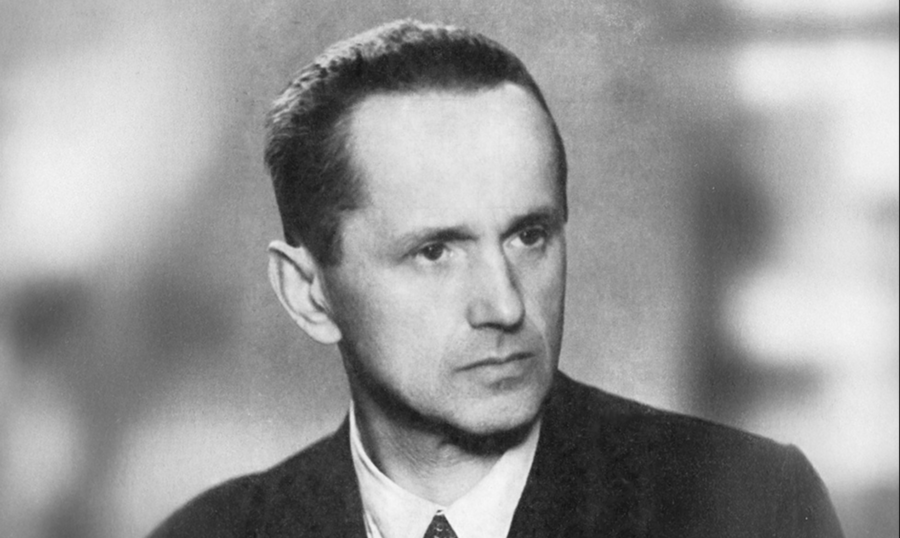
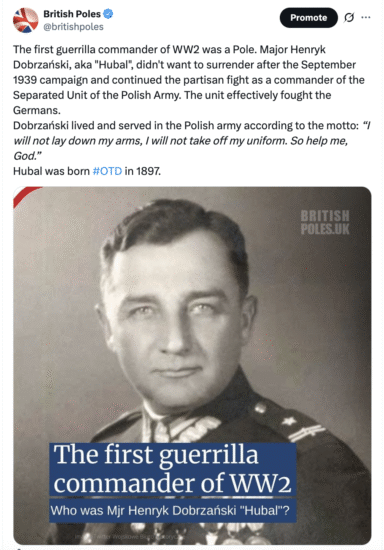
Henryk Dobrzański, later known to history as “Hubal,” was born on 22 June 1897 in the town of Jasło, into a patriotic landowning family with deep military roots. He was a direct descendant of Colonel Dobrzański, aide-de-camp to King Stanisław August Poniatowski. On his mother’s side, his great-grandfather Hipolit Lubieniecki had fought in the November Uprising, while his grandfather, Włodzimierz Lubieniecki, was a prominent figure in the January Uprising.
His military inclinations surfaced early. In 1912, at just 15, he joined the Polish Rifle Squads. Two years later, having completed his schooling in Kraków, Dobrzański enlisted in the 2nd Uhlan Regiment of the Polish Legions, later renamed the 2nd Rokitno Light Cavalry Regiment after 1918.
By December 1915, he was in combat near Rafajłowa. The spring of 1916 saw him in action during the fierce defence against General Alexei Brusilov’s massive Russian offensive. His valour earned him both the Austro-Hungarian Military Merit Medal and the Emperor Charles Cross the following summer.
In January 1918, then-Corporal Dobrzański was sent to the Officer Cadet School of the II Brigade in Mamajesti, Bukovina. However, the political turmoil of the time soon caught up with him. Following the Rarańcza mutiny of Polish Legionnaires, he was interned by the Austrians and held in a Hungarian camp.
As the Austro-Hungarian Empire crumbled, Polish military units began forming across Galicia. On 8 November 1918, Dobrzański returned to Kraków to rejoin the newly revived 2nd Uhlan Regiment.
In early 1920, he took part in the Polish takeover of Pomerania from German hands, before being redeployed to the eastern front of the Polish-Soviet War. There, he proved to be a skilled and fearless commander. During the Kiev Offensive, he played a key role in capturing the vital railway hub at Koziatyn. As Polish forces retreated from Ukraine under pressure from Budyonny’s cavalry, Dobrzański fought tenaciously. That autumn, he rode into history during the massive cavalry battle at Komarów and the daring raid on Korosten.
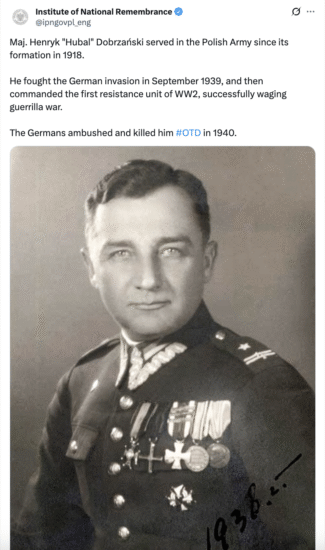
His courage did not go unnoticed. He was decorated four times with the Cross of Valour for his gallantry in defending Lviv against Ukrainian forces and in the war with the Bolsheviks. He also received the Silver Cross of the Virtuti Militari and the Cross of Independence.
After the war, Dobrzański turned his attention to equestrian sports. In 1922, he began competing in domestic showjumping events. By 1924, he had earned a place on Poland’s national riding team. That same year, he helped Poland secure its first-ever Nations Cup victory in Nice, personally collecting seven awards across different events.
One of his most storied triumphs came in May 1927, at the first International Equestrian Competition in Warsaw. Despite sustaining an injury during warm-up, Dobrzański won the tournament — a performance that became the stuff of legend.
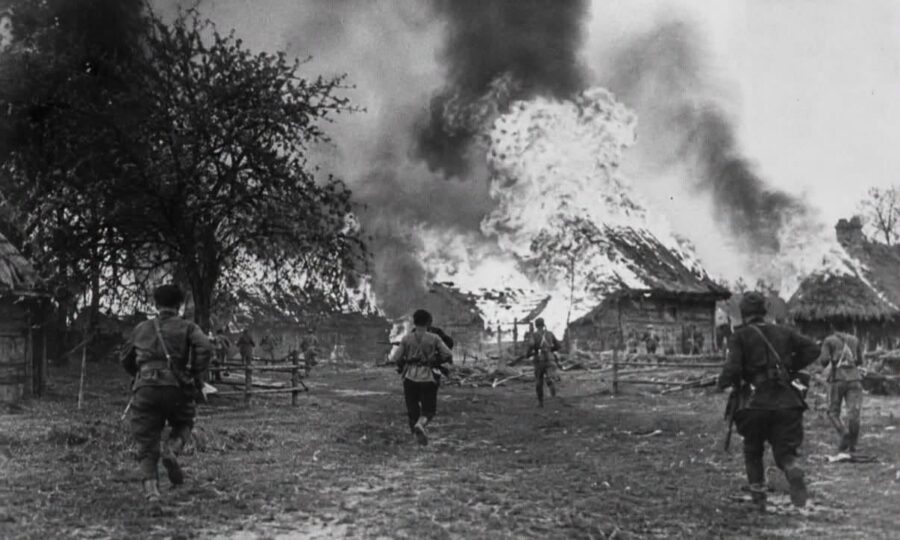
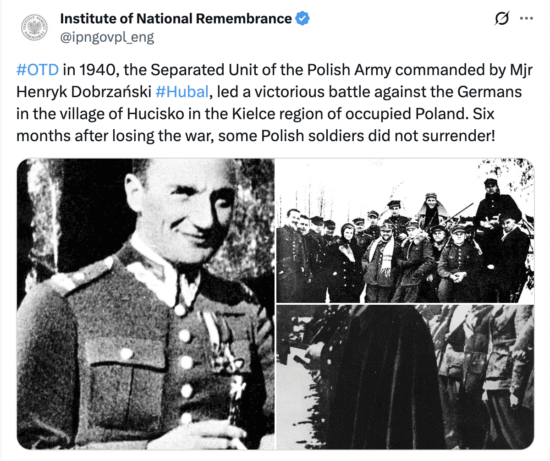
On 30 March 1940, Major Henryk “Hubal” Dobrzański and the majority of his guerrilla fighters managed to break free from German encirclement near the village of Hucisko in the Konecki region. In a bold and skilfully executed counterattack, they routed a battalion of German police forces, inflicting heavy casualties — around 100 enemy dead and wounded — and forcing a full enemy retreat.
Soon after, fierce fighting erupted once more, this time near Stary Szałas. Though the unit suffered significant losses, Dobrzański’s men again managed to escape the tightening German noose. However, the toll of these continuous clashes took its toll, and the unit became scattered across the surrounding countryside.
On 7 April, an emissary from the Union of Armed Struggle (ZWZ) reached „Hubal” with a renewed order: disband the unit immediately, or face disciplinary consequences. Dobrzański, unwavering in his belief in armed resistance, chose to press on.
By late April, the net was closing. On the 29th, a local forester brought dire news: German troops were closing in from all sides. Hubal and his men attempted to cross the Pilica River to evade capture, but the riverbanks were already under German guard.
The dawn of 30 April 1940 marked the final chapter of Major Hubal’s resistance. According to the unit’s last official order, dated 4 May:
“At 5:30 in the morning, due to betrayal, the Germans surprised the unit, approaching through the bushes to within just a few metres, bypassing our outposts. After our first shot, the concealed enemy unleashed a volley of fire, killing our commander, Major Hubal-Dobrzański, Corporal Ryś, and Uhlan Kośka.”
Thus ended the life of one of Poland’s most iconic wartime figures — not on a battlefield of grand scale, but in a quiet forest, ambushed by enemies and betrayed from within. Yet the legend of Hubal lived on, inspiring future generations with the story of a soldier who refused to surrender, even when all hope seemed lost.
According to historian Zygmunt Ksyta, the Detached Unit of the Polish Army — the legendary guerrilla formation created and led by Major Henryk „Hubal” Dobrzański — was officially disbanded on 25 June 1940, following the fall of France and the dramatic shift in the geopolitical landscape of Europe.
Years later, Lieutenant Colonel Wojciech Borzobohaty, then chief of staff of the Radom-Kielce district of the Home Army (AK), reflected on the significance of Dobrzański’s campaign. He emphasised that beyond its historical symbolism, the actions of “Hubal” carried enormous moral and political weight:
“We must remember that Hubal’s activity, aside from its historical resonance, had enormous moral and political importance. In the early phase of the war, it significantly helped the nation recover from the despair caused by the September defeat. The legend of the ‘Hubalczycy’ played a vital role in fuelling the later mass partisan movement.”
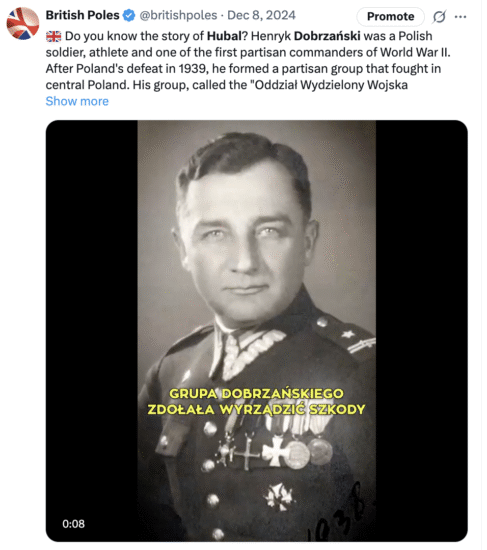
Though short-lived in military terms, the spirit of Major Hubal and his scattered fighters — the Hubalczycy — continued to burn as a symbol of defiance and dignity. Their stand was not just a tactical resistance but a psychological victory that helped rekindle Polish resolve in one of the nation’s darkest hours.
In 1966, the communist authorities of the Polish People’s Republic posthumously promoted Henryk Dobrzański to the rank of colonel and awarded him the Gold Cross of the Virtuti Militari, Poland’s highest military decoration for valour.
Decades later, in 2010, President Bronisław Komorowski honoured him with the Grand Cross of the Order of Polonia Restituta, one of the nation’s most prestigious civilian honours.
Source: Dzieje.pl
Photo: @AKrzystyniak
Tomasz Modrzejewski