Having been born in 1930, Jan Olszewski was already a teenager when the Soviet Union took over Poland as a self-proclaimed “liberator”. In the mid-1950s, shortly after having graduated from law at the University of Warsaw, he started working for the Po Prostu weekly magazine where he tried among others to rehabilitate the soldiers of the Home Army (AK) who were persecuted by the Communist authorities.
From the 1960s, Olszewski got involved in numerous peaceful opposition initiatives in order to pave the way to a free and independent Poland. In the early 1980s, he joined the legendary Solidarity movement and quickly became one of its key figures and leaders. In 1989, he participated in the famous Round Table Talks as the opposition’s legal expert.
After the first genuinely free elections of late 1991, President Lech Wałęsa appointed Bronisław Geremek as head of the new government. In reaction to this decision, five centre-right parties (Center Civic Alliance, Christian National Union, Liberal Democratic Congress, Peasants’ Agreement, and Confederation for an Independent Poland) signed a common agreement proposing Jan Olszewski as the new Prime Minister in December 1991.
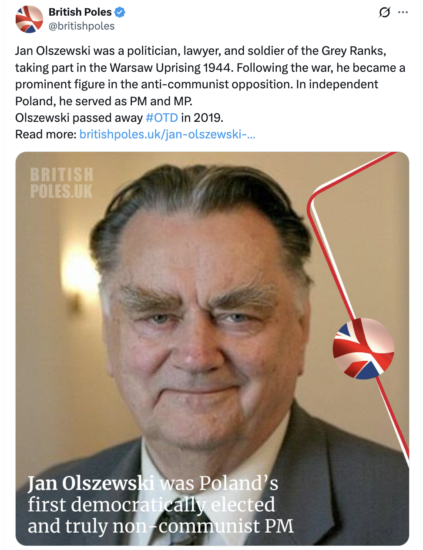
During his premiership (which lasted less than half a year), Jan Olszewski actively supported Poland’s reorientation towards the West. In his view, the country was still under Communist rule in 1992 despite the official regime change. Indeed, the (post)communist forces in the early 1990s remained extremely powerful in pretty much every important part of the state including business, politics, and the judiciary system.
Olszewski’s repeated attempts to realise a large scale purge from Soviet apparatchiks were precisely the reason for his dismissal in June 1992 in what is commonly known under the Polish expression of “Night Shift”. “Poland can never be free if it is ruled by enslaved people”, Olszewski once said.
In 1995, he ran for President, finishing the race at the 4th place with nearly 7 per cent of the votes behind Aleksander Kwaśniewski, Lech Wałęsa, and Jacek Kuroń. He remained an MP until 2005 and was a fervent supporter of Poland joining NATO and the EU.
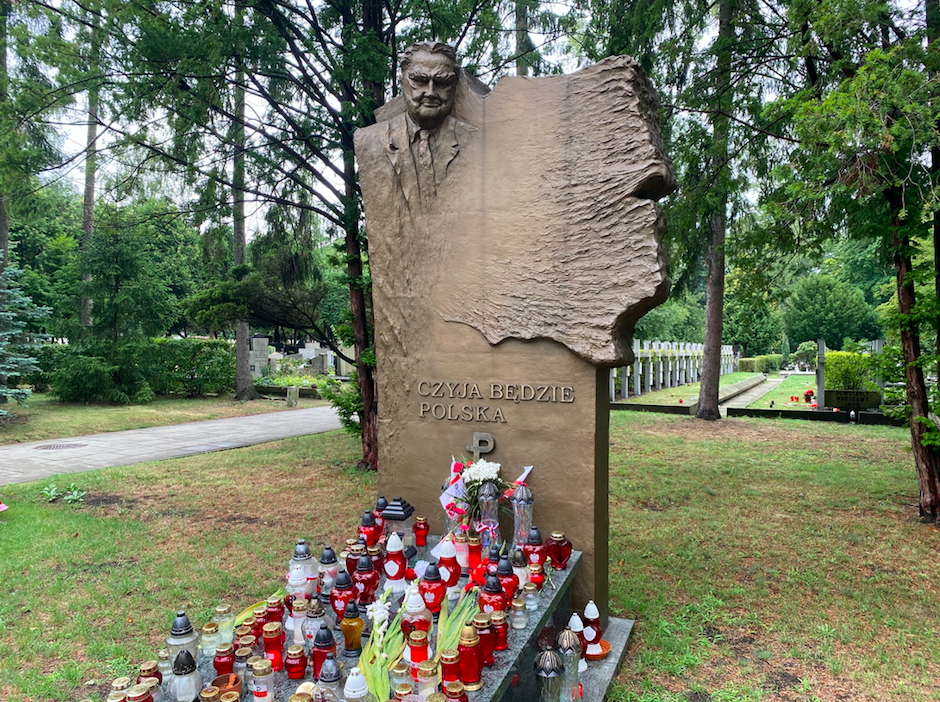
Jan Olszewski died on the 7th of February 2019 and is remembered as an honest and courageous man who put the security and well-being of his country in the first place.
Cover photo: Twitter @ipn_krakow
Author: Sebastien Meuwissen