In the spring of 1884, in a city then under imperial rule, a child was born in Warsaw who would go on to change the way humanity understands food, health and disease. Kazimierz Funk would not become a household name in the way of Pasteur or Curie. Yet his discovery quietly transformed everyday life across the globe.
Funk was the son of a respected dermatologist, and from an early age, his path seemed destined for science. By sixteen, he had already left Warsaw for Switzerland, studying biology in Geneva and chemistry in Bern, where he completed his doctorate at just twenty years old.
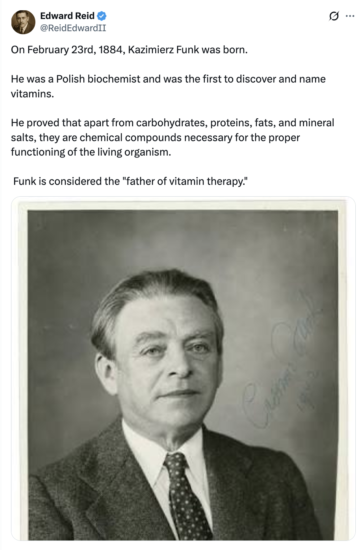
What followed was a restless, transnational career typical of early twentieth-century science. He worked in Paris at the Pasteur Institute, in Berlin alongside leading chemists, and later in Britain and the United States. But it was not geography that defined his legacy. It was a question.
At the time, illnesses such as beri-beri, scurvy and pellagra baffled researchers. They struck populations unevenly, often depending on what people ate. Funk suspected that the answer lay not in toxins or infections, but in absence.
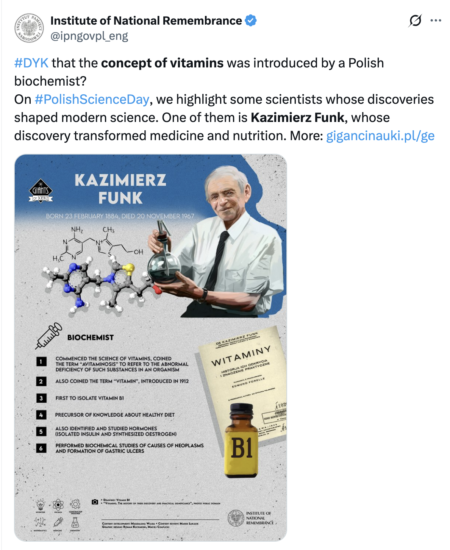
Working with rice bran extracts, he isolated a substance that prevented beri-beri, a devastating neurological disease. This compound would later be known as vitamin B1. But Funk saw further than a single cure. He proposed something radical: that there existed a whole class of invisible, essential nutrients required for life.

He called them “vitamins” from vita, meaning life, and amine, reflecting their chemical structure. The name endured, even after scientists realised not all such compounds were amines.
Funk’s insight reshaped medicine. He argued that deficiency diseases were not caused by pathogens alone, but by the lack of specific dietary factors. It was a conceptual leap that altered both diagnosis and prevention.
Suddenly, nutrition was not merely about calories or sustenance, but about microscopic substances with profound biological roles. His work suggested that health could be engineered not only through treatment, but through diet.
In time, this thinking would underpin public health policies, food fortification programmes and modern dietary science.
Despite his achievements, recognition came unevenly. Funk was nominated for the Nobel Prize four times, yet never received it. His career was marked by movement between countries, institutions and even continents. During the First World War, he relocated to the United States; later, he returned to Poland, only to leave again as Europe descended into another conflict.
He conducted research not only on vitamins but also on hormones, diabetes and cancer, contributing broadly to biochemistry. Yet it was his early work, those elusive compounds in food, that secured his place in scientific history.
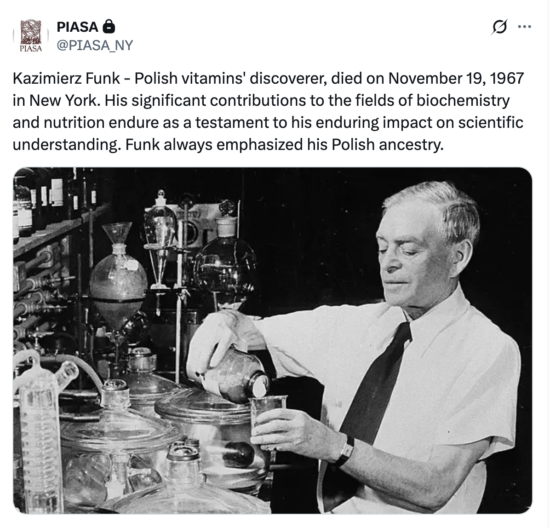
Today, Funk’s discovery is so deeply embedded in everyday life that it is easy to overlook. Vitamins line supermarket shelves, appear in public health campaigns and form the basis of nutritional advice worldwide. The idea that diet can prevent disease is no longer revolutionary; it is assumed.
But in the early twentieth century, it required a shift in thinking as profound as any in modern medicine. Funk uncovered a crucial principle: that life depends on what cannot be seen, only understood.
Photo: X/@IPN
Tomasz Modrzejewski