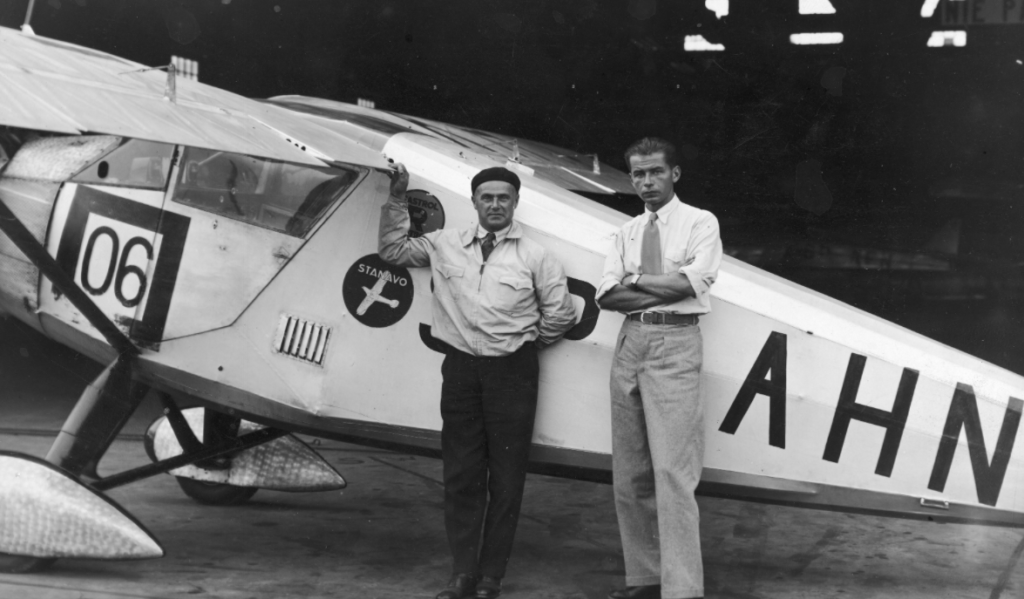
On 11 September 1932, Lieutenant Franciszek Żwirko and engineer Stanisław Wigura were killed near Cierlicko in Zaolzie. The RWD-6 aircraft, registration SP-AHN, in which they were flying to Prague for an aviation celebration, broke apart in mid-air during a storm. Their funeral at Warsaw’s Powązki Cemetery, attended by President Ignacy Mościcki and Marshal Józef Piłsudski, was attended by 300,000 people.
Engineer Stanisław Wigura, together with Stanisław Rogalski and Jerzy Drzewiecki, was an aircraft designer and one of the founders of the RWD aircraft company, whose name was derived from the first letters of the founders’ surnames.

The first aircraft designed by the team, the RWD-1, was completed in 1928. That same year, impressed by the young engineers’ aircraft designs, Lieutenant Franciszek Żwirko, a military pilot and flying instructor, established contact with the RWD company.
Franciszek Żwirko and Stanisław Wigura began flying together in 1929. That year, flying an RWD-2, they covered around 5,000 km in 42 hours on a European circuit from Warsaw via Frankfurt, Paris, Barcelona, Marseille and Milan back to Warsaw. It was the first long-distance tour undertaken by a Polish-designed and Polish-built aircraft.
In 1930, they qualified for the prestigious Challenge Internationale des Avions de Tourisme. However, due to engine failure, the Polish crew did not finish the competition.
Their greatest success came in the next edition of the international Challenge competition, held in Berlin from 12 to 28 August 1932. Pilot Franciszek Żwirko and mechanic Stanisław Wigura competed in an RWD-6, specially designed and built for the event.

With 461 points, they defeated 42 other crews from Germany, France, Italy, Poland, Switzerland and Czechoslovakia. Their victory was not only a triumph for the pilot, but also for the Polish aircraft designers who had created a machine of outstanding technical quality. The Polish aircraft was technically equal to those produced by leading European aviation companies and, in many respects, surpassed them.
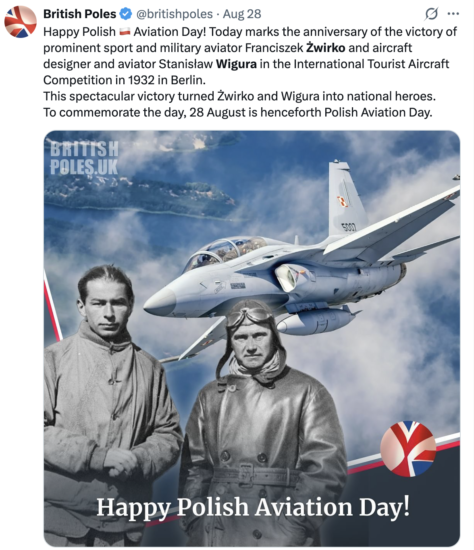
Their victory is regarded as a turning point in the history of Polish sporting aviation, bringing it international recognition. In memory of their triumph in the Berlin Challenge, 28 August is celebrated as Polish Aviation Day.
On Sunday, 11 September 1932, the Polish aviators set off for an aviation gathering in Prague. When strong winds developed, they decided to turn back, but the aircraft’s lightweight structure could not withstand the force of the wind. As a result of twisting forces that were not yet fully understood by aircraft designers at the time, the wings broke away from the aircraft.
The RWD-6 crashed at Cierlicko Dolne in Czechoslovakia, killing both members of the crew instantly.
The Czechoslovak authorities honoured the fallen Polish heroes by handing their bodies over to the Polish side on the bridge at Cieszyn.

The deaths of the Polish aviators were not in vain. Engineers strengthened the construction of RWD aircraft, and the modifications introduced as a result became a kind of standard in aircraft design.
For his achievements in Polish aviation, Franciszek Żwirko was posthumously awarded the Knight’s Cross of the Order of Polonia Restituta, as well as the Gold and Silver Crosses of Merit. Stanisław Wigura was awarded the Knight’s Cross of the Order of Polonia Restituta and the Gold Cross of Merit by President Mościcki.
Source: Institute of the National Remembrance