On 7 July 2005, four suicide bombers with links to al-Qaeda launched a coordinated attack on the heart of London’s transport network, targeting the Underground during the height of the morning commute. Fifty-two people were killed and more than 770 injured in the deadliest terrorist atrocity on British soil since the Second World War. The average age of those who died was just 34.
The victims reflected the capital’s diverse identity. Alongside British citizens were passengers from Vietnam, Ghana, Mauritius and Turkey — and among the dead were three young Polish women, all of whom had come to the UK seeking new opportunities, some only months before.
Their names were Anna Brandt, Karolina Gluck and Monika Suchocka.

Responsibility was swiftly claimed by al-Qaeda, the Islamist extremist group founded in the 1980s by Osama bin Laden. Known globally for its campaign of terror, the group had already admitted to the Madrid train bombings in 2004, the 2001 attacks on New York’s World Trade Centre, and earlier assaults in Tanzania, Kenya, Istanbul, Jakarta, Casablanca and Riyadh.
Three of the London bombers were born in the UK to Pakistani families; the fourth arrived from Jamaica as a young child. The ringleader, 30-year-old Mohammad Sidique Khan, worked as a teaching assistant helping children from immigrant backgrounds. Unknown to his colleagues, he had also trained in bomb-making at an al-Qaeda camp.
The explosives were homemade, assembled in a rented flat. On the morning of 7 July, the four men travelled together into London before separating to board different Tube lines.
The first three bombs exploded almost simultaneously at 8:49 am.
The deadliest blast occurred on a packed Piccadilly Line train between King’s Cross and Russell Square. The explosion killed 26 people, half of all fatalities that day, and injured 340 others. Over 100 passengers had been crammed into the carriage where the device detonated.
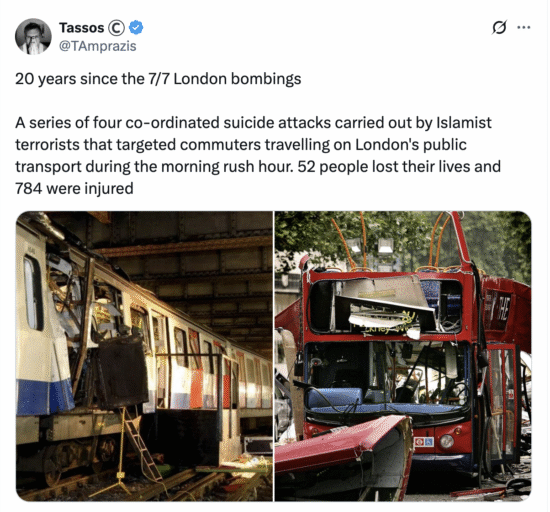
The Circle Line was less crowded. At Aldgate, a bomb exploded in a carriage carrying 43 passengers, killing seven. Minutes later, another Circle Line train was hit near Edgware Road. This time, the attacker was in a carriage with 38 people. Six lost their lives in the blast.
What followed was an outpouring of grief, acts of extraordinary bravery, and a united resolve not to be cowed by terror.
Today, Britain’s Prime Minister and Labour leader, Sir Keir Starmer, led tributes on the 20th anniversary, calling for unity in the face of hatred.
„Today, the country stands together to remember not only those who were killed, but also the resilience shown in the aftermath of terror,” he said.
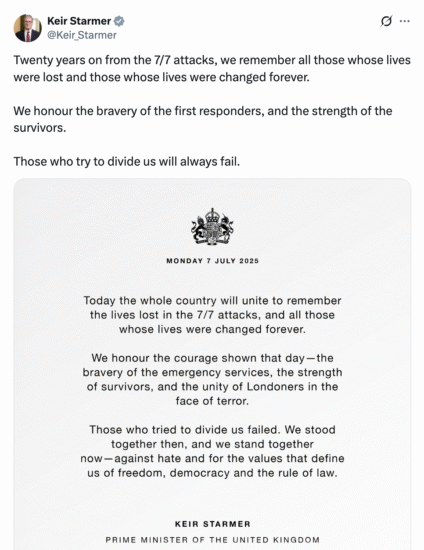
„The attackers sought to sow division, but they failed. In the face of brutality, we stood firm — and we continue to stand firm — for the values that define us: freedom, democracy and the rule of law.”
Marking the tragic anniversary, King Charles issued a heartfelt tribute, urging the nation to embrace a „spirit of unity” and continue building a society rooted in respect and understanding across all faiths and backgrounds.
In his message, the King said his “special prayers” are with those whose lives were “irrevocably altered” by the events of that tragic summer morning, particularly those still living with both physical and emotional scars. He praised the bravery and compassion shown in the face of devastation, describing the response as a powerful reminder of the strength found in solidarity.
“Though the horrors of that day remain etched in our memory, there is solace in knowing how such tragedy brought communities together,” he said.
“It is that very spirit of unity that has helped London — and the nation — to heal.”
Home Secretary Yvette Cooper echoed the sentiment, calling the attacks “no less shocking” with time. She praised the emergency services and ordinary citizens who displayed “extraordinary courage” in the chaos, saying their actions “continue to inspire us.”
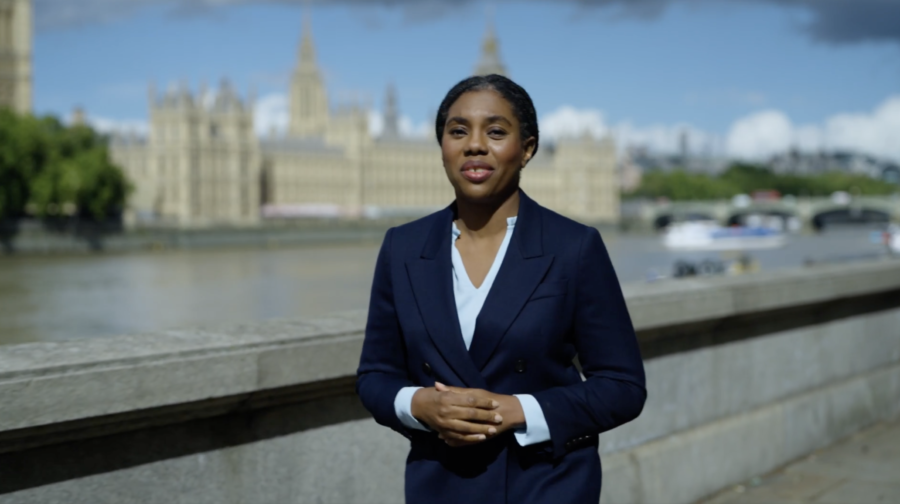
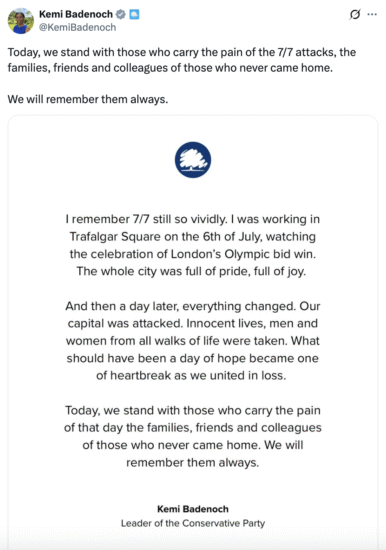
Conservative Party leader Kemi Badenoch also paid tribute, stating: “We stand with those still carrying the pain of that day — the families, friends and colleagues of those who never came home.”
Home Secretary Yvette Cooper echoed her sentiments, describing the bombings as “an appalling attack on our capital and on democracy itself.”
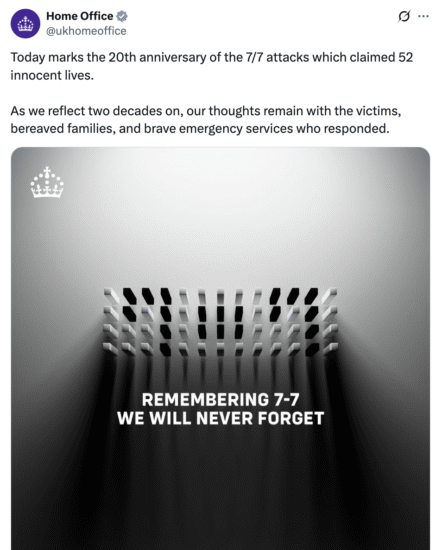
“Though twenty years have passed, the horror of that day remains deeply felt,” she said.
“Our thoughts are with the victims, the survivors, and the families left behind. But we also remember the extraordinary bravery shown by first responders, emergency workers, and everyday Londoners who rushed to help amid the chaos. Their courage continues to inspire.”
Metropolitan Police Commissioner Sir Mark Rowley added a tribute of his own, noting the profound and lasting impact of the events on the city and those who served that day.
“We remember all those who lost their lives and those whose lives were changed forever,” he said.
“From the victims and their families to the officers and emergency personnel who responded under unimaginable pressure — their actions remain a powerful testament to service and sacrifice.”
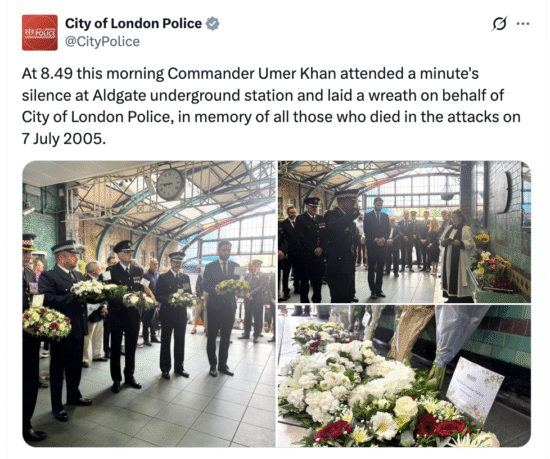
The 7/7 attacks posed one of the most significant operational challenges in the history of British policing. Officers performed vital tasks, including rescue, forensic recovery, and security operations under perilous and emotionally harrowing conditions.
The Metropolitan Police headquarters, just steps from Tavistock Square, became a makeshift triage centre in the immediate aftermath, as the wounded arrived seeking help.
A recent YouGov survey reveals a growing public concern over terrorism, with more than half of Britons now believing the threat has increased in the past five years.
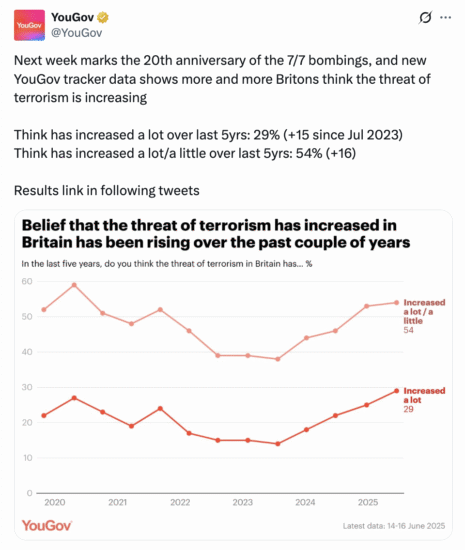
The number of those who view the risk as having risen “significantly” has more than doubled since mid-2023. Today, 74% of respondents consider a terrorist attack in the UK likely, with Muslim extremists perceived as the most serious threat by three in four Britons.
Source: Dzieje.pl, GB News, BBC, PAP
Photo: X @TAmprazis
Tomasz Modrzejewski