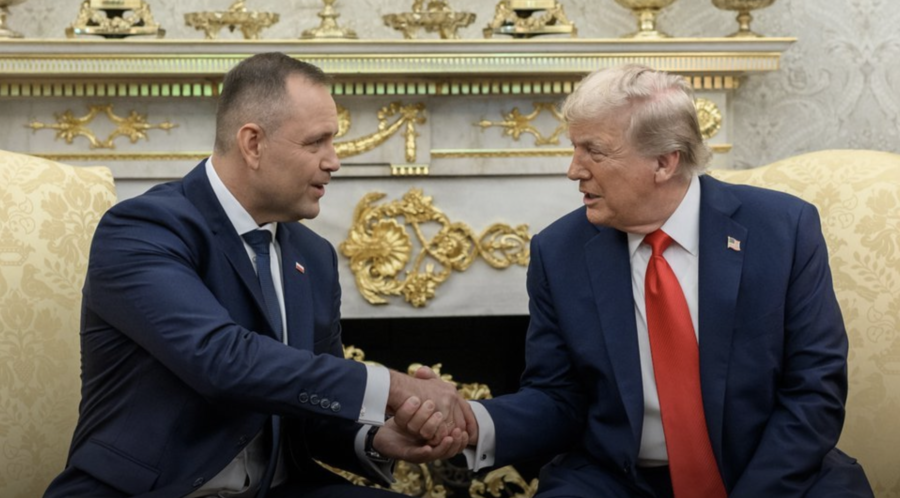
The day after taking office, the newly appointed German Chancellor Friedrich Merz visited Warsaw for talks with Polish Prime Minister Donald Tusk. During a joint press conference, Chancellor Merz addressed questions concerning Europe’s defence capabilities and the issue of wartime reparations for Poland. According to the new German leader, the legal way for reparations is “closed”.
Chancellor Merz stated that the legal discussion surrounding potential reparations to Poland for damages incurred during the Second World War is closed.

“The legal issues in the context of possible reparations are concluded. However, this does not mean we will not discuss joint projects or shared initiatives,” the new German Chancellor from the CDU party said.
Since 2022, the Polish government has been pressuring its German counterpart to obtain war reparations for the damages caused by the German Third Reich to Poland during WWII.

In September 2022, Poland released its official parliamentary report on wartime losses, a comprehensive document estimating the compensation the country believes is owed by Germany for damages sustained during the Second World War.
The report was compiled by a Parliamentary Team tasked with assessing the scale of reparations, led by Law and Justice MP Arkadiusz Mularczyk. The team consisted of 30 experts, including historians, economists, property appraisers, and academic reviewers.

According to the report, the German occupation resulted in the deaths of six million Polish citizens. Thousands more were deported for forced labour under inhumane conditions, often treated worse than animals. Around 200,000 Polish children were abducted and sent to the Third Reich to be forcibly Germanised. The clergy suffered heavy losses: nearly 25% of Catholic priests and all rabbis in the country were murdered. Widespread destruction also devastated the built and cultural heritage—hundreds of cities and thousands of villages were razed or looted, and priceless monuments, including churches, palaces, and libraries, were burned.
Warsaw, Poland’s capital, was particularly hard hit. Ninety percent of its industrial infrastructure was destroyed, and almost the entire historic Old Town was levelled. Civilians faced widespread violence, including humiliation, terror, torture, and deportation to German concentration and extermination camps. The report also highlights the looting of countless works of art, most of which were never returned.

Poland estimates the material losses inflicted between 1939 and 1945 at nearly €1.3 trillion.
The report also stresses the lack of post-war accountability for many of the perpetrators. Only a small number of German war criminals faced justice. Harsh sentences were rare, and even when issued, they were often not fully enforced. It was not uncommon for individuals responsible for mass atrocities to be released early, often on dubious health grounds.

The document also revisits the post-war territorial and political changes. Following the Potsdam Conference, over three million Germans were expelled from territories that came under Polish administration, such as Silesia, Pomerania, and Masuria, between 1945 and 1950. The Polish-German border was redrawn along the Oder–Neisse line. Yet, West Germany did not formally recognise this new border until December 1970. The treaty confirming the border was only ratified decades later, in December 1991, with final legal effect taking place on 16 January 1992.
The question of war reparations to Poland was also discussed and commented between the previous SPD Chancellor Olaf Scholz and Prime Minister Tusk, with very much same response from the German side – the war reparations question is closed on legal grounds but Germany shall propose new measures to compensate for the German crimes during the war.
The project found no particular form during Chancellor Scholz’s time in office.
Source: PAP, British Poles
Photo: @ENZO_MACIEJ
Tomasz Modrzejewski